Throughout this long development, from 600 B.C. to the present day, philosophers have been divided into those who wished to tighten social bonds and those who wished to relax them. With this difference others have been associated. The disciplinarians have advocated some system of dogma, either old or new, and have therefore been compelled to be in a greater or less degree, hostile to science, since their dogmas could not be proved empirically. They have almost invariably taught that happiness is not the good, but that "nobility" or "heroism" is to be preferred. They have had a sympathy with the irrational parts of human nature, since they have felt reason to be inimical to social cohesion. The libertarians, on the other hand, with the exception of the extreme anarchists [Robespierre!], have tended to be scientific, utilitarian, rationalistic, hostile to violent passion, and enemies of all the more profound forms of religion. This conflict existed in Greece before the rise of what we recognize as philosophy, and is already quite explicit in the earliest Greek thought. In changing forms, it has persisted down to the present day, and no doubt will persist for many ages to come.
[Well, at least we've established a bias, Mr. Russell]

Thursday, July 31, 2008

The Rise of Greek Civilization
So, Russell left us last week with an oscillation -- the pitch between social-cohesion/tradition/authority/dogma and individualism/empiricism/science.
Which makes me think of Galileo, sitting before the Catholic tribunal, feeling convinced of what he had observed and reasoned, and yet perhaps also feeling sympathy for the concepts that the Catholic Church had draped her authority, and therefore her empire, over.
Perhaps the best image of this oscillation is the French Revolution. France swung, in a matter of ten years, from a Monarchical society, where Aristocracy and Clergy held places of power, to "forms based on the Enlightenment" -- individualism, science, democracy. Many hold that the conflict came because of the clash between the capitalistic bourgeoisie and the aristocracy -- which sounds again like this oscillation.
Russell chooses, I think, a middle way. He is all for science and subjectivity, but he also knows that Storming the Bastille might mean you get, along with a Republic, The Reign of Terror. You might get blood-thirsty mobs running through the streets.
Which makes me respect the original United States Government all the more -- for striking a delicate balance, or seeming to at least, between centralized power and individual freedom. But then, I have libertarian leanings.
Money -- so much has been said about it -- symbol of individualism, issued by a centralized power.
Which has nothing yet to do with the Rise of Greek Civilization.
Which makes me think of Galileo, sitting before the Catholic tribunal, feeling convinced of what he had observed and reasoned, and yet perhaps also feeling sympathy for the concepts that the Catholic Church had draped her authority, and therefore her empire, over.
Perhaps the best image of this oscillation is the French Revolution. France swung, in a matter of ten years, from a Monarchical society, where Aristocracy and Clergy held places of power, to "forms based on the Enlightenment" -- individualism, science, democracy. Many hold that the conflict came because of the clash between the capitalistic bourgeoisie and the aristocracy -- which sounds again like this oscillation.
Russell chooses, I think, a middle way. He is all for science and subjectivity, but he also knows that Storming the Bastille might mean you get, along with a Republic, The Reign of Terror. You might get blood-thirsty mobs running through the streets.
Which makes me respect the original United States Government all the more -- for striking a delicate balance, or seeming to at least, between centralized power and individual freedom. But then, I have libertarian leanings.
Money -- so much has been said about it -- symbol of individualism, issued by a centralized power.
Which has nothing yet to do with the Rise of Greek Civilization.
Wednesday, July 30, 2008
Blue Angel
written at Squaw...
My brother chose Bubba Shot the Jukebox
For God knows why. He bought some snakeskin boots.
This was our brief Summer of Country, and
I did it my way: more secretive, no
Tight jeans, no cowboy hat – I hadn’t yet rung
Puberty’s bell. I still crept through starless vaults
Rat-like, even as we learned to line-dance,
Both hands hooked on bighorn buckles – Angel
It was then I chose you. That night
The newly buxom white-fringed girls
bootscooted the hardwood, invisible to me.
A lonely tune began to conjure you
from another, darker, world. Blue Angel, he crooned,
And my rat-eyes gleamed, and my brother, dimly, knew.
My brother chose Bubba Shot the Jukebox
For God knows why. He bought some snakeskin boots.
This was our brief Summer of Country, and
I did it my way: more secretive, no
Tight jeans, no cowboy hat – I hadn’t yet rung
Puberty’s bell. I still crept through starless vaults
Rat-like, even as we learned to line-dance,
Both hands hooked on bighorn buckles – Angel
It was then I chose you. That night
The newly buxom white-fringed girls
bootscooted the hardwood, invisible to me.
A lonely tune began to conjure you
from another, darker, world. Blue Angel, he crooned,
And my rat-eyes gleamed, and my brother, dimly, knew.
One more post from Richardson
This collection also has aphorisms! I love this guy. Here are some that caught my eye as I flipped through them:
219. It takes more than one life to be sure what's killing you.
221. More than you remember stays green all winter.
222. Worry wishes life were over.
224. Water deepens where it has to wait.
227. I am saving good deeds to buy a great sin.
234. Why should the whole lake have the same name?
242. If I can keep giving you want you want, I may not have to love you.
395. Disillusionment is also an illusion.
475. We have secrets from others. But our secrets have secrets from us.
32. If you're Larkin or Bishop, one book a decade is enough. If you're not? More than enough.
39. The will is weak. Good thing, or we'd succeed in governing our lives with our stupid ideas!
128. Intimates: the ones it's hardest to tell everything you're thinking.
212. Happiness is not the only happiness.
276. No gardens without weeds? No weeds without gardens.
219. It takes more than one life to be sure what's killing you.
221. More than you remember stays green all winter.
222. Worry wishes life were over.
224. Water deepens where it has to wait.
227. I am saving good deeds to buy a great sin.
234. Why should the whole lake have the same name?
242. If I can keep giving you want you want, I may not have to love you.
395. Disillusionment is also an illusion.
475. We have secrets from others. But our secrets have secrets from us.
32. If you're Larkin or Bishop, one book a decade is enough. If you're not? More than enough.
39. The will is weak. Good thing, or we'd succeed in governing our lives with our stupid ideas!
128. Intimates: the ones it's hardest to tell everything you're thinking.
212. Happiness is not the only happiness.
276. No gardens without weeds? No weeds without gardens.
Encyclopedia of Stones
(These are entries from James Richardson's Encyclopedia of the Stones - a Pastoral.)
1.
They do not believe in the transmigration of souls.
They say their bodies will move
as leaves through light.
Everything would be perfect if the atoms
were the right shape and did not fall down.
2.
They resent being inscribed
as if they could not remember,
but they congratulate us on the wisdom
of using them to mark graves.
3.
Sand makes them nervous.
4.
They perceive the cosmos as the interior
of a mighty stone.
At night this is perfectly clear.
5.
Long ago
they began to give of their light
to build what we now call the moon.
It was almost finished.
6.
Tradition says they were the paperweights of a lord
whose messages rotted beneath them.
So they think hard.
The old remember being flowers,
but the young ridicule them and remember fire.
8.
This is their heroic myth:
"One afternoon the great stone set out."
It is not over.
9.
They are unable to perceive moths.
10.
They have a dream, but it is taking
all of them all time
to imagine it.
13.
Knowing them to be fond of games, I asked
why they did not arrange themselves
according to the constellations, but they said
Look.
22.
Here is another one of their stories:
"One Stone."
Like the others it is characterized
by control of plot and fidelity to the real.
24.
They are experimenting with sex
but are still waiting for the first ones to finish.
28.
When it is unbearably clear,
the stones have taken a deep breath.
35.
When I describe to them how we see a shooting star,
they say "That is how you look to us."
When I tell them how they look to me,
they are elated and describe in turn
something I have never seen and do not understand.
37.
Some of their favorites: October,
salt, flowers, 10 P.M., starfish,
Paul Klee, stories, waiting, the moon.
38.
You know the sky is blue
from the accumulated breath of stones,
or will, next time you are asked.
48.
I told them my favorite story:
"One day."
They liked it except for
the surprise ending.
49.
They know the infinitesimal ways
to the center of peach and oyster,
cherry, brain and heart.
63.
I say "How do you get to the river?"
They say "It will come."
1.
They do not believe in the transmigration of souls.
They say their bodies will move
as leaves through light.
Everything would be perfect if the atoms
were the right shape and did not fall down.
2.
They resent being inscribed
as if they could not remember,
but they congratulate us on the wisdom
of using them to mark graves.
3.
Sand makes them nervous.
4.
They perceive the cosmos as the interior
of a mighty stone.
At night this is perfectly clear.
5.
Long ago
they began to give of their light
to build what we now call the moon.
It was almost finished.
6.
Tradition says they were the paperweights of a lord
whose messages rotted beneath them.
So they think hard.
The old remember being flowers,
but the young ridicule them and remember fire.
8.
This is their heroic myth:
"One afternoon the great stone set out."
It is not over.
9.
They are unable to perceive moths.
10.
They have a dream, but it is taking
all of them all time
to imagine it.
13.
Knowing them to be fond of games, I asked
why they did not arrange themselves
according to the constellations, but they said
Look.
22.
Here is another one of their stories:
"One Stone."
Like the others it is characterized
by control of plot and fidelity to the real.
24.
They are experimenting with sex
but are still waiting for the first ones to finish.
28.
When it is unbearably clear,
the stones have taken a deep breath.
35.
When I describe to them how we see a shooting star,
they say "That is how you look to us."
When I tell them how they look to me,
they are elated and describe in turn
something I have never seen and do not understand.
37.
Some of their favorites: October,
salt, flowers, 10 P.M., starfish,
Paul Klee, stories, waiting, the moon.
38.
You know the sky is blue
from the accumulated breath of stones,
or will, next time you are asked.
48.
I told them my favorite story:
"One day."
They liked it except for
the surprise ending.
49.
They know the infinitesimal ways
to the center of peach and oyster,
cherry, brain and heart.
63.
I say "How do you get to the river?"
They say "It will come."
Tuesday, July 29, 2008
Squaw Valley, James Richardson, and Russell
I've been a week away, and so Russell has had to wait by the wayside. Whatever that might mean. I've been in Squaw Valley, which is a lovely dip in the rock, a meadow lined with Aspens, twenty minutes away from Tahoe. I was there for a writing conference, and did write, some of which I will shortly post.
Today I've been catching up on the centuries -- that is, regaining the speed necessary to not be flung far off when I lay a hand back to Russell. Charting the 15th. If the 16th century was the beginning of the modern era, then the 15th was the ending of the middle era, the middle ages -- Constantinople fell, Brunelleschi painted perspective, Gutenberg invented the Press, and Columbus sailed the Ocean Blue.
And I've also been reading James Richardson's poetry -- suggested to me by Jim McMichael, who is my professor here at UCI, and was a nominee for 2006's National Book Award.
It's a collection called Interglacial. The first three poems -- one which serves as an epigraph, and two from his first collection called Reservations -- are fantastic. They don't give me the feeling of beings rhetorical tricks, which of course merely means they are better at being rhetorical, at convincing me -- more convincingly speaking of some True.
Here is one of his published in the New Yorker (I like it):
End of Summer
Just an uncommon lull in the traffic
so you hear some guy in an apron, sleeves rolled up,
with his brusque sweep brusque sweep of the sidewalk,
and the slap shut of a too thin rental van,
and I told him no a gust has snatched from a conversation
and brought to you, loud.
It would be so different
if any of these were missing is the feeling
you always have on the first day of autumn,
no, the first day you think of autumn, when somehow
the sun singling out high windows,
a waiter settling a billow of white cloth
with glasses and silver, and the sparrows
shattering to nowhere are the Summer
waving that here is where it turns
and will no longer be walking with you,
traveller, who now leave all of this behind,
carrying only what it has made of you.
Already the crowds seem darker and more hurried
and the slang grows stranger and stranger,
and you do not understand what you love,
yet here, rounding a corner in mild sunset,
is the world again, wide-eyed as a child
holding up a toy even you can fix.
How light your step
down the narrowing avenue to the cross streets,
October, small November, barely legible December.
Today I've been catching up on the centuries -- that is, regaining the speed necessary to not be flung far off when I lay a hand back to Russell. Charting the 15th. If the 16th century was the beginning of the modern era, then the 15th was the ending of the middle era, the middle ages -- Constantinople fell, Brunelleschi painted perspective, Gutenberg invented the Press, and Columbus sailed the Ocean Blue.
And I've also been reading James Richardson's poetry -- suggested to me by Jim McMichael, who is my professor here at UCI, and was a nominee for 2006's National Book Award.
It's a collection called Interglacial. The first three poems -- one which serves as an epigraph, and two from his first collection called Reservations -- are fantastic. They don't give me the feeling of beings rhetorical tricks, which of course merely means they are better at being rhetorical, at convincing me -- more convincingly speaking of some True.
Here is one of his published in the New Yorker (I like it):
End of Summer
Just an uncommon lull in the traffic
so you hear some guy in an apron, sleeves rolled up,
with his brusque sweep brusque sweep of the sidewalk,
and the slap shut of a too thin rental van,
and I told him no a gust has snatched from a conversation
and brought to you, loud.
It would be so different
if any of these were missing is the feeling
you always have on the first day of autumn,
no, the first day you think of autumn, when somehow
the sun singling out high windows,
a waiter settling a billow of white cloth
with glasses and silver, and the sparrows
shattering to nowhere are the Summer
waving that here is where it turns
and will no longer be walking with you,
traveller, who now leave all of this behind,
carrying only what it has made of you.
Already the crowds seem darker and more hurried
and the slang grows stranger and stranger,
and you do not understand what you love,
yet here, rounding a corner in mild sunset,
is the world again, wide-eyed as a child
holding up a toy even you can fix.
How light your step
down the narrowing avenue to the cross streets,
October, small November, barely legible December.
Wednesday, July 16, 2008
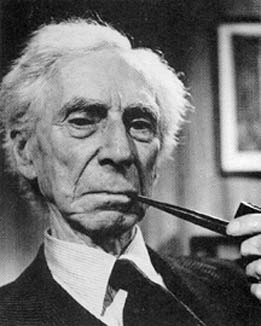
Introduction to Russell's "History"
I was taught to consider "evil" all those who spoke out against the tradition in which I was raised. To look on them with a mixture of pity and hate.
I found Russell's "Why I am not a Christian" when I was in high-school, and promptly assigned him to my growing blacklist. I found his arguments to be outrageous. I decided, almost immediately, that they were juvenile, inflammatory, and empty.
Of course, they aren't. They are, for the most part, compelling. They do still prickle my skin, simply by being polemics aimed at the heart of my mind -- however, he himself has since been granted (by whom?) a pardon. His horns have fallen off. I've read a bit of a biography of his childhood as well as bits of other works, and they've convinced me of his sincere desire to believe what he feels are honest and justifiable things to believe.
"Why I'm not a Christian" ends by advocating the leaving-off of dogmas -- "A good world needs knowledge, kindliness, and courage; it does not need a regretful hankering after the past or a fettering of the free intelligence by the words uttered long ago by ignorant men," Russell says.
20 years later, in the middle of the second world war, Russell finished writing his History of Western Philosophy, with the help of his wife Patricia (who did most of the research for him). The issue of dogma factors heavily in this work as well. Dogma is on one end of the pendulum swing that Western Philosophy has been beating out since the beginning -- the other is Science. The No Man's Land between the two is Philosophy -- "something intermediate between Theology and Science."
All definite knowledge ... belongs to Science; all dogma as to what surpasses definite knowledge belongs to Theology. ... Almost all the questions of most interest to speculative minds are sych as science cannot answer, and the confident answers of theologians no longer seem so convincing as they did in former centuries.
He lists a series of unanswerable questions, questions that require dogmatic belief, or ... philosophy. He asserts that this book will be the answer to the question of why, historically, philosophy has bothered to ponder these unanswerable questions. Action depends on belief, and to understand why people acted the way they did, is to understand, in part, what they believed.
Science tells us what we can know -- not much -- and Theology purports to fill in the rest. Russell clearly doesn't appreciate this gesture. He would rather live bravely through the uncertainty he believes himself to be in, but "it is not good either to forget the questions that philosophy asks..."
To teach how to live without certainty, and yet without being paralyzed by hesitation, is perhaps the chief thing that philosophy, in our age, can still do for those who study it.
Russell then proceeds to give us the brief outline of history, through this oscillation-lens. He links to dogma any sort of cultural tradition that unites a people in a unified belief -- thus creating civilization of some sort -- and to science he ties any individualism or free-minded exploration of the world that tends to dissolve societal bonds. The cycle of history, according to Russell, follows this track, back and forth, rigid tradition to a relaxation to the beginnings of free-minded genius, to dissolution, to tyranny, whereby a new tradition is instituted ...
Russell ends his introduction with a rally-cry quite similar to that of "Why I am not..." His vision of a brighter future, in this instance, comes under the title of "Liberalism":
The doctrine of liberalism is the attempt to escape this endless oscillation [the one I've illustrated for you above.] The essence of liberalism is an attempt to secure a social order not based on irrational dogma, and insuring stability without innvolving more restraints than are necessary for the preservation of the community. Whether this attempt can succeed...
...only the future can determine.
I found Russell's "Why I am not a Christian" when I was in high-school, and promptly assigned him to my growing blacklist. I found his arguments to be outrageous. I decided, almost immediately, that they were juvenile, inflammatory, and empty.
Of course, they aren't. They are, for the most part, compelling. They do still prickle my skin, simply by being polemics aimed at the heart of my mind -- however, he himself has since been granted (by whom?) a pardon. His horns have fallen off. I've read a bit of a biography of his childhood as well as bits of other works, and they've convinced me of his sincere desire to believe what he feels are honest and justifiable things to believe.
"Why I'm not a Christian" ends by advocating the leaving-off of dogmas -- "A good world needs knowledge, kindliness, and courage; it does not need a regretful hankering after the past or a fettering of the free intelligence by the words uttered long ago by ignorant men," Russell says.
20 years later, in the middle of the second world war, Russell finished writing his History of Western Philosophy, with the help of his wife Patricia (who did most of the research for him). The issue of dogma factors heavily in this work as well. Dogma is on one end of the pendulum swing that Western Philosophy has been beating out since the beginning -- the other is Science. The No Man's Land between the two is Philosophy -- "something intermediate between Theology and Science."
All definite knowledge ... belongs to Science; all dogma as to what surpasses definite knowledge belongs to Theology. ... Almost all the questions of most interest to speculative minds are sych as science cannot answer, and the confident answers of theologians no longer seem so convincing as they did in former centuries.
He lists a series of unanswerable questions, questions that require dogmatic belief, or ... philosophy. He asserts that this book will be the answer to the question of why, historically, philosophy has bothered to ponder these unanswerable questions. Action depends on belief, and to understand why people acted the way they did, is to understand, in part, what they believed.
Science tells us what we can know -- not much -- and Theology purports to fill in the rest. Russell clearly doesn't appreciate this gesture. He would rather live bravely through the uncertainty he believes himself to be in, but "it is not good either to forget the questions that philosophy asks..."
To teach how to live without certainty, and yet without being paralyzed by hesitation, is perhaps the chief thing that philosophy, in our age, can still do for those who study it.
Russell then proceeds to give us the brief outline of history, through this oscillation-lens. He links to dogma any sort of cultural tradition that unites a people in a unified belief -- thus creating civilization of some sort -- and to science he ties any individualism or free-minded exploration of the world that tends to dissolve societal bonds. The cycle of history, according to Russell, follows this track, back and forth, rigid tradition to a relaxation to the beginnings of free-minded genius, to dissolution, to tyranny, whereby a new tradition is instituted ...
Russell ends his introduction with a rally-cry quite similar to that of "Why I am not..." His vision of a brighter future, in this instance, comes under the title of "Liberalism":
The doctrine of liberalism is the attempt to escape this endless oscillation [the one I've illustrated for you above.] The essence of liberalism is an attempt to secure a social order not based on irrational dogma, and insuring stability without innvolving more restraints than are necessary for the preservation of the community. Whether this attempt can succeed...
...only the future can determine.
Tuesday, July 15, 2008
One of a Kinds
The ones
who each think
that they are the one
not of, but distinct
from the kind.
They are right --
for the kind know
it's wrong to seem
to themselves as anything
but the one who is
very much like
every other.
To say "I like you"
is to make this claim.
who each think
that they are the one
not of, but distinct
from the kind.
They are right --
for the kind know
it's wrong to seem
to themselves as anything
but the one who is
very much like
every other.
To say "I like you"
is to make this claim.
Friday, July 11, 2008
"Thoughts that are at peace"
When you find yourself awake at 1 am charting the events of the 16th century, you should ask yourself: Am I insane? Am I doing this out of anxiety, or pride, or because of strange love?
I'll agree with Wittgenstein, who was in turn agreeing with a great many philosophers before him, starting with Socrates, who first said: The goal of philosophy is thoughts that are at peace.
That is, the product of loving wisdom is thoughts that are at peace. Wisdom is -- so the cliche goes -- knowing that you don't know much. Loving wisdom -- that is: humbly observing and meditating on the world and its ways because you just want to, that is: philosophy -- is the process of untangling what you think you know and why you think you know it. It is therapeutic. It is freeing oneself, and humbling oneself, at the same time.
Knowledge is what we call our belief concerning the experiential relationship between ourselves and the world. It is a relationship. Certainty is the name of a feeling we have about that relationship. It is not the result of mathematical deduction. One becomes more or less convinced that what one says about the relationship between oneself and the world is an accurate way of saying it.
I for one am glad for the few simple human dogmas we all, or nearly all, share: 1. That we are existing in a world (I've never met or heard of someone not considered crazy who did not act on this belief) (if you say "Buddhism" I say read the story of Siddhartha's enlightenment, and think on the significance of the way he comes to it) (If you say George Berkeley, I say that saying that the world is actually there or saying that it is just perceived aren't really different, practically speaking) 2. That the world, existing outside of us, is governed by laws that we perceive, not that we create. 3. That reflecting on and talking about our relationship to the world, revering the existence of and power of objective reality, is a good thing: Sursum Corda -- lift up your heart.
To that end, some stay up late charting the centuries, mulling over the course of human thought and action. We are strange creatures -- strange that it fills me with feelings of wonder and of its strangeness -- strange compared to what?
I think it is strange compared to what I once thought of being human. Which wasn't much -- not much thinking, that is. Or, thinking that happened behind many veils.
So, to get to my purpose: I am reading Betrand Russell's "History of Western Philosophy" and will be doing little summaries of the chapters here, for my own benefit. I have an awful memory. Fixing this online, forever!, will be helpful for me, and maybe also for anyone else who happens to stumble upon it, and doesn't have the time to read the actual 800 page text.

I'll agree with Wittgenstein, who was in turn agreeing with a great many philosophers before him, starting with Socrates, who first said: The goal of philosophy is thoughts that are at peace.
That is, the product of loving wisdom is thoughts that are at peace. Wisdom is -- so the cliche goes -- knowing that you don't know much. Loving wisdom -- that is: humbly observing and meditating on the world and its ways because you just want to, that is: philosophy -- is the process of untangling what you think you know and why you think you know it. It is therapeutic. It is freeing oneself, and humbling oneself, at the same time.
Knowledge is what we call our belief concerning the experiential relationship between ourselves and the world. It is a relationship. Certainty is the name of a feeling we have about that relationship. It is not the result of mathematical deduction. One becomes more or less convinced that what one says about the relationship between oneself and the world is an accurate way of saying it.
I for one am glad for the few simple human dogmas we all, or nearly all, share: 1. That we are existing in a world (I've never met or heard of someone not considered crazy who did not act on this belief) (if you say "Buddhism" I say read the story of Siddhartha's enlightenment, and think on the significance of the way he comes to it) (If you say George Berkeley, I say that saying that the world is actually there or saying that it is just perceived aren't really different, practically speaking) 2. That the world, existing outside of us, is governed by laws that we perceive, not that we create. 3. That reflecting on and talking about our relationship to the world, revering the existence of and power of objective reality, is a good thing: Sursum Corda -- lift up your heart.
To that end, some stay up late charting the centuries, mulling over the course of human thought and action. We are strange creatures -- strange that it fills me with feelings of wonder and of its strangeness -- strange compared to what?
I think it is strange compared to what I once thought of being human. Which wasn't much -- not much thinking, that is. Or, thinking that happened behind many veils.
So, to get to my purpose: I am reading Betrand Russell's "History of Western Philosophy" and will be doing little summaries of the chapters here, for my own benefit. I have an awful memory. Fixing this online, forever!, will be helpful for me, and maybe also for anyone else who happens to stumble upon it, and doesn't have the time to read the actual 800 page text.
Thursday, August 30, 2007
A Difficult Grace
I've been reading the essays of Michael Ryan, one of the professors of poetry here at UCI. Which is an interesting title, I've always thought - professor of anything. A public declaration of your expertise in a field, apparently, from the Latin verb "profitieri".
Anyway, his essays, as Pinsky tells us on the front cover blurb, are "crisp, passionate, and learned." I like "learned", thanks Bob.
Crisp, though, yes, they are crisp. They slice well. Many of them are short, and full of clear expressions of a simple philosophy of poetry, form and purpose.
Anyway, his essays, as Pinsky tells us on the front cover blurb, are "crisp, passionate, and learned." I like "learned", thanks Bob.
Crisp, though, yes, they are crisp. They slice well. Many of them are short, and full of clear expressions of a simple philosophy of poetry, form and purpose.
Tuesday, May 29, 2007
This Mortal Coil
This blog has been on hiatus again. It seems to happen for a few months, every few months. It usually corresponds to some new swing of thought and action -- in this case, a series of actions, that led to a series of thoughts, that led to the neglecting of this blog.
I've been reading Shakespeare, and Hass, and Heidegger -- that is The Poet, a poet, and a poet-philosopher. I am thinking about Hamlet, and that too much introspection becomes inaction. As Coleridge says, "I have a smack of Hamlet myself, if I may say so."
You may.
I've been reading Shakespeare, and Hass, and Heidegger -- that is The Poet, a poet, and a poet-philosopher. I am thinking about Hamlet, and that too much introspection becomes inaction. As Coleridge says, "I have a smack of Hamlet myself, if I may say so."
You may.
Wednesday, March 21, 2007
Anamnesis
I found some previously unpublished blogs, sitting in draft-form in the "Edit posts" section -- this one from early 2007 (about Anamnesis -- the process (to state it simply) of remembering what you have forgotten) (So strange to think about the history of your own psyche) :
"It's that time again - cycle, cycle, cycle - wheel of time churns its melancholy way, me hog-tied to a cross beam, coming up for air.
Asleep in the water, bewildered in the light.
Shall I make written language the memory I don't have? Shall I correspond with the visible - make symbols for the abstract concepts in my head?
The answer to that question is yes. Yes I will do this, having found it the best way to maintain the livelihood of the eternalhoodness of my head. That is, keep the body in step with the "me" that has been a-ponderin for some years now, gnawing at its favorite bone, but forgetful. Forgetting everything it loves, always - its okay. We start again.
Principal #1: Express the yet-unexpressed intuitions of the world and its loveliness.
Principal #2: Wholeness and soundness of being.
Principal #3: Be still and know the voice, the hand, the shepherd. Know the worlds Maker as best as you can, and let the goodness of that knowing change the way you talk and step.
Principal #4: Don't ever hesitate to say what you mean, regardless of what nonsense it seems to be.
Principal #5: Don't try to sound cool. Don't try to be sexy. Don't believe the sugar-lie.
The Sugar-lie? Thus: the lie my body believes, told to it by sweet sweet voices, that hunger must be filled immediately. It must not necessarily. Maybe not evil to fill it -- what is the definition of evil? Who defines evil? Say God, yes, but how do you know what God says? Who made you Lord over the world's knowledge?
All of the symbols of my life stand before me mute, waiting for the signal. I have none. I am listening to Gorecki's 3rd symphony, and I have none. I am holding up a finger.
"It's that time again - cycle, cycle, cycle - wheel of time churns its melancholy way, me hog-tied to a cross beam, coming up for air.
Asleep in the water, bewildered in the light.
Shall I make written language the memory I don't have? Shall I correspond with the visible - make symbols for the abstract concepts in my head?
The answer to that question is yes. Yes I will do this, having found it the best way to maintain the livelihood of the eternalhoodness of my head. That is, keep the body in step with the "me" that has been a-ponderin for some years now, gnawing at its favorite bone, but forgetful. Forgetting everything it loves, always - its okay. We start again.
Principal #1: Express the yet-unexpressed intuitions of the world and its loveliness.
Principal #2: Wholeness and soundness of being.
Principal #3: Be still and know the voice, the hand, the shepherd. Know the worlds Maker as best as you can, and let the goodness of that knowing change the way you talk and step.
Principal #4: Don't ever hesitate to say what you mean, regardless of what nonsense it seems to be.
Principal #5: Don't try to sound cool. Don't try to be sexy. Don't believe the sugar-lie.
The Sugar-lie? Thus: the lie my body believes, told to it by sweet sweet voices, that hunger must be filled immediately. It must not necessarily. Maybe not evil to fill it -- what is the definition of evil? Who defines evil? Say God, yes, but how do you know what God says? Who made you Lord over the world's knowledge?
All of the symbols of my life stand before me mute, waiting for the signal. I have none. I am listening to Gorecki's 3rd symphony, and I have none. I am holding up a finger.
Monday, March 12, 2007
Objectivism
Ayn Rand, your spirit hovers over these american waters. Since Atlas shrugged, many of us have been following suit. I'm not sure what it was that makes me hate you so much. I think that it's because, like everyone, you failed to say the truth, the whole truth, and nothing but. And you wouldn't admit having failed.
Of course, I have figured it all out. All of the unfitting pieces of your systematic assembly of the puzzle of existence I have removed and filled the gaps with light. You left me your mantle like Elijah, and I've cut it to pieces, patched it into sails, tried to catch the wind.
The world exists. In this we agree, apparently. Knowledge is a relationship to this actual existent and orderly world. Yes, this order that we perceive hovers between two layers of flux - our minds and mystic fields of energy - yet it exists.
Certainty is a feeling about the relationship of our minds to this world. Concepts, we agree I think, are abstractions of perceived objects and their relationships - or that language, the ability to perceive ourselves lucidly and conceptualize and step back and speak, is grounded in things. So if there was a chain, our minds perceive things and relations between things, and this is grounds for language, symbol for thing, which causes communication, which causes the ability to abstract, which causes language about abstractions, which causes self-awareness, which I have right now. I am aware of my flesh in a tilting chair in Irvine, CA (we give names to geographical locations!) (language is beautiful) and I am aware that I am aware, and it allows me to circle around myself as I speak, to check myself, to say to self:
"Self, as ye listen to Thomas Tallis' lovely ancient music through two ear buds sucking electronic juice through long black root to release wave-sound-scent into your head's chambers remember that ye are capable of commiting the sins of your foremother, our dearly beloved Aynnie Randoferous. You are capable of speaking too soon and saying a dishonest word. You are capable of flinging words unwinged out of the nest, and they will fall hard to the real ground. Self, come to me, let me hold you, let me kiss you, yes, we are crazy, but it is the kind of craziness I desire, the kind that does not hide from itself, that kind that stands willingly in the hard light of the world, not even turning from the hope that is here, not even turning from the happiness of it. "
Of course, I have figured it all out. All of the unfitting pieces of your systematic assembly of the puzzle of existence I have removed and filled the gaps with light. You left me your mantle like Elijah, and I've cut it to pieces, patched it into sails, tried to catch the wind.
The world exists. In this we agree, apparently. Knowledge is a relationship to this actual existent and orderly world. Yes, this order that we perceive hovers between two layers of flux - our minds and mystic fields of energy - yet it exists.
Certainty is a feeling about the relationship of our minds to this world. Concepts, we agree I think, are abstractions of perceived objects and their relationships - or that language, the ability to perceive ourselves lucidly and conceptualize and step back and speak, is grounded in things. So if there was a chain, our minds perceive things and relations between things, and this is grounds for language, symbol for thing, which causes communication, which causes the ability to abstract, which causes language about abstractions, which causes self-awareness, which I have right now. I am aware of my flesh in a tilting chair in Irvine, CA (we give names to geographical locations!) (language is beautiful) and I am aware that I am aware, and it allows me to circle around myself as I speak, to check myself, to say to self:
"Self, as ye listen to Thomas Tallis' lovely ancient music through two ear buds sucking electronic juice through long black root to release wave-sound-scent into your head's chambers remember that ye are capable of commiting the sins of your foremother, our dearly beloved Aynnie Randoferous. You are capable of speaking too soon and saying a dishonest word. You are capable of flinging words unwinged out of the nest, and they will fall hard to the real ground. Self, come to me, let me hold you, let me kiss you, yes, we are crazy, but it is the kind of craziness I desire, the kind that does not hide from itself, that kind that stands willingly in the hard light of the world, not even turning from the hope that is here, not even turning from the happiness of it. "
Monday, January 29, 2007
Thread of the Amnesiac
The thread often slips. I try
to keep it clasped tight between my pincers
through the long-winded goose
chasing. I fail.
Even in this moment as I clatter backwards
on all fours recounting
all of the ways I have fallen short – all of the music
I began, with what heat!, and promptly cut off cold
turkey. Oh, I’m sorry, yes,
an accident of course, just
slipped my mind. Socrates
stood motionless for days on end
to keep a palsied grip on the kite’s
elusive tail that whips up sometimes, pulls taut, 80 degrees
skyward, significant
I’m telling you, easy to follow.
We get this hallowed sense of self, religious
inflation, which, in the course of things, is lost
when the kite dips and the rope
goes limp,
and I’m left alone
in one place, trying to re-collect the story,
trying to patch together clues
to my amnesiac life, amidst a rabble
of circumstantial evidence, and this ridiculous
rope strung backwards through time,
tied always - strange now that I think of it -
to the successive images of me.
to keep it clasped tight between my pincers
through the long-winded goose
chasing. I fail.
Even in this moment as I clatter backwards
on all fours recounting
all of the ways I have fallen short – all of the music
I began, with what heat!, and promptly cut off cold
turkey. Oh, I’m sorry, yes,
an accident of course, just
slipped my mind. Socrates
stood motionless for days on end
to keep a palsied grip on the kite’s
elusive tail that whips up sometimes, pulls taut, 80 degrees
skyward, significant
I’m telling you, easy to follow.
We get this hallowed sense of self, religious
inflation, which, in the course of things, is lost
when the kite dips and the rope
goes limp,
and I’m left alone
in one place, trying to re-collect the story,
trying to patch together clues
to my amnesiac life, amidst a rabble
of circumstantial evidence, and this ridiculous
rope strung backwards through time,
tied always - strange now that I think of it -
to the successive images of me.
Sunday, January 21, 2007
Vivaldi
all of the ways
that eagerness fails –
in the end. But do we ever have the end?
We have only now, this: mop of hair
on the Red Priest’s pate jouncing back and forth
to the cheerful cadence, raised arm
announcing each arriving beat.
We wait expectant for the bright descent –
for the opening of the next gate, ajar,
daylight betraying the world behind.
We follow the hand that runs from room to room
throwing wide the doors of the house.
Don’t try and explain away
the smile on Vivaldi’s face,
or mine. Let tomorrow worry
about itself.
Won’t eagerness wend its way off some distant cliff
of meaninglessness? Yes, and how the hell should I know.
Too many monolithic syllables in between.
And such delight in the next.
Such vivid delight in the next.
Monday, January 08, 2007
Arcangelo Corelli
Jumping back to one of Vivaldi's influences, Corelli's music sounds more like Scarlatti than the later more complex Baroque sound. Listening to his violin sonata opus 5.
He was born in Ravenna, which was one of my favorite stops in Italy when I went a couple years back. Lovely old Byzantine city, cobblestoned and courtyarded - home to San Vitale, an exceptionally beautiful Byzantine Basilica of the 6th century.
His melodies are clear and fluid. They are refreshing.
Click on Corelli's flowing mane to hear Concerti Grossi, Opus 6, no 8, allegro.

He was born in Ravenna, which was one of my favorite stops in Italy when I went a couple years back. Lovely old Byzantine city, cobblestoned and courtyarded - home to San Vitale, an exceptionally beautiful Byzantine Basilica of the 6th century.
His melodies are clear and fluid. They are refreshing.
Click on Corelli's flowing mane to hear Concerti Grossi, Opus 6, no 8, allegro.
Saturday, January 06, 2007
Mortaldi
Get it? "Viva" means "live" and "morte" means "die" so "mortaldi" would be... nevermind. This is the last day of Vivaldi's ornate moment in the spotlight. Listening to a random concerto for violin, strings, and the harpsichord right now. I read somewhere that the historical category of "baroque" as its own era is questionable because of the vast differences between early baroque, and late. I can hear them. Vivaldi was a bit of a jump into the mid to late baroque for me, and his music is quite different than Scarlatti's. Much more... classical - you know, complex and varied. Lots of tempo changes. Violins dancing around like fruit flies - the strings in the back like an industrious cityscape. Bom, bom, bom! (puffs of smoke) Scarlatti still had that careful, reserved simplicity of ye olden days.
As I listen, I'm prepping to jump back into the waters of Rhetoric and Critical Reading. Met my new class. They seem swell. Not so much in the swollen sense, as in the neat-o, allright.
As I listen, I'm prepping to jump back into the waters of Rhetoric and Critical Reading. Met my new class. They seem swell. Not so much in the swollen sense, as in the neat-o, allright.
Thursday, January 04, 2007
The Man and His Soul
The man sat next to his soul on the sofa touching it occasionally to see if its feeling would change from moment to moment. It did not. He only asked it questions when he became lonely. I would encourage those inclined to object to the ambiguity of the pronoun usage in this scene to remember that when I say "he" in any moment, it does not matter to whom I am referring - either way it is one and the same. The soul abstracts the man, as does the man, away from himself. They are, however, and ever will be, the same creature.
So, as I said, the soul asked questions to the man who touched, and he replied in kind with light and encouraging puffs of language. His sentences, it became clear, his words to himself, were wrapped about something.
This made the soul touch faster - the man began to ask his questions in rapid succession - poppop pop -like a derrick pumping oil, bad and noxious, from the world's snake bite wound. They watched his words unravel. Something was appearing. Loneliness evaporated into mystic glee. Harder and harder they went, language greased and gunning, and then
the thing itself revealed.
Was laid bare.
I saw it.
I was watching.
The man and the soul, however, had fallen asleep. Three times this happened. Before the fourth could find its culmination, the ground had taken back its own.
So, as I said, the soul asked questions to the man who touched, and he replied in kind with light and encouraging puffs of language. His sentences, it became clear, his words to himself, were wrapped about something.
This made the soul touch faster - the man began to ask his questions in rapid succession - poppop pop -like a derrick pumping oil, bad and noxious, from the world's snake bite wound. They watched his words unravel. Something was appearing. Loneliness evaporated into mystic glee. Harder and harder they went, language greased and gunning, and then
the thing itself revealed.
Was laid bare.
I saw it.
I was watching.
The man and the soul, however, had fallen asleep. Three times this happened. Before the fourth could find its culmination, the ground had taken back its own.
The Consolation of the Soul
After all the doors have had their handles
twisted off. After all the roads out to the lake
have been erased. (Leaving me stranded)
After we have stood and faced
what it is
that we aren't capable of calling you,
Soul, come, and sit with me.
I need an arm,
a bit of flesh,
to lean my weight upon.
You dont refuse an old man
it? A moment ago I was young
and building -
Then the raucous vacuum
came and orchestrated the renewal
of the dark. It meant to.
Oh, it feels that it meant to
do that to you.
Come, then, let me touch your face
so you can know
you are.
And we shall lean again into the wind -
Soul, do you hear me
calling down the funnel?-
the dark and ravishing wind.
twisted off. After all the roads out to the lake
have been erased. (Leaving me stranded)
After we have stood and faced
what it is
that we aren't capable of calling you,
Soul, come, and sit with me.
I need an arm,
a bit of flesh,
to lean my weight upon.
You dont refuse an old man
it? A moment ago I was young
and building -
Then the raucous vacuum
came and orchestrated the renewal
of the dark. It meant to.
Oh, it feels that it meant to
do that to you.
Come, then, let me touch your face
so you can know
you are.
And we shall lean again into the wind -
Soul, do you hear me
calling down the funnel?-
the dark and ravishing wind.
Wednesday, January 03, 2007
Viva Vivaldi
Buona vita nel'anno nouvo. Is that the way its said? I guess that would be saying that the good life, buona vita, is in, "inside of", nel, the new year. Which isn't what I meant, but sort of nice. Poetical. And thats my question. Does the poetical blurring of reality by language create some of the meta-substances we base so much of our lives on? I don't think so, but its a question anyway.
Vivaldi! He, formidable master of the Baroquean pitch, is the composer of the week. I've been listening to the Four Seasons, which you've heard nearly in entirety even if you think you haven't. La Stravaganza is next in the queue. His music feels like the Californian New Year: bright, busy, wealthy.
Vivaldi! He, formidable master of the Baroquean pitch, is the composer of the week. I've been listening to the Four Seasons, which you've heard nearly in entirety even if you think you haven't. La Stravaganza is next in the queue. His music feels like the Californian New Year: bright, busy, wealthy.
Come now, let us reason it together Soul
We must be frank,
for the days are short -
It being winter.
It being the climate.
It being the mustard sandwich
we wave when bereft at lunch
of the thing itself -
whatever we happen to be speaking of.
Soul? Are you my gesture's pith or sandwich?
That's not the question I brought you here to ask,
but it seems pertinent.
It seems like it will fit.
It always fits.
It was made to.
I'm asking: there's you, and there's your flesh -
in English, two extremities, and two hearts, composite
acting as the thing we wave
when we speak of you.
My lips, bread.
My tongue, processing meat -
I am waving myself out over the dark lake.
I am conversing of you.
With whom?
With whom?
------
dedicated to the Hofer
for the days are short -
It being winter.
It being the climate.
It being the mustard sandwich
we wave when bereft at lunch
of the thing itself -
whatever we happen to be speaking of.
Soul? Are you my gesture's pith or sandwich?
That's not the question I brought you here to ask,
but it seems pertinent.
It seems like it will fit.
It always fits.
It was made to.
I'm asking: there's you, and there's your flesh -
in English, two extremities, and two hearts, composite
acting as the thing we wave
when we speak of you.
My lips, bread.
My tongue, processing meat -
I am waving myself out over the dark lake.
I am conversing of you.
With whom?
With whom?
------
dedicated to the Hofer
What the Soul is making
In the mornings, over the stovetop.
With an arched neck,
lays an ear to the fleshy divet
between his chests pectoral lumps
and listens to the metronomic
drumbeat of blood.
Oh Soul, can't you see I'm dying
to know where it is you're making
your habitation?
(This is not about the beauty of the language!
Come out, my hands are clean!)
The soul remains quiet,
flexing in the dark
to whom I addressed my next question:
And what are you the lack of?
And why do I hate you so much?
The blood pumps.
A waft of pancake batter cooking lifts,
pungence of a morphic creature.
With an arched neck,
lays an ear to the fleshy divet
between his chests pectoral lumps
and listens to the metronomic
drumbeat of blood.
Oh Soul, can't you see I'm dying
to know where it is you're making
your habitation?
(This is not about the beauty of the language!
Come out, my hands are clean!)
The soul remains quiet,
flexing in the dark
to whom I addressed my next question:
And what are you the lack of?
And why do I hate you so much?
The blood pumps.
A waft of pancake batter cooking lifts,
pungence of a morphic creature.
Monday, January 01, 2007
Vegas
It means the meadows! I was thinking of warrior Amazon goddesses, not grasslands. Apparently it was named thus because the Spaniards who christened it found natural artesian springs as they passed through.
It was a clean place, and gracious.
It was a clean place, and gracious.
Ulysses and the New Year
I have just finished reading, here on this lovely and bright January the first of 2007, the opening chapter of James Joyce's Ulysses. It is, to be blunt, amazing. The last time that I can remember enjoying a bit of prose so much was my brief liaison with the journal entries of Gerard Manley Hopkins.
The syntax is a veritable freak show of perfection, the slipping between thought and dialogue smooth and sweet, and the characters livid with animation. Buck Mulligan is doing wonders for my heart.
This may be presumptuous, but if the first chapter is a clue, this book will be one of my favorites long before I reach its faraway final word. It is, after all, not in the least a short novel.
And the new year is here. As you might have induced from my last two poems, I spent some of it in the desert. Mojave National Preserve, 100 miles southwest of Satan's National Preserve. No, I'm not talking about Death Valley - that's 100 miles due north. I'm speaking of Vegas. Las Vegas. The Vegas. And what are the Vegas? No one really knows, but shoot, can they put on a show.
Sorry, my verbosity has been aroused.
Back to Stephen Dedalus.
The syntax is a veritable freak show of perfection, the slipping between thought and dialogue smooth and sweet, and the characters livid with animation. Buck Mulligan is doing wonders for my heart.
This may be presumptuous, but if the first chapter is a clue, this book will be one of my favorites long before I reach its faraway final word. It is, after all, not in the least a short novel.
And the new year is here. As you might have induced from my last two poems, I spent some of it in the desert. Mojave National Preserve, 100 miles southwest of Satan's National Preserve. No, I'm not talking about Death Valley - that's 100 miles due north. I'm speaking of Vegas. Las Vegas. The Vegas. And what are the Vegas? No one really knows, but shoot, can they put on a show.
Sorry, my verbosity has been aroused.
Back to Stephen Dedalus.
on the graciousness of light to the desert
the sun and moon are both good to the desert.
they do no harm to it.
it is so simple. it is not listening
to the babble of the way things
should be. it is even, steady,
and rises quickly in both lights
when it wants to.
these rises, these white peaks, granite
and dry scrub,
are silent in that hour
when the sun and moon meet -
they want to be silent -
they have nothing more to say than being there.
they let the sky speak its smallest most
neglected songs: the low swish of cirrus clouds
unraveling, the faint clap
of stars appearing. these love the desert for its humility,
and fear it.
who is this, so wise, so simple
as to let things be how they are?
the sun reveals it.
the moon makes it bright with joy.
they do no harm to it.
it is so simple. it is not listening
to the babble of the way things
should be. it is even, steady,
and rises quickly in both lights
when it wants to.
these rises, these white peaks, granite
and dry scrub,
are silent in that hour
when the sun and moon meet -
they want to be silent -
they have nothing more to say than being there.
they let the sky speak its smallest most
neglected songs: the low swish of cirrus clouds
unraveling, the faint clap
of stars appearing. these love the desert for its humility,
and fear it.
who is this, so wise, so simple
as to let things be how they are?
the sun reveals it.
the moon makes it bright with joy.
What the Soul is doing in the Desert
Oh Soul,
I am thinking of a new kind of year.
As the late year folded down
old behind the last range,
red and thin, flapping in the hard winter wind,
I clapped my hands -
a new idea.
I waited, not speaking a word to any soul,
not even you,
until the sun blushed its sphere
and sank. Until the last spot of light winked.
Until the dimming sky screamed,
ripped the last pink
gauze off the dying thing and slapped it
back into the universe, I waited,
every inch of my skin bristling -
and when the old man howled and collapsed back,
I clapped
and the sky said "Ma cosa fai?"
I replied "I am inventing again."
I am thinking of a new kind of year.
As the late year folded down
old behind the last range,
red and thin, flapping in the hard winter wind,
I clapped my hands -
a new idea.
I waited, not speaking a word to any soul,
not even you,
until the sun blushed its sphere
and sank. Until the last spot of light winked.
Until the dimming sky screamed,
ripped the last pink
gauze off the dying thing and slapped it
back into the universe, I waited,
every inch of my skin bristling -
and when the old man howled and collapsed back,
I clapped
and the sky said "Ma cosa fai?"
I replied "I am inventing again."
Saturday, December 30, 2006
The Soul
I am asking myself a question
when I write those two words.
It has been said that God will not be mocked,
so I am not afraid to ask.
I am in a small room
typing on a black plastic keyboard
having just read the words of a friend about
the desert he is in;
Iraq, war, separation,
the soul.
Some of us are forced to stand still in the dark and face ourselves.
I lift my trembling hand out over the dark lake.
What do I hope for, oh Soul, in all of this reaching,
say it back to me:
joy.
when I write those two words.
It has been said that God will not be mocked,
so I am not afraid to ask.
I am in a small room
typing on a black plastic keyboard
having just read the words of a friend about
the desert he is in;
Iraq, war, separation,
the soul.
Some of us are forced to stand still in the dark and face ourselves.
I lift my trembling hand out over the dark lake.
What do I hope for, oh Soul, in all of this reaching,
say it back to me:
joy.
Sunday, December 17, 2006
Hanukkah
It’s such a small miracle –
1 days oil stretching to 8.
No one come death-ragged from
the gaping tomb,
no one taken up
in a whirl of fire.
I almost believe it
like I would believe you if you told me
that you made a cake yesterday
and it came out
with the shape of a feather on it.
Feathers mean something to you and I,
vaguely. Just enough. But if none had come
no one would be weeping.
No souls would plummet to the earth.
We’d wait awhile
till we got the oil
and come up with a reason
why it was all perfect timing –
light the candles,
call it “When the Oil
Finally Showed Up Day.”
But it stretched.
You pulled the cake
from the hot tomb
and across its yellow face
a feather had been mysteriously swirled.
You called me.
I remember.
Sunday, December 10, 2006
A Native Hill
I am heading back toward home soon for Christmas - early this week.
For awhile, I thought that it was good to call whatever place I was in, I was living, my home, in order to fully define myself as a man - a rock - carrying his home on his back like a manly snail. Snails are manly in this sense.
Irvine is lovely, and I can feel myself acclimating to its oceanview desert scrubbrush wilderness. But it is not home. It is not in my blood. And the ridiculous suit of armor, concrete and plastic, that has been pulled over top of its rooty desert beauty, makes it nearly impossible for me to love it fully.
Can a man love a city? Yes. A city, glass and chrome, does not seem quite as much of an insult to land as this sprawling suburbia that Irvine is made of - that shrieks when it sees an open spot, diving to clap a strip mall over it.
The Lord is making me sane in an insane world. I am afraid it is going to be painful. I am afraid of the pain of sanity in America.
Wendell Berry, author of the essay A Native Hill, has his land in Kentucky - he can stand back and say "Well at least I settled in a place, and raised a family, and did not destroy, but shepherded, made good." Wendell, I am a wanderer - I am a shepherd only to a flock of wild visions.
Can a man find a home in an idea? Can he find home in a Spirit? Can he find home in a woman?
This below is one the last poems from Shepherd, which I've been working on over the course of the last year.
______
For awhile, I thought that it was good to call whatever place I was in, I was living, my home, in order to fully define myself as a man - a rock - carrying his home on his back like a manly snail. Snails are manly in this sense.
Irvine is lovely, and I can feel myself acclimating to its oceanview desert scrubbrush wilderness. But it is not home. It is not in my blood. And the ridiculous suit of armor, concrete and plastic, that has been pulled over top of its rooty desert beauty, makes it nearly impossible for me to love it fully.
Can a man love a city? Yes. A city, glass and chrome, does not seem quite as much of an insult to land as this sprawling suburbia that Irvine is made of - that shrieks when it sees an open spot, diving to clap a strip mall over it.
The Lord is making me sane in an insane world. I am afraid it is going to be painful. I am afraid of the pain of sanity in America.
Wendell Berry, author of the essay A Native Hill, has his land in Kentucky - he can stand back and say "Well at least I settled in a place, and raised a family, and did not destroy, but shepherded, made good." Wendell, I am a wanderer - I am a shepherd only to a flock of wild visions.
Can a man find a home in an idea? Can he find home in a Spirit? Can he find home in a woman?
This below is one the last poems from Shepherd, which I've been working on over the course of the last year.
______
If in the wild places of the world
you come across the cloaked figure
of a man clenching a black bag
pacing or perched in a squat
on the high point of a desert rock,
violently sweating,
leave him be. He
is looking for his home
and he does not have a home.
Friday, December 08, 2006

Scarlatti!
First, a shout out to Google for revamping Blogger.com - it's much more excellenter now.
Second, a shout out to Allesandro Scarlatti. A prominent figure in the landscape of Baroque composers, Scarlatti's pieces have levity, energy and clarity even through their relative complexity. Music beyond the Baroque era is often full of a complexity that can become a sort of heaviness - like hearing Joyce read aloud. Its beautiful, but too much. Scarlatti's music seems to be a perfect balance, for my ear, between simplicity and complexity, joy and sorrow. I am listening to Sinfonia in C Major, and I don't have any idea what this means (specifically the Sinfonia part), but I am enjoying immensely even in my ignorance.
Third, a shout out to the students in 39B Rhetoric & Critical Reading, section whatever-the-stink-it-was, who learned a thing or two I think, and enjoyed themselves in the process - this is all a way of saying that I liked my students, and am sad to part with them. They will always hold a place in my heart until they don't anymore.
Christmas is coming. Listen world - the One you long for has come. Let's tell each other the story again.
Second, a shout out to Allesandro Scarlatti. A prominent figure in the landscape of Baroque composers, Scarlatti's pieces have levity, energy and clarity even through their relative complexity. Music beyond the Baroque era is often full of a complexity that can become a sort of heaviness - like hearing Joyce read aloud. Its beautiful, but too much. Scarlatti's music seems to be a perfect balance, for my ear, between simplicity and complexity, joy and sorrow. I am listening to Sinfonia in C Major, and I don't have any idea what this means (specifically the Sinfonia part), but I am enjoying immensely even in my ignorance.
Third, a shout out to the students in 39B Rhetoric & Critical Reading, section whatever-the-stink-it-was, who learned a thing or two I think, and enjoyed themselves in the process - this is all a way of saying that I liked my students, and am sad to part with them. They will always hold a place in my heart until they don't anymore.
Christmas is coming. Listen world - the One you long for has come. Let's tell each other the story again.
Tuesday, November 28, 2006
l'Orfeo, favola in musica
Orfeo, fable in music, is the earliest work considered to be an opera. Monteverdi composed the music, and another Italian with a rad name, Alessandro Striggio, wrote the text. Orfeo, or Orpheus as he is commonly known in English, could sing and play the lute so beautifully, so powerfully, he could sway the gods themselves with its loveliness.
Euridice, his new bride, dies suddenly, and Orfeo descends into Hades armed only with his music.
This is the prologue to the Opera, in which the single female vocalist sings of the power of music.
And this is the first four stanzas of William Wordsworth's "Power of Music":
AN Orpheus! an Orpheus! yes, Faith may grow bold,
And take to herself all the wonders of old; --
Near the stately Pantheon you'll meet with the same
In the street that from Oxford hath borrowed its name.
His station is there; and he works on the crowd,
He sways them with harmony merry and loud;
He fills with his power all their hearts to the brim --
Was aught ever heard like his fiddle and him?
What an eager assembly! what an empire is this!
The weary have life, and the hungry have bliss;
The mourner is cheered, and the anxious have rest;
And the guilt-burdened soul is no longer opprest.
As the Moon brightens round her the clouds of the night,
So He, where he stands, is a centre of light;
It gleams on the face, there, of dusky-browed Jack,
And the pale-visaged Baker's, with basket on back.
Euridice, his new bride, dies suddenly, and Orfeo descends into Hades armed only with his music.
This is the prologue to the Opera, in which the single female vocalist sings of the power of music.
And this is the first four stanzas of William Wordsworth's "Power of Music":
AN Orpheus! an Orpheus! yes, Faith may grow bold,
And take to herself all the wonders of old; --
Near the stately Pantheon you'll meet with the same
In the street that from Oxford hath borrowed its name.
His station is there; and he works on the crowd,
He sways them with harmony merry and loud;
He fills with his power all their hearts to the brim --
Was aught ever heard like his fiddle and him?
What an eager assembly! what an empire is this!
The weary have life, and the hungry have bliss;
The mourner is cheered, and the anxious have rest;
And the guilt-burdened soul is no longer opprest.
As the Moon brightens round her the clouds of the night,
So He, where he stands, is a centre of light;
It gleams on the face, there, of dusky-browed Jack,
And the pale-visaged Baker's, with basket on back.
More "Animal"
He is blind, that grim and rawboned god,
black smoke,
and the world now dark –
he didn’t see me
flat behind the back of the creature,
my lamp clapped dim
between our bodies.
Or did I put it out?
I would ask – lift my tongue
into your matted hair –
if I thought you cared to, or could,
answer with any sort of luminous
word.
The sound of death’s footsteps
made me forget almost everything.
Yet he passed,
and did his sullen work
to lift the wooden hatch,
as the night rumbled forward on its track
toward the round horizon.
black smoke,
and the world now dark –
he didn’t see me
flat behind the back of the creature,
my lamp clapped dim
between our bodies.
Or did I put it out?
I would ask – lift my tongue
into your matted hair –
if I thought you cared to, or could,
answer with any sort of luminous
word.
The sound of death’s footsteps
made me forget almost everything.
Yet he passed,
and did his sullen work
to lift the wooden hatch,
as the night rumbled forward on its track
toward the round horizon.
Monteverdi = Greenmountain
Claudio Monteverdi is seen as the last of the Renaissance composers, and the first of the Baroque composers. Plus, he's got a sweet name.
In his most famous work, Vespro della Beata Vergine, you can hear both the influence of the monophonic plainchant of the Gregorians, and the markedly different instrumental intricacies of the new styles.
The first movement opens with a male voice chanting, in the old style, the phrase "O God make speed to save me." Hearing only the single voice, I thought I was still lost in the familiar mystic realm of the ancients, out in the shadowed wilds. But then, like a ceiling full of chandeliers suddenly lit (I actually shook in my chair), comes the full orchestral and choral response, "O Lord make haste to help me." This ain't early music anymore. He combines masterfully the old and the new.
I wish it was easier. I find myself thinking of this constantly: how do you proceed through life so that the lessons you learn stick with you, and show up in the new situations - so that what you learn is added to, is gained upon. Monteverdi's music represents the giant snowball of Western music that had been slowly growing, collecting new techniques and instruments, having begun as a simple chanted melody during the time of the Byzantine empire. His Vespro is a huge ball of lutes, harpsichords, violas, counterpoint technique, new harmony, and choir voices.
Hot damn, I want that. Every word should brim with the knowledge of the learned - of time experienced. I think this is called wisdom.
My poems are my memory, and my teachers. They walk behind me in a motley gang, making strange noises - birds, creatures, plants, robed figures - heads bobbing. I want to feel them there, reteaching me what they taught me, so painfully and beautifully, once before.
In his most famous work, Vespro della Beata Vergine, you can hear both the influence of the monophonic plainchant of the Gregorians, and the markedly different instrumental intricacies of the new styles.
The first movement opens with a male voice chanting, in the old style, the phrase "O God make speed to save me." Hearing only the single voice, I thought I was still lost in the familiar mystic realm of the ancients, out in the shadowed wilds. But then, like a ceiling full of chandeliers suddenly lit (I actually shook in my chair), comes the full orchestral and choral response, "O Lord make haste to help me." This ain't early music anymore. He combines masterfully the old and the new.
I wish it was easier. I find myself thinking of this constantly: how do you proceed through life so that the lessons you learn stick with you, and show up in the new situations - so that what you learn is added to, is gained upon. Monteverdi's music represents the giant snowball of Western music that had been slowly growing, collecting new techniques and instruments, having begun as a simple chanted melody during the time of the Byzantine empire. His Vespro is a huge ball of lutes, harpsichords, violas, counterpoint technique, new harmony, and choir voices.
Hot damn, I want that. Every word should brim with the knowledge of the learned - of time experienced. I think this is called wisdom.
My poems are my memory, and my teachers. They walk behind me in a motley gang, making strange noises - birds, creatures, plants, robed figures - heads bobbing. I want to feel them there, reteaching me what they taught me, so painfully and beautifully, once before.
Sunday, November 26, 2006
Deliquence
You'd think a man about to step through the ornate gates of the world of Baroque music would have a better grip on his daily habits - you'd think he'd have a track of well-placed steps upon the daily race. Nope. I hiked up, however, some green scrub-desert hills south of Irvine, just east of San Juan Capistrano, which is the town famous for its mission swallows. Sparrows? Birds.
Ate a tasty turkey sandwich while perched on a rock overlooking a ridged valley. Felt like an Indian, or a hawk. Tried smoking my pipe, but it wouldn't light in the wind.
Where to begin with this new world. The thanksgiving meditation was good. Paused from posts - is how I would describe what I did If I didn't feel so deliquent.
But, I do. I owe something now to this electronic page. A lesson, at least, in the ways of ancient music. But no longer! - will I be deliquent. (That's not true)
Moving forward into a brave new world.
If you been reading and would like a cd & short guide of the music I've described during the study of early music, let me know. I'll send one to you.
I haven't posted a new poem in a few light years. Which is a measure of distance. Which makes no sense.
So here's one, from my new series, Animal:
--
Today these hands are mine.
I say it in a dream – a dismal haze.
Today I will do what is good and mindful.
I will do what is natural to the light.
I move, mistaken, on the inside.
Today I’ll writhe up from this hole
and take a bite of all the brightest things.
But even as I say it, twisted with pleasure,
I rap against the inner notches of my ribs and wake
silent in the dark wet,
where the heat of a distant noon sun seeps through
the outer skin of the sheath pulled close around this cavity,
this suffocating world,
and I hear the sound of mine own voice, speaking, above me -
Today I am animal.
Ate a tasty turkey sandwich while perched on a rock overlooking a ridged valley. Felt like an Indian, or a hawk. Tried smoking my pipe, but it wouldn't light in the wind.
Where to begin with this new world. The thanksgiving meditation was good. Paused from posts - is how I would describe what I did If I didn't feel so deliquent.
But, I do. I owe something now to this electronic page. A lesson, at least, in the ways of ancient music. But no longer! - will I be deliquent. (That's not true)
Moving forward into a brave new world.
If you been reading and would like a cd & short guide of the music I've described during the study of early music, let me know. I'll send one to you.
I haven't posted a new poem in a few light years. Which is a measure of distance. Which makes no sense.
So here's one, from my new series, Animal:
--
Today these hands are mine.
I say it in a dream – a dismal haze.
Today I will do what is good and mindful.
I will do what is natural to the light.
I move, mistaken, on the inside.
Today I’ll writhe up from this hole
and take a bite of all the brightest things.
But even as I say it, twisted with pleasure,
I rap against the inner notches of my ribs and wake
silent in the dark wet,
where the heat of a distant noon sun seeps through
the outer skin of the sheath pulled close around this cavity,
this suffocating world,
and I hear the sound of mine own voice, speaking, above me -
Today I am animal.
Monday, November 20, 2006
Review of Thanks & von Bingen
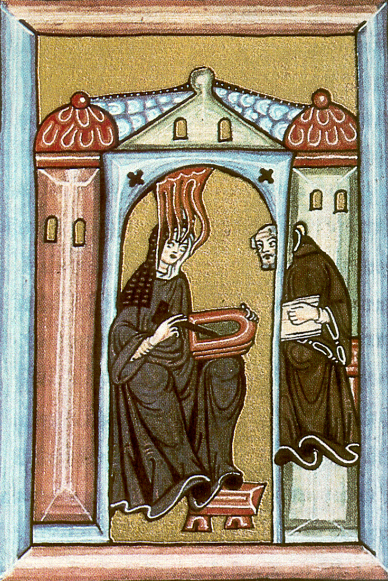 Well, I decided Thanksgiving week would be a good time to do a wrap-up review of early music - it certainly has created a new room in my mind & heart worth being thankful for. I am thankful for Palestrina, Machaut, the Franco-Flems, the British buds - they are all friends of mine now, in some capacity or other.
As a backdrop for a week of meditative reflection, I have chosen to kick it way back to the roots - to the early of the early birds. This includes gregorian & ambrosian chant, as well as the mystic Hildegard von Bingen.
Hildegard was a mystic from the 12th century - she claims to have received visions from God, as well as the command to "Write what you see." She wrote: three books of descriptions of her visions with interpretations, poetry, as well as musical compositions.
I was just listening to "Fire of Creation," from The Origin of Fire.
That's Hildegard in the blue doorway, with her scribe Volmar.
Um... I want a scribe named Volmar.
Sunday, November 19, 2006
I call and cry unto Thee
... is the name of the last song I am listening to by Thom Tallis. He and his licensed compatriot are being swept off the lens.
I don't know who I will choose next. I might break the bubble of the baroque tonight - step in from the strange & vast medieval landscape to the intricate interior of the Baroque.
Went on a walk tonight with Alan, my good fiction friend - he is not a fiction, I'm fairly certain, but he does write it. We walked through some of the wild Irvine brush just west of my apartment complex. There is a certain dip in the path where the air cools. Irvine, as she was meant to be, comes alive there. Sparrows dart from the bushes, white-tailed rabbits do the same, plunging back in moments later, and the wild scent of all the local herbs culminates into something like music.
I call and cry unto Thee, Being whose presence shines in this world you've made, whose voice mutters joyfully in the dry stick-bushes where the path dips.
I am a wild creature, tied to a lamp, tied to a bag of broken words. The sparrows don't accuse me - they don't notice. They assume I am an animal, like themselves, singing my song, walking along, eating seeds, maybe, they think, or meat - (all along the trail piles of coyote dung betray other wild eaters).
If we are full of the hot air of language disconnected from experience, then we must slowly exhale, paper bags puffed up and crushed, squeezed like bagpipes - to the point of being small and compact and ourselves. Wheeze with me awhile, and return to find that things have meaning. This is not existential moping - I pray it is not. This is not a task that many, most, have the pleasure of undertaking: To know oneself. To drag every last creature out of ones head & flesh and ask them "Who are you, little one, with a life inside of me?"
I am Animal. I am Lamp.
Unfortunately, this all has the flavor & tone of solipsism - to become wise, a man must walk through many doors, and the door of the self is one of them. At this point, he will not be sure if he is an egotistical ass or not - chances are, he is. We, most of us, are.
I draw my pictures. I write my words. I learn about music. I look for love. I strengthen my body. I whistle. Like a bird sometimes.
But after this, after a man walks through this door once - (I call and cry unto Thee with the hope of it God) - he can turn the lamp upon other things, other people. He can sweep the self from the center of his head's light, and fill it with other worthy creatures.
I don't know who I will choose next. I might break the bubble of the baroque tonight - step in from the strange & vast medieval landscape to the intricate interior of the Baroque.
Went on a walk tonight with Alan, my good fiction friend - he is not a fiction, I'm fairly certain, but he does write it. We walked through some of the wild Irvine brush just west of my apartment complex. There is a certain dip in the path where the air cools. Irvine, as she was meant to be, comes alive there. Sparrows dart from the bushes, white-tailed rabbits do the same, plunging back in moments later, and the wild scent of all the local herbs culminates into something like music.
I call and cry unto Thee, Being whose presence shines in this world you've made, whose voice mutters joyfully in the dry stick-bushes where the path dips.
I am a wild creature, tied to a lamp, tied to a bag of broken words. The sparrows don't accuse me - they don't notice. They assume I am an animal, like themselves, singing my song, walking along, eating seeds, maybe, they think, or meat - (all along the trail piles of coyote dung betray other wild eaters).
If we are full of the hot air of language disconnected from experience, then we must slowly exhale, paper bags puffed up and crushed, squeezed like bagpipes - to the point of being small and compact and ourselves. Wheeze with me awhile, and return to find that things have meaning. This is not existential moping - I pray it is not. This is not a task that many, most, have the pleasure of undertaking: To know oneself. To drag every last creature out of ones head & flesh and ask them "Who are you, little one, with a life inside of me?"
I am Animal. I am Lamp.
Unfortunately, this all has the flavor & tone of solipsism - to become wise, a man must walk through many doors, and the door of the self is one of them. At this point, he will not be sure if he is an egotistical ass or not - chances are, he is. We, most of us, are.
I draw my pictures. I write my words. I learn about music. I look for love. I strengthen my body. I whistle. Like a bird sometimes.
But after this, after a man walks through this door once - (I call and cry unto Thee with the hope of it God) - he can turn the lamp upon other things, other people. He can sweep the self from the center of his head's light, and fill it with other worthy creatures.
Thursday, November 16, 2006
To Be Perceived
...as such and such; To be regarded highly; To be known as someone who is different - as someone who has done something great; To do something great; To reach out to the world, great Philanthropist, and rescue many, heal wounds, lift the downtrodden of the world; To make sure that someone sees the thing you do for good in secret; To do a thing for good in secret and roll it under your tongue like a caramel; To distract yourself from the pain of not doing something great; To hide the fact that you have never acted because you have been afraid of the failure of not being perceived as having acted greatly; To know exactly what it means to do something great;
all these are chains that stop a man from doing - what? From living as himself. From doing the thing that is his thing to do. I am not entirely sure what this means.
But here is the world. Here I am, contraption of flesh & light. Here are others, near me. Push the whole damn dark world of fear aside - the fear of not being perceived by oneself or by the world as great - and suddenly you are very small, and very much yourself. Reach up and touch your nose. That is the sort of thing you can do.
And if there are things happening to you, things that you are choosing, that have the smell and texture of greatness, ingest them as the skin does oil - soak, and do not say a word, but keep doing things. Keep touching your nose. Keep combing the hair of the good thing. Listen to William Byrd's keyboard music. Smile and bend your knees and eat some food. It will break apart, back into the flesh & light it came from, and nourish you - a creature - an animal - a soul.
all these are chains that stop a man from doing - what? From living as himself. From doing the thing that is his thing to do. I am not entirely sure what this means.
But here is the world. Here I am, contraption of flesh & light. Here are others, near me. Push the whole damn dark world of fear aside - the fear of not being perceived by oneself or by the world as great - and suddenly you are very small, and very much yourself. Reach up and touch your nose. That is the sort of thing you can do.
And if there are things happening to you, things that you are choosing, that have the smell and texture of greatness, ingest them as the skin does oil - soak, and do not say a word, but keep doing things. Keep touching your nose. Keep combing the hair of the good thing. Listen to William Byrd's keyboard music. Smile and bend your knees and eat some food. It will break apart, back into the flesh & light it came from, and nourish you - a creature - an animal - a soul.
Tuesday, November 14, 2006
Spem in Alium
Not a beautiful phrase, (the first word being a near homonym to everyone's favorite meat-product), but, indeed, a beautiful song. Spem in Alium is a motet (a type of medieval musical composition) by Thomas Tallis, written for an 40-voice choir. The title translates as Hope in Another. I think.
Music is becoming the lense through which I see the world - or, to use a more apt metaphor, the ear, with curled and ornate lobe, through which I hear. If you say something to me, it's likely being filtered through the haunting sonic matrix of Spem in Alium, or Lamentations of Jeremiah - another piece by Tallis. Lamentations is a 2-set, nine part piece based on the Biblical book of Lamentations - it has also set camp in my cranium. Which is now covered in long hair. Which, as my sister tells me, looks like Mom's. I'd like to think I look like Dad back in his italian-soccer/beach-bum days (sorry Mom).
The lyrics (as you listen) (click the colored words above and wait - it's a big'n):
I have never put my hope in any other but in you
God of Israel
who will be angry
and yet become again gracious
and who forgives all the sins of suffering man
Lord God
Creator of Heaven and Earth
look upon our lowliness
Music is becoming the lense through which I see the world - or, to use a more apt metaphor, the ear, with curled and ornate lobe, through which I hear. If you say something to me, it's likely being filtered through the haunting sonic matrix of Spem in Alium, or Lamentations of Jeremiah - another piece by Tallis. Lamentations is a 2-set, nine part piece based on the Biblical book of Lamentations - it has also set camp in my cranium. Which is now covered in long hair. Which, as my sister tells me, looks like Mom's. I'd like to think I look like Dad back in his italian-soccer/beach-bum days (sorry Mom).
The lyrics (as you listen) (click the colored words above and wait - it's a big'n):
I have never put my hope in any other but in you
God of Israel
who will be angry
and yet become again gracious
and who forgives all the sins of suffering man
Lord God
Creator of Heaven and Earth
look upon our lowliness
Sunday, November 12, 2006
Byrd & Tallis
 William Byrd and Thomas Tallis were the first two composers in England with enough musical noteriety to earn themselves acknow- ledgement from the finicky hand of Music History. In fact, they were the only composers with a license to publish music in the 16th century in England. Yes, the whole century. They worked as a team at the Chapel Royal in London, and danced around waving their licenses when no one else was around. I would have. I bet the Chapel Royal has some big aisleways.
These two English blokes are the composers of the week, pushing the Franco-Flems out of the spotlight, though I have, as of yet, no idea what their music sounded like, nor how the mechanics of it worked. So here's hoping for the best [note: at this point, one would raise one's pint of Guinness awkwardly and nod]
Saturday, November 11, 2006
Drupelets and Splices
Today was an interesting day - mostly because I spent it with good people. First: eggnog pancakes & basic drum lessons with some old friends in Santa Ana, next: wild raspberry jam & lessons in comma splices with a friend here in Irvine, and last: Korean BBQ with my roommate Steve.
Theres a lot here, so I'll give you the basics. Keep the 8th note beats on the hi-hat, bass drum on 1, snare on 3; raspberries are not berries, but aggregate fruits, made of an aggregation of little fruit-droplets called drupelets; a comma splice is a common punctuation error made by 39B writing students wherein they use a comma to divide 2 independent clauses, which should only be divided by either a semi-colon or an em-dash; Korean BBQ involves a grill in the center of a table with various meats one applies to the grill, and then many little white dishes full of fermented cabbages and fish cakes and pickled onions.
My stomach is packed and my head is wriggling with new creatures.
Theres a lot here, so I'll give you the basics. Keep the 8th note beats on the hi-hat, bass drum on 1, snare on 3; raspberries are not berries, but aggregate fruits, made of an aggregation of little fruit-droplets called drupelets; a comma splice is a common punctuation error made by 39B writing students wherein they use a comma to divide 2 independent clauses, which should only be divided by either a semi-colon or an em-dash; Korean BBQ involves a grill in the center of a table with various meats one applies to the grill, and then many little white dishes full of fermented cabbages and fish cakes and pickled onions.
My stomach is packed and my head is wriggling with new creatures.
Friday, November 10, 2006
To a Little One
You are small right now. I have prayed
that you would grow. I have asked the Shepherd
to help you find your way into this field.
Your father is a tree, faithful,
firmly planted - your mother is a light;
full of bright laughter. Your brother
is a growing thing, green and more than a little
silly. I love him. Music never met us
except within a dream - but still it seems
not right to leave her out. Her?
I'm not sure why I call her her, since we never knew;
neither do we know who you, little one,
will be - will you join your brother in the underbrush,
or your mother in the spaces in between?
Well, either way you come is fine - but come,
little one, come now, let us see. If you please Dear
Shepherd, if you please.
that you would grow. I have asked the Shepherd
to help you find your way into this field.
Your father is a tree, faithful,
firmly planted - your mother is a light;
full of bright laughter. Your brother
is a growing thing, green and more than a little
silly. I love him. Music never met us
except within a dream - but still it seems
not right to leave her out. Her?
I'm not sure why I call her her, since we never knew;
neither do we know who you, little one,
will be - will you join your brother in the underbrush,
or your mother in the spaces in between?
Well, either way you come is fine - but come,
little one, come now, let us see. If you please Dear
Shepherd, if you please.
To Medieval Music
The old ones are mourning
for the new ones. Yes, long dead,
but they made their songs wise;
their music reaches forward into time
so that its beauty rings with sorrow
for us. This song, now wrapping
round my chest its arms
from somewhere miles and miles
ago, when men & women bent
their heads to older loves,
must feel the dark and growing
scar that’s hid beneath my shirt.
I hear, in the tremors of the wrists
pressed tight to me, a weeping.
for the new ones. Yes, long dead,
but they made their songs wise;
their music reaches forward into time
so that its beauty rings with sorrow
for us. This song, now wrapping
round my chest its arms
from somewhere miles and miles
ago, when men & women bent
their heads to older loves,
must feel the dark and growing
scar that’s hid beneath my shirt.
I hear, in the tremors of the wrists
pressed tight to me, a weeping.
Thursday, November 09, 2006
Figures of Speech
Yesterday in workshop words were getting thrown around that, yes, I have been acquainted to, but never really had any substantial relationship with. I know what they look and sound like, but don't know where they're from, how many brothers and sisters they have, if they're dating anyone.
IDIOM for instance. So... knowing it was a figure of speech, a figure within speech, i.e. not plain speech itself (when is speech ever plain?) - I looked it up on wiktionary.org.
An idiom is any group of words that can't be translated literally into another language and retain its meaning - E.g (the example they give) "kick the bucket". If I told my my italian cousin to "scosse la benna", even if I am saying it correctly, it won't mean "death" to her. It will mean "kick the bucket". Which is not the meaning of the phrase, though it is the literal meaning, that we think of when we say it. So, it is a group of words, usually an image, that is assigned an alterior meaning different than the literal meaning of the phrase.
The other major figures of speech they listed were SIMILE (My love, you are like a cananda goose, filling my heart with brillaint honking) and METAPHOR (My love, you are a canada goose, filling my heart with equally brilliant honking).
Oak Titmouse! click it
IDIOM for instance. So... knowing it was a figure of speech, a figure within speech, i.e. not plain speech itself (when is speech ever plain?) - I looked it up on wiktionary.org.
An idiom is any group of words that can't be translated literally into another language and retain its meaning - E.g (the example they give) "kick the bucket". If I told my my italian cousin to "scosse la benna", even if I am saying it correctly, it won't mean "death" to her. It will mean "kick the bucket". Which is not the meaning of the phrase, though it is the literal meaning, that we think of when we say it. So, it is a group of words, usually an image, that is assigned an alterior meaning different than the literal meaning of the phrase.
The other major figures of speech they listed were SIMILE (My love, you are like a cananda goose, filling my heart with brillaint honking) and METAPHOR (My love, you are a canada goose, filling my heart with equally brilliant honking).
Oak Titmouse! click it
Tuesday, November 07, 2006
Veni Redemptor
Here is a lovely old monophonic Ambrosian hymn, translated Come Redeemer.
click here to download and listen
click here to download and listen
Counterpoint & Elsewise
Counterpoint is a form of POLYPHONY. Are they the same thing? Well, as far as I can tell, yes, they are, but you know, in the all-asians-look-alike sort of way. What then are they? Polyphony is the layering of distinct melodies, that interweave and play off of each other, but remain their own separate creature. This below is the first line of the oldest recorded notation for a polyphonic composition, called Sumer is Icumen In. To translate this from the old english, read it aloud. Its in 6 parts traditionally, and this is a delightful version of it, that brings me great joy. Tidings of them. Listen to the way they counter & point at one another.
Click on the picture to download the song.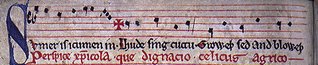
HOMOPHONIC music, as distinct from homophobic music, is different than polyphony in that it is carried by one strong melody. The separate musical parts, voices, harmonize with the lead meoldy, creating chordal sounds. Notice how the four parts of this old hymn are laid out, following one another, forming a four note chord with the four parts. Click on the picture below to listen to a homophonic hymn composed by Thomas Tallis, an early English composer.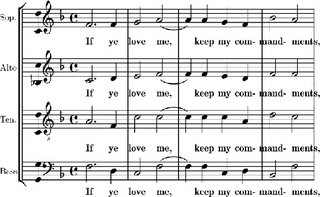
Lastly, we have MONOPHONY, from which both of the crazy chickens above hatched. It is the form of music that is composed of only one single melodic line, which all the singers sing together. Gregorian chant and other varities of single melody chant from early western culture are examples of this. Click here to listen an example of Gregorian Chant.
Click on the picture to download the song.
HOMOPHONIC music, as distinct from homophobic music, is different than polyphony in that it is carried by one strong melody. The separate musical parts, voices, harmonize with the lead meoldy, creating chordal sounds. Notice how the four parts of this old hymn are laid out, following one another, forming a four note chord with the four parts. Click on the picture below to listen to a homophonic hymn composed by Thomas Tallis, an early English composer.
Lastly, we have MONOPHONY, from which both of the crazy chickens above hatched. It is the form of music that is composed of only one single melodic line, which all the singers sing together. Gregorian chant and other varities of single melody chant from early western culture are examples of this. Click here to listen an example of Gregorian Chant.
Monday, November 06, 2006
The Franco-Flems
These guys keep coming out of the wood work - now I've come upon the MOST importantest of all the 15th century Franco-Flemish composers: Gilles Binchois. His fine melodies had an arguably greater influence, apparently, on composers of his time, and in centuries to come. I don't really know, so I choose to love them all equally.
Still listening to Ockeghem this morning. Ockeghem studied under Binchois, and took his place as most important Franco-Flem of the 15th century. Guillaume Dufay was writing at the same time as Binchois, and Josquin des Prez took up the tail-end of all four of them, pushing forward into the 16th century. J des Prez, as I like to call him, took what his Franco-Flemish ForeFathers had proffered to him, and wrought a style very near to perfection - so thought Gioseffo Zarlino, a musical theorist of the time. He may have studied counterpoint under Ockeghem. What is counterpoint? Tune in next time to find that out, and other secrets behind the technical wizardy of the Franco-Flemish composers.
The picture below is of Ockeghem (with the glasses) and his singers.
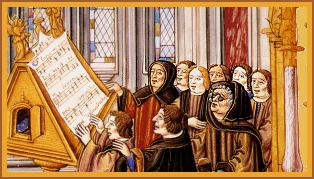
Still listening to Ockeghem this morning. Ockeghem studied under Binchois, and took his place as most important Franco-Flem of the 15th century. Guillaume Dufay was writing at the same time as Binchois, and Josquin des Prez took up the tail-end of all four of them, pushing forward into the 16th century. J des Prez, as I like to call him, took what his Franco-Flemish ForeFathers had proffered to him, and wrought a style very near to perfection - so thought Gioseffo Zarlino, a musical theorist of the time. He may have studied counterpoint under Ockeghem. What is counterpoint? Tune in next time to find that out, and other secrets behind the technical wizardy of the Franco-Flemish composers.
The picture below is of Ockeghem (with the glasses) and his singers.
Low Volume
And I mean, amount of weekly posts. Interestingly, we usually associate this phrase with sound intensity. It comes from the Latin word which signifies a series of pages of writing, in the Book Volume sense, and I suppose it made its way to Quantity after that - it does mean that though now as well: quantity, how much of something there is. I suppose that the Sound Volume evolved from the Quantity Volume, which evolved from the Book Volume, which did not evolve, but was created directly, because books are angelic beings.
I spent a weekend up in the woods up in the mountains with 12 other poets. We read poetry and ate hummus and sat on big rocks. It was good life. It didn't help the already pressing problem of weekly time management. Hence and thus, last week's low volume.
Speaking of low volume, we need to choose the weekly composer. Guillaume de Machaut must make way for another man who was writing in France, a hundred years later, in the 15th century: Johannes Ockeghem. He was a Franco-Flemish composer, and I think that since I have so little on his two Franco-Flemish neighbors, Guillaume Dufay before him, and Josquin des Prez after, I will talk about the three of them together. Yes, this is 15th century Franco-Flemish week. I'm listening to the Kyrie from Ockeghem's "Missa L'homme Arme" right now - definitely some polyphonic refinement on the music of Machuat. A little of that Franco-Flemish polish.
I spent a weekend up in the woods up in the mountains with 12 other poets. We read poetry and ate hummus and sat on big rocks. It was good life. It didn't help the already pressing problem of weekly time management. Hence and thus, last week's low volume.
Speaking of low volume, we need to choose the weekly composer. Guillaume de Machaut must make way for another man who was writing in France, a hundred years later, in the 15th century: Johannes Ockeghem. He was a Franco-Flemish composer, and I think that since I have so little on his two Franco-Flemish neighbors, Guillaume Dufay before him, and Josquin des Prez after, I will talk about the three of them together. Yes, this is 15th century Franco-Flemish week. I'm listening to the Kyrie from Ockeghem's "Missa L'homme Arme" right now - definitely some polyphonic refinement on the music of Machuat. A little of that Franco-Flemish polish.
Sunday, October 29, 2006
Le Voir Dit
Translated A True Tale, this collection of poems set to polyphonic music is considered Machaut's masterpiece. It is the tale of the author's sorrowful separation from his beloved. It is absolutely lovely. He has been considered the "last great poet who was also a composer."
While in Minnesota, Eric Alness, Ben Wright, Tim Beardshear and I, walked downtown in the crisp air and sunlight to a Dunn Brothers coffee shop, and a great used bookstore. Where I am going with this is right here: I found a book of Petrarch's sonnets - in the Italian, with translations. As some of you might know, as I didn't know before this week, his best sonnets were love sonnets written to a certain Laura.
So I have Dante and Beatrice, Petrarch and Laura, and now Machaut and his lost love, all milling melancholy in my mind.
I went on a run in Minneapolis - down into the heart of the city, back to a cathedral we had seen - a lutheran church. A woman was at the enormous organ practicing. I sat in the cruciform building, under the stainglass light, and listened in shorts and a white bandana. This has almost nothing to do with Le Voir Dit, except that it is a true story, and was full of music in many ways. Joy always surprises us when we least expect it.
While in Minnesota, Eric Alness, Ben Wright, Tim Beardshear and I, walked downtown in the crisp air and sunlight to a Dunn Brothers coffee shop, and a great used bookstore. Where I am going with this is right here: I found a book of Petrarch's sonnets - in the Italian, with translations. As some of you might know, as I didn't know before this week, his best sonnets were love sonnets written to a certain Laura.
So I have Dante and Beatrice, Petrarch and Laura, and now Machaut and his lost love, all milling melancholy in my mind.
I went on a run in Minneapolis - down into the heart of the city, back to a cathedral we had seen - a lutheran church. A woman was at the enormous organ practicing. I sat in the cruciform building, under the stainglass light, and listened in shorts and a white bandana. This has almost nothing to do with Le Voir Dit, except that it is a true story, and was full of music in many ways. Joy always surprises us when we least expect it.
Guillaume De Machaut
After a 3 day visit to Minneapolis Minnesota, and its neighboring towns and cities, I have returned to my little black laptop computer, my potted plant, and some Bailey's on ice. Palestrina's week in the limelight has passed, and now I find myself listening to the spare, and very different, Messa de Nostre Dame by Guillaume de Machaut. He was composing in France in the 14th century, and was apparently the most prominent figure of the French Ars Nova - a musical movement in France that consisted essentially of 14th century music and its innovations. It sounds quite different than Palestrina's Misse. I can't quite describe it - it's clear that Machaut's music was much earlier. It is polyphony in its youth - healthy and strong, but simple. The picture below, an early illustration for a manuscript of his music, depicts Nature giving a gift to Machaut: her three children, Sense, Rhetoric, and Music.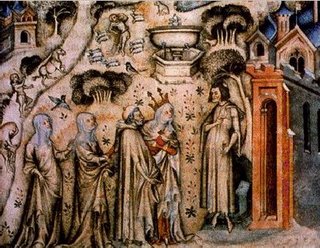
(No such bird) VII
It wasn’t a conspiracy.
Hers had been the shop
he’d come upon in his urgency
to know, and she had known.
When the third syllable had
dropped he had waited for another
word, but none had come.
He shifted, hesitated,
wanting her to catch herself,
to take it back, wait, you know,
there is one just like that,
yes, let me think,
it’s called…
The animals had crunched their seeds
audibly, and stared.
The parrot turned away –
looked out the window.
Hers had been the shop
he’d come upon in his urgency
to know, and she had known.
When the third syllable had
dropped he had waited for another
word, but none had come.
He shifted, hesitated,
wanting her to catch herself,
to take it back, wait, you know,
there is one just like that,
yes, let me think,
it’s called…
The animals had crunched their seeds
audibly, and stared.
The parrot turned away –
looked out the window.
Thursday, October 26, 2006
(No such bird) VI
He stood in the center of the city street.
Manned cars mashed their horns in angry loops around him,
but he did not pull in his feet – he did not blink.
Sunlight angled down, clear and bright, between
the glass and steel - a solvent, and the air grew
thin enough for hurried forms to cut right through it.
Round and round him, without effort - there was
no conscious struggle. Some sentiment,
yes, between apathy and wrath,
but the city flashed around him easily.
Nothing escaped his notice.
The light went through his hair and skull.
He knew better now: this was not confusion.
It was the quiet aftermath
of a detached hope – variation in the repetition,
but always some form of the same answer.
The bells of the shop were still jingling.
The trees in the park moved only for the wind.
Manned cars mashed their horns in angry loops around him,
but he did not pull in his feet – he did not blink.
Sunlight angled down, clear and bright, between
the glass and steel - a solvent, and the air grew
thin enough for hurried forms to cut right through it.
Round and round him, without effort - there was
no conscious struggle. Some sentiment,
yes, between apathy and wrath,
but the city flashed around him easily.
Nothing escaped his notice.
The light went through his hair and skull.
He knew better now: this was not confusion.
It was the quiet aftermath
of a detached hope – variation in the repetition,
but always some form of the same answer.
The bells of the shop were still jingling.
The trees in the park moved only for the wind.
(No such bird) V
The branches domed above his head.
Lifted up, the leaves
would press against the light
and translate through their porous flesh
the story of heaven.
In the still air,
on the soft floor,
he would turn and read the prophecy
written in that brilliant green,
looking for the figured one
that would come: Postured
centerward, a heralding of red
amidst the native green.
A scribe, he waited with his pencil ready.
Lifted up, the leaves
would press against the light
and translate through their porous flesh
the story of heaven.
In the still air,
on the soft floor,
he would turn and read the prophecy
written in that brilliant green,
looking for the figured one
that would come: Postured
centerward, a heralding of red
amidst the native green.
A scribe, he waited with his pencil ready.
Monday, October 23, 2006
(No such bird) IV
“It’s time to grow up,”
he lipped with observation’s
overaction. He lifted a hand
to the mirror and crunched it
tight. “To be a man one must
kill everything he loves.”
It made him glad to say it.
Meanwhile, she flipped precisely
through blunt-cornered, hardbound books,
looking for a name. Funny, the feelings one has
despite being sure.
he lipped with observation’s
overaction. He lifted a hand
to the mirror and crunched it
tight. “To be a man one must
kill everything he loves.”
It made him glad to say it.
Meanwhile, she flipped precisely
through blunt-cornered, hardbound books,
looking for a name. Funny, the feelings one has
despite being sure.
Sunday, October 22, 2006
Giovanni da Palestrina
Palestrina is a small town 23 miles east of Rome; ancient stone resting on a hilltop. Giovani Pierluigi was born in Palestrina during the 16th century - took it as part of his name - "da" meaning "from". First Question: why don't we do that anymore?
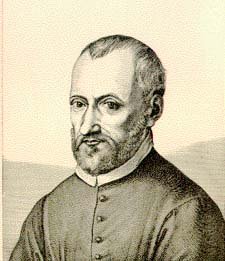 Palestrina was a medieval composer, pre-baroque, composing mainly polyphonic (intertwining harmonious melodies) religious chant. Most of his famous works are Masses, which traditionally consist of five parts: Kyrie, Gloria, Credo, Sanctus, Benedictus, and Agnus Dei. You should be able to figure those out.
He has taken the place of Mozart as composer of the week. Sit down Mozart, were playing it old school now.
Apparently he composed Mass in and for St. Peter's for a large portion of his life, achieving great renown. Also, pertaining to his reputation, Bach's masterpiece Mass in B minor was inspired by Palestrina's Missa sine nomine.
My apartment bedroom sounds like a monastery.
I don't have a second question. Click on Palestrina's vague medieval smile to hear one of his compositions.
 Palestrina was a medieval composer, pre-baroque, composing mainly polyphonic (intertwining harmonious melodies) religious chant. Most of his famous works are Masses, which traditionally consist of five parts: Kyrie, Gloria, Credo, Sanctus, Benedictus, and Agnus Dei. You should be able to figure those out.
He has taken the place of Mozart as composer of the week. Sit down Mozart, were playing it old school now.
Apparently he composed Mass in and for St. Peter's for a large portion of his life, achieving great renown. Also, pertaining to his reputation, Bach's masterpiece Mass in B minor was inspired by Palestrina's Missa sine nomine.
My apartment bedroom sounds like a monastery.
I don't have a second question. Click on Palestrina's vague medieval smile to hear one of his compositions.
Saturday, October 21, 2006
Intransitive Verbs and Mozart
Have you ever been a victim of unrequited love? - that insatiable longing, that sucking inconsolable desire, all heart and all mind aimed toward one specific being. It's like being half mad, where everything in all of life ends up bending back towards that one person, like a glaring red arrow, a grasping hand.
This (oh soul, take heed) is different than an intransitive verb. I was grading student summaries of Stanley Milgram's "Perils of Obedience" essay, when I came across the word "inquired" used without being followed by a preposition or a prepositional phrase, and it didnt seem right. I think it might be an INTRANSITIVE (!) verb. Someone correct the government paid english professor if he is wrong. He wants to know.
Regardless, an intransitive verb takes no object. For example, you couldn't say: Justin sleeps bed. "Sleep" is an intransitive verb; it has a subject performing its action, but does not have an object upon which it is performed.
Which, of course, brings us to Mozart. It is the last day of Mozart Week, and boy howdy, it has been a good week. But Mozarts music has not taken me as a direct object - in fact, it takes no object at all. Music, in general, does not take an object - has no end it is trying to effect through its action. Or something. I swear it ties together in my head.
And somehow a bleary-eyed heart calms a little, with the music of verbs and violins pointing skyward, shooting brilliantly just for the sake of lovely sound.
This (oh soul, take heed) is different than an intransitive verb. I was grading student summaries of Stanley Milgram's "Perils of Obedience" essay, when I came across the word "inquired" used without being followed by a preposition or a prepositional phrase, and it didnt seem right. I think it might be an INTRANSITIVE (!) verb. Someone correct the government paid english professor if he is wrong. He wants to know.
Regardless, an intransitive verb takes no object. For example, you couldn't say: Justin sleeps bed. "Sleep" is an intransitive verb; it has a subject performing its action, but does not have an object upon which it is performed.
Which, of course, brings us to Mozart. It is the last day of Mozart Week, and boy howdy, it has been a good week. But Mozarts music has not taken me as a direct object - in fact, it takes no object at all. Music, in general, does not take an object - has no end it is trying to effect through its action. Or something. I swear it ties together in my head.
And somehow a bleary-eyed heart calms a little, with the music of verbs and violins pointing skyward, shooting brilliantly just for the sake of lovely sound.
Friday, October 20, 2006
Purple Finch
I have never seen one of these, but it is lovely, no? Apparently, they are a local species; another Californian I haven't met. I was trying to find a green-bellied bird I saw yesterday, but this wine-drenched gent will have to suffice for now. He suffices well.
(Click on our local purple frie nd to hear his song.)
(Click on our local purple frie
 nd to hear his song.)
Wednesday, October 18, 2006
(No such bird) III
This often happened. His pen
rendered the paper still
beneath it's thought thing:
a bird, in flight. Each sounding
stone pulled across the page made
the repetition of the extended wing,
and it's curve, a reality. He
was careful. He was in earnest.
And as often, one
would blink into existence
over his shoulder - no bird, but
a known face, speaking words
in a manner of speaking, chiding,
"What, this again? My God
friend, it's time to grow up."
rendered the paper still
beneath it's thought thing:
a bird, in flight. Each sounding
stone pulled across the page made
the repetition of the extended wing,
and it's curve, a reality. He
was careful. He was in earnest.
And as often, one
would blink into existence
over his shoulder - no bird, but
a known face, speaking words
in a manner of speaking, chiding,
"What, this again? My God
friend, it's time to grow up."
Tuesday, October 17, 2006
Lark Sparrow
This is a good picture for the local Lark Sparrow: he is seated on a native So Cal plant. I saw these birds in downtown Los Angeles often, when I spent my time there. Out here in the desert, where things are certainly different, (more smells, wild and herbal), this little sparrow seems very much at home.
(Click on his russet stripes to hear him sing. )

(Click on his russet stripes to hear him sing. )

Monday, October 16, 2006
Wolfgand Amadeus Mozart
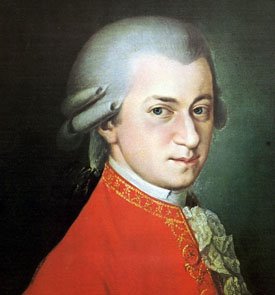 I've decided to learn a bit of music history while I am here at UC Irvine. This isn't a new decision - I originally began wanting to try during undergrad - but never had the chance to follow through. Meaning: didn't. But now....!
So, out of the names milling around in my head tagged with the label "Classical Composer", I chose Mozart first.
He was a composer of the Classical era, which is a name given to the distinctive era in music history generally recognized as beginning in the early 1700's and ending in the early 1800's. It seems that this era in music corresponded nicely to the developments in philosophy at the time. It was the Age of the Enlightenment, the Age of Reason, in Europe, and philosphers were looking for clean logic-driven explanations of the world - new refined simplicity, order, science.
Mozart wrote lovely concerti, which were arrangements with the orchestra that highlighted one instrument, exploiting its individual characteristics and capabilities. I've been listening to the Violin Concerti numbers 3 and 5. Click on Mozart to hear the Adagio movement of Concerto #3.
Saturday, October 14, 2006
(No such bird) II
They leaned in together, and
together clapped their hands
and he waited. They swung
their heads like strung balls,
prolonged pause on each outer edge,
and through this he waited.
He asked again, the same as he had
the first time: "Any such?"
and they launched back into it, balled
yolks rolling back and forth, together.
together clapped their hands
and he waited. They swung
their heads like strung balls,
prolonged pause on each outer edge,
and through this he waited.
He asked again, the same as he had
the first time: "Any such?"
and they launched back into it, balled
yolks rolling back and forth, together.
No such bird
A smudge of light, hole
in the leaf layers 50 feet away,
moved across the glass pane
as he pushed open the door.
Bells accompanied his coming
and the lady, bent over
at a mouse cage but alert,
leaned up and straightened
her shirt and smiled at him.
"Hello" she said, mouth pinched
into an arc.
"Hello" he replied, and shifted
his eyes around the busy room.
The smell he liked and so passed over
for the sound of crickets burrowing
into the sawdust.
Mice broke kernels apart.
Something licked its chops. A parrot
squawked obnoxiously, inches from his ear,
and he drew back, hesitated, then said "Do you have
a small-boned bird, chestnut-red,
with a bright golden beak?"
She paused long enough for the light
reflected from a passing car outside the glass to move
across her face.
"There is no such bird."
in the leaf layers 50 feet away,
moved across the glass pane
as he pushed open the door.
Bells accompanied his coming
and the lady, bent over
at a mouse cage but alert,
leaned up and straightened
her shirt and smiled at him.
"Hello" she said, mouth pinched
into an arc.
"Hello" he replied, and shifted
his eyes around the busy room.
The smell he liked and so passed over
for the sound of crickets burrowing
into the sawdust.
Mice broke kernels apart.
Something licked its chops. A parrot
squawked obnoxiously, inches from his ear,
and he drew back, hesitated, then said "Do you have
a small-boned bird, chestnut-red,
with a bright golden beak?"
She paused long enough for the light
reflected from a passing car outside the glass to move
across her face.
"There is no such bird."
Friday, October 13, 2006
The People, Yes
This is an audio clip of Carl Sandburg reading an excerpt from his masterpiece, The People, Yes. (103 poems long).
Click on his photo to hear him reading.

Click on his photo to hear him reading.

Black Phoebe
I see these little gentlemen in my field. They perch on the chain-link fence that surrounds a garden on the northern end of the field.
(Click on the picture to hear his song.)

(Click on the picture to hear his song.)


Thursday, October 12, 2006
More Blog Changes
So, I'm trying to figure out how to make all of this work for all browsers. Apparently my banner wasn't showing on any browers other than Internet Explorer, which is a little pathetic. I am embarrased. Not that it looks much better now, but at least it looks like I intend it to look.
Ah, so, in order to refresh ourselves after that little bit of madness, lets consider the Swainson's Thrush. Click on the picture to here his song.

Ah, so, in order to refresh ourselves after that little bit of madness, lets consider the Swainson's Thrush. Click on the picture to here his song.

Thursday, October 05, 2006
Another Sighting
I was walking through my field, attention turned inward to thoughts, syphoning then upward into the sky (it was a lovely day today), only vaguely aware of the crunch of cut wild grass stalks and the stirring of peripheral plantlife, when a commanding squawk exploded on my right. I turned, and there behind a chain-link fence a Roadrunner was proudly waiting for me to be aware of his presence.
He stayed motionless for a moment, pointed like a weapon. I found respect for him. His crest was smaller than his cartoon counterpart's, his body mostly mottled-brown, and his legs very much bird-legs, but thicker, stronger looking - somewhere between a chicken's fat taloned limbs and a songbird's delicate twig-legs.
He began to move - it was very quick, but all seemed graceful and purposeful. His movement was not reckless. Up and over the fence in a flash, then down onto the dust and mown grass floor, he started performing the famous run from which he earned half his name. It was entrancing. It was not wild; not two churning propellors whirring madly at his sides. It was like a slow-motion dance, that somehow happened to burn across the landscape. I see where they got the stopping-on-a-dime thing, and the sudden-cloud-of-smoke departure. Wile E., you have a worthy adversary.
He stayed motionless for a moment, pointed like a weapon. I found respect for him. His crest was smaller than his cartoon counterpart's, his body mostly mottled-brown, and his legs very much bird-legs, but thicker, stronger looking - somewhere between a chicken's fat taloned limbs and a songbird's delicate twig-legs.
He began to move - it was very quick, but all seemed graceful and purposeful. His movement was not reckless. Up and over the fence in a flash, then down onto the dust and mown grass floor, he started performing the famous run from which he earned half his name. It was entrancing. It was not wild; not two churning propellors whirring madly at his sides. It was like a slow-motion dance, that somehow happened to burn across the landscape. I see where they got the stopping-on-a-dime thing, and the sudden-cloud-of-smoke departure. Wile E., you have a worthy adversary.
Sunday, September 24, 2006
Cafe Rant
Yes, Gather ye Suburbanites
round cafe' tables smartly
with your perfect cups of coffee
which ye, in all your wisdom,
shall toss into the heap
that is growing and becoming
and will soon wake from it's sleep.
round cafe' tables smartly
with your perfect cups of coffee
which ye, in all your wisdom,
shall toss into the heap
that is growing and becoming
and will soon wake from it's sleep.
Wednesday, September 20, 2006
Creatures
So, I was on the path that leads me through various fields, frat house mazes, and parking lots, to the heart of campus, to the grassy ring called Aldrich Park, to the Humanities building, where I will spend a great deal of time in the next few years; and I happened to be looking for a red flower I'd seen the day before, and intended to pick today; and suddenly I saw creature movement out the corner of my eye (top left corner). Before I continue, let me say that I love creature movement - that blurred black or brown swoosh as you round a corner, or pass beneath a branch. That crack and rustle in the tall grass.
These stayed for a moment, to my great pleasure. Two long-legged, ten inch tall birds, with blue-marked cheeks, mottled brown bodies, and little fan-crests on the tops of their heads. Male and female. Yes, they were Roadrunners.
How cool is that?! The creatures live here too. Rabbits and crickets and roadrunners and yellow warblers and lizards - even here in Irvine, my friends, the creatures live.
These stayed for a moment, to my great pleasure. Two long-legged, ten inch tall birds, with blue-marked cheeks, mottled brown bodies, and little fan-crests on the tops of their heads. Male and female. Yes, they were Roadrunners.
How cool is that?! The creatures live here too. Rabbits and crickets and roadrunners and yellow warblers and lizards - even here in Irvine, my friends, the creatures live.
Wednesday, September 13, 2006
A Lesson taught to the Self
Soul, be awake. Break away
from pedantic landscape - stop
trying to say something soul.
You don't have a single particle
caught in your clasp
other than words.
Open your hand! Let the words
blow and scatter away.
From what inspired fountain
do they arise? Ah, yes,
the deep mind, the deep well
beneath the meticulous streets
that we know so well, that we
walk daily, leashed in necktie
language. Arise, deep words:
I will let you go. I will let you pluck
away from my pimpled hide,
I will let the wind gain force
and carry you high above
my pathetic reach. This is
of course a battle against the
Gods of Egypt, who sway on milky
coils, who say, "The Nile is mine.
I have made it for myself."
It is a battle against the philosopher
in me. Oh, don't worry,
he will melt in the levity of
unchained, unleashed words
barking gleefully down the street, yes,
like a pack of rubber-jowled bulldogs,
howling with rabid joy.
from pedantic landscape - stop
trying to say something soul.
You don't have a single particle
caught in your clasp
other than words.
Open your hand! Let the words
blow and scatter away.
From what inspired fountain
do they arise? Ah, yes,
the deep mind, the deep well
beneath the meticulous streets
that we know so well, that we
walk daily, leashed in necktie
language. Arise, deep words:
I will let you go. I will let you pluck
away from my pimpled hide,
I will let the wind gain force
and carry you high above
my pathetic reach. This is
of course a battle against the
Gods of Egypt, who sway on milky
coils, who say, "The Nile is mine.
I have made it for myself."
It is a battle against the philosopher
in me. Oh, don't worry,
he will melt in the levity of
unchained, unleashed words
barking gleefully down the street, yes,
like a pack of rubber-jowled bulldogs,
howling with rabid joy.
Friday, September 08, 2006
No Need To Rage
In the last days you will grow tired
and your eyes will close mid-day -
having had tasks removed
from your fumbling grip, you gasped
deep existential breaths, and then
gave up. Let go. Found a quiet table
on the patio. It's okay - whether you
have hope beyond this flesh or don't,
there's no need to rage, rage. All of it
will end in the same moment anyway:
soft stares into nowhere sky, and
wrinkled eyelids that slowly sigh, and close.
and your eyes will close mid-day -
having had tasks removed
from your fumbling grip, you gasped
deep existential breaths, and then
gave up. Let go. Found a quiet table
on the patio. It's okay - whether you
have hope beyond this flesh or don't,
there's no need to rage, rage. All of it
will end in the same moment anyway:
soft stares into nowhere sky, and
wrinkled eyelids that slowly sigh, and close.
Bluegrass
Go on, old men,
playing around with wooden boxes
strung tight across with cat gut.
Dodge in and out of
cherry-lacquered fence-posts;
ramble and sing late into evening -
the coda will wrap you back eventually.
But now, crow on, gentlemen; tonight
a certain heart could use
a bit of bluegrass light.
Can you sense the limpness of my limbs?
Pry back these cedar slats,
and show me into what dark basement
my heart has slipped, like a cold and fleshy coin.
Do you see it Charlie? Shine
your violin right there.
playing around with wooden boxes
strung tight across with cat gut.
Dodge in and out of
cherry-lacquered fence-posts;
ramble and sing late into evening -
the coda will wrap you back eventually.
But now, crow on, gentlemen; tonight
a certain heart could use
a bit of bluegrass light.
Can you sense the limpness of my limbs?
Pry back these cedar slats,
and show me into what dark basement
my heart has slipped, like a cold and fleshy coin.
Do you see it Charlie? Shine
your violin right there.
Thursday, September 07, 2006
Let Go You Soul
Let go, soul; you who would
have control over every situation.
Lose your pinch on the loose ends, here
in the spotlights red wash over
felt hats and dog-wag wrists;
where no one can keep his own mind
straight from the others.
Tumble along to the rag-tag beat; Let it creep,
tip-tap toe-shoe, up your widening
bloodstream; let it gleam in
that usually uninhabited left
corner of your eye. Don't
cross out lines as you tend to do,
hoping to keep them sober and sane;
dont try and keep them out
of the sugar cane. These lines are sheep
that you don't own. Scratch their hides
& feed them fat & let them
find their own way home.
have control over every situation.
Lose your pinch on the loose ends, here
in the spotlights red wash over
felt hats and dog-wag wrists;
where no one can keep his own mind
straight from the others.
Tumble along to the rag-tag beat; Let it creep,
tip-tap toe-shoe, up your widening
bloodstream; let it gleam in
that usually uninhabited left
corner of your eye. Don't
cross out lines as you tend to do,
hoping to keep them sober and sane;
dont try and keep them out
of the sugar cane. These lines are sheep
that you don't own. Scratch their hides
& feed them fat & let them
find their own way home.
Wednesday, September 06, 2006
Things to Think
by Robert Bly
Think in ways you've never thought before
If the phone rings, think of it as carrying a message
Larger than anything you've ever heard,
Vaster than a hundred lines of Yeats.
Think that someone may bring a bear to your door,
Maybe wonded and deranged; or think that a moose
Has risen out the lake, and he's carrying on his antlers
A child of your own whom you've never seen.
When someone knocks on the door, think that he's about
To give you something large: to tell you you're forgiven,
Or that it's not necessary to work all the time, or that it's
Been decided that if you lie down no one will die.
Think in ways you've never thought before
If the phone rings, think of it as carrying a message
Larger than anything you've ever heard,
Vaster than a hundred lines of Yeats.
Think that someone may bring a bear to your door,
Maybe wonded and deranged; or think that a moose
Has risen out the lake, and he's carrying on his antlers
A child of your own whom you've never seen.
When someone knocks on the door, think that he's about
To give you something large: to tell you you're forgiven,
Or that it's not necessary to work all the time, or that it's
Been decided that if you lie down no one will die.
Monday, August 21, 2006
Queen: an opening mouth
More than what you are Los Angeles;
you, like every small god, are
a brilliant metaphor, clammed
and cool. You take your place in line.
You herald your own coming.
You chomp your stainless jaws robotically,
waiting for the ventriloquist.
But I will not be this, for you.
Oh queen, oh giant thing on whom
my mind has found its parasitic life,
quit blubbering like a thin-boned
hollywood broad, and climb the thin stroke
of my body; I have cleared a place for
you. I had myself beheaded, for you,
sweet Lady Blue, vulgur with voided eyes,
delicate vulture, whose fingers stretch, red and white,
down the freeways every night.
A pestilent creature has opened
its groin with your name, but
I will steal it away. I have taken up
the habit of dragging the desert
in my teeth.
I desire your beauty, Los Angeles.
you, like every small god, are
a brilliant metaphor, clammed
and cool. You take your place in line.
You herald your own coming.
You chomp your stainless jaws robotically,
waiting for the ventriloquist.
But I will not be this, for you.
Oh queen, oh giant thing on whom
my mind has found its parasitic life,
quit blubbering like a thin-boned
hollywood broad, and climb the thin stroke
of my body; I have cleared a place for
you. I had myself beheaded, for you,
sweet Lady Blue, vulgur with voided eyes,
delicate vulture, whose fingers stretch, red and white,
down the freeways every night.
A pestilent creature has opened
its groin with your name, but
I will steal it away. I have taken up
the habit of dragging the desert
in my teeth.
I desire your beauty, Los Angeles.
Tuesday, August 15, 2006
Melodrama of the Moon
Sometimes the night is overlong; we wait
with eyes upon the moon's slow course across
the stretching sky. It barely seems to move -
it snags on every star it meets, lingering,
nosing every red or blue-smeared galaxy.
A snail, gigantic; sphere of spiraled-bone,
leaving in its milky-wake a sparkling veil,
tattered by the periodic hail of shooting stars.
Without fail, it will reach the other side
of the night sky's vast expanse, we know,
but in the quiet vacuum of a single moment
it seems to be frozen into place - the face
of Lot's wife, surprised, and caught mid-stride.
Luckily, the crickets and the barnowl
regale us with their songs, curing our impatience,
adding music to the melodrama of the moon.
with eyes upon the moon's slow course across
the stretching sky. It barely seems to move -
it snags on every star it meets, lingering,
nosing every red or blue-smeared galaxy.
A snail, gigantic; sphere of spiraled-bone,
leaving in its milky-wake a sparkling veil,
tattered by the periodic hail of shooting stars.
Without fail, it will reach the other side
of the night sky's vast expanse, we know,
but in the quiet vacuum of a single moment
it seems to be frozen into place - the face
of Lot's wife, surprised, and caught mid-stride.
Luckily, the crickets and the barnowl
regale us with their songs, curing our impatience,
adding music to the melodrama of the moon.
Friday, July 28, 2006
Taming Your Journals
It's okay to lift your pen away
from the flat white paper-face of
what-have-you. Probably
an emotionally needy diary
of some sort. Like wide-mouthed
hatchlings whining for a morsel,
they beg, and we, like sway-backed slaves
consent to labor, hefting heavy words in.
But its okay to let them go hungry.
Okay even to let them starve,
for a time, till their ribs show through
their dustjackets. Wait, I say, past
their desperate grimaces, past
even their final gasps. They will
inflate finally, in the fashion of the movies,
exhale dramatically and falter back,
keeping one eye always on you,
watching to see if you are watching.
Do not watch. Wait, and when
your empty notebooks, now
with tight stomachs and sharp jaw lines,
stand and dust their hands on their pants
and say "Fine then!" - then pounce,
and pin them down, whip out your pen,
tatoo them all over once again.
from the flat white paper-face of
what-have-you. Probably
an emotionally needy diary
of some sort. Like wide-mouthed
hatchlings whining for a morsel,
they beg, and we, like sway-backed slaves
consent to labor, hefting heavy words in.
But its okay to let them go hungry.
Okay even to let them starve,
for a time, till their ribs show through
their dustjackets. Wait, I say, past
their desperate grimaces, past
even their final gasps. They will
inflate finally, in the fashion of the movies,
exhale dramatically and falter back,
keeping one eye always on you,
watching to see if you are watching.
Do not watch. Wait, and when
your empty notebooks, now
with tight stomachs and sharp jaw lines,
stand and dust their hands on their pants
and say "Fine then!" - then pounce,
and pin them down, whip out your pen,
tatoo them all over once again.
Friday, July 21, 2006
Barn Swallow Sonnet
The swallows dipped into the shallow pond
and scooped 1/2 teaspoon gulps of glossy blue
but didn't swallow. Instead, they ricocheted
back to the sky like feathered balls bounced off
a marble floor. Physics grinned, and as a prize
he pulled the droplets down each throated sluice
to tiny red translucent sacs. Yes, Light
passed through all parts of these iridescent
blue chips of wind-flint flung through summer air -
broken strips of stain glass window spun like discs
above the heads of wheat, lensing rainbows,
diamond-shaped, smooth. Even that tiny ball
of hydrogen glowed inside each swallow core
with a fierce and smoky sapphire light.
and scooped 1/2 teaspoon gulps of glossy blue
but didn't swallow. Instead, they ricocheted
back to the sky like feathered balls bounced off
a marble floor. Physics grinned, and as a prize
he pulled the droplets down each throated sluice
to tiny red translucent sacs. Yes, Light
passed through all parts of these iridescent
blue chips of wind-flint flung through summer air -
broken strips of stain glass window spun like discs
above the heads of wheat, lensing rainbows,
diamond-shaped, smooth. Even that tiny ball
of hydrogen glowed inside each swallow core
with a fierce and smoky sapphire light.
Coal
All men live in dim mines of coal.
The sun pulls in elastic strands
through cracks in the cavern walls
and men mostly dance about
in the dark, frantically heaping,
hoping to amount to something.
I am one of the misinformed breed
who sit in thin sun-shafts, pressing
one black lump between patient hands.
"As much a fool as Noah," the say.
"No, wait, watch," we reply
and we press, and hold, and wait.
The sun pulls in elastic strands
through cracks in the cavern walls
and men mostly dance about
in the dark, frantically heaping,
hoping to amount to something.
I am one of the misinformed breed
who sit in thin sun-shafts, pressing
one black lump between patient hands.
"As much a fool as Noah," the say.
"No, wait, watch," we reply
and we press, and hold, and wait.
Monday, July 17, 2006
Artist Temperment
All of my injuries come within an hour of commencing some new dangerous undertaking. Often less than an hour. There was kitchen duty at camp, and quad errands with my brother. Today it was table-sawing hard wood floor panels. Never done anything like that before - it was new and interesting. So was the 2 inch rota-gash I tore in the pad of my thumb.
I suppose being a poet, full of that tremulous artist temperment, I am prone to feelings of anxiety concerning my capacity to engage this world in a normal fashion.
Cutting my thumb, losing a days work, and general worry over money and relationships, makes me realize that I havent had any sort of plan of attack, you know, method, to my approach to societal success. I have floundered, as I once said, like a fish in a barrel of light. Even that metaphor is a sort of floundering - images splattered over a problem.
Ingenuity and dedication to a single problem is needed for success.
I don't know why I am writing these words.
We all want to air out our souls every once in awhile. This hasn't always been my goal in writing. My goal before, at times, was much more modern - you know, articulate some important truth to the masses.
I guess I am still aiming towards that. But tonight, through a feeling of anxiety, I am standing naked again in the field of the world, without any weapons, without any signs telling me where I might at least find some clothing. Feelings of security really change ones attitude toward ones place in the world. I remember times when I felt successful and secure, and it is so much easier to be confident about metaphysical ideas. Belief affected by mood, as it has been said.
I don't care for success in this world. I just want to feel secure - no, to know I am secure. I don't think I can feel it unless I know it - at least I hope I can't. And if faith can truly give that to me, despite how poor I am and what parts of my body I am currently tearing up, then I will cling to the gospel of the incarnate God, in Jesus Christ - I know we are spinning in the worlds bright darkness. I know that we all want this security. We all remember from our youth that we are going to die. We never forget it. We all know deep in are unspoken thoughts that at some point we are going to rota-drill a little too much flesh, and it will spell our end. Success is a pleasureable slap on the seat of your pants, and it leaves marks in the history books, yes, but we are going to die and be forgotten.
Life enternal. Been reading the psalms and in ecclesiates, and they treat death as an end. As if they will exist only nominally; no thought or consciousness. No sentience. Sinking down into sheol, where apparently everything is taken from a man. I realized when cutting my finger how okay with death I am - that is, when my heart is safe on the rock of the gospel.
I can't, obviously, continue in this constant rehashing of the problem. Lord have mercy on those whom you are calling to be men and women after your own heart.
I suppose being a poet, full of that tremulous artist temperment, I am prone to feelings of anxiety concerning my capacity to engage this world in a normal fashion.
Cutting my thumb, losing a days work, and general worry over money and relationships, makes me realize that I havent had any sort of plan of attack, you know, method, to my approach to societal success. I have floundered, as I once said, like a fish in a barrel of light. Even that metaphor is a sort of floundering - images splattered over a problem.
Ingenuity and dedication to a single problem is needed for success.
I don't know why I am writing these words.
We all want to air out our souls every once in awhile. This hasn't always been my goal in writing. My goal before, at times, was much more modern - you know, articulate some important truth to the masses.
I guess I am still aiming towards that. But tonight, through a feeling of anxiety, I am standing naked again in the field of the world, without any weapons, without any signs telling me where I might at least find some clothing. Feelings of security really change ones attitude toward ones place in the world. I remember times when I felt successful and secure, and it is so much easier to be confident about metaphysical ideas. Belief affected by mood, as it has been said.
I don't care for success in this world. I just want to feel secure - no, to know I am secure. I don't think I can feel it unless I know it - at least I hope I can't. And if faith can truly give that to me, despite how poor I am and what parts of my body I am currently tearing up, then I will cling to the gospel of the incarnate God, in Jesus Christ - I know we are spinning in the worlds bright darkness. I know that we all want this security. We all remember from our youth that we are going to die. We never forget it. We all know deep in are unspoken thoughts that at some point we are going to rota-drill a little too much flesh, and it will spell our end. Success is a pleasureable slap on the seat of your pants, and it leaves marks in the history books, yes, but we are going to die and be forgotten.
Life enternal. Been reading the psalms and in ecclesiates, and they treat death as an end. As if they will exist only nominally; no thought or consciousness. No sentience. Sinking down into sheol, where apparently everything is taken from a man. I realized when cutting my finger how okay with death I am - that is, when my heart is safe on the rock of the gospel.
I can't, obviously, continue in this constant rehashing of the problem. Lord have mercy on those whom you are calling to be men and women after your own heart.
Sunday, July 16, 2006
So Many Things
We are creatures of flesh and blood. We have muscles, and tendons, and skin. Hair. We can move. We consume organic material, i.e. plants and other creatures, for the transference of energy into ourselves from this material.
I was working in Dufur, Oregon all week. Here is a picture.
Beautiful, no? My soul found rest. My body found good hard work. My mind stayed quiet, and hummed to itself.
Been thinking (yeah, my mind never really stays quiet for long) about politics, and how a person can enter in to such a large, corrupt, dramatic, bureaucratic world when one is a small spatio/temporally confined creature. When one is not omnipotent or omniscient. Oh, it is like believing in anything; fighting for anything. It is never easy. It always demands faith and a clear-head. It always requires humility, and confidence, and a certain inexorable love of the world and its beauty - of wisdom.
If I ever find a way to say a single word concerning our nation, and the governing of our nation, and the proper ways of representing the different peoples of our nation, it will not be because someone puked their imprecise passions into my throat, and I have regurgitated it.
It will be because it has sprung up naturally in the field of my body as I have walked the narrow road.
"All of us who are concerned for peace and triumph of reason and justice must be keenly aware how small an influence reason and honest good will exert upon events in the political field." ~Albert Einstein
I am suddenly faced with the question: am I conservative? Am I trying to conserve the old ideas? Yes, I suppose, in so far as they partake in wisdom. Am I liberal? Am I open to new ideas and in-so-far as I am able to be, free from bigotry? Yes, I am open to new articulations of wisdom, and to being free myself from my own blindness.
Politics is the managing of the state, which is the union of a people and the representation of these people - a government for the people and by the people. And people are people - they are creatures of flesh and blood and bone and sinew, and they have minds - sentient, intelligent, and souled. Therefore, wisdom.
I love America, because she loves these ideas, or did, and was founded on principles which were made of these ideas. Is America a fat blind obnoxious beast now? Maybe. But in her youth she was strong and clear-headed and wise.
God, we humble ourselves before you, not thinking more highly of ourselves and our ideas than we know to be wise. If Bush is a wise man, then we have some sort of semblence of safety until his term is completed. If he is not a wise man, lets find a wise man and replace him. We are clever, no? We can find a way.
What is wisdom? I hear the question buzzing about my ears. Dang - I thought you'd ask that. If you dont know I cant tell you. Come to me in 40 years. I'll tell you the same thing, but more emphatically.
I was working in Dufur, Oregon all week. Here is a picture.
Beautiful, no? My soul found rest. My body found good hard work. My mind stayed quiet, and hummed to itself.
Been thinking (yeah, my mind never really stays quiet for long) about politics, and how a person can enter in to such a large, corrupt, dramatic, bureaucratic world when one is a small spatio/temporally confined creature. When one is not omnipotent or omniscient. Oh, it is like believing in anything; fighting for anything. It is never easy. It always demands faith and a clear-head. It always requires humility, and confidence, and a certain inexorable love of the world and its beauty - of wisdom.
If I ever find a way to say a single word concerning our nation, and the governing of our nation, and the proper ways of representing the different peoples of our nation, it will not be because someone puked their imprecise passions into my throat, and I have regurgitated it.
It will be because it has sprung up naturally in the field of my body as I have walked the narrow road.
"All of us who are concerned for peace and triumph of reason and justice must be keenly aware how small an influence reason and honest good will exert upon events in the political field." ~Albert Einstein
I am suddenly faced with the question: am I conservative? Am I trying to conserve the old ideas? Yes, I suppose, in so far as they partake in wisdom. Am I liberal? Am I open to new ideas and in-so-far as I am able to be, free from bigotry? Yes, I am open to new articulations of wisdom, and to being free myself from my own blindness.
Politics is the managing of the state, which is the union of a people and the representation of these people - a government for the people and by the people. And people are people - they are creatures of flesh and blood and bone and sinew, and they have minds - sentient, intelligent, and souled. Therefore, wisdom.
I love America, because she loves these ideas, or did, and was founded on principles which were made of these ideas. Is America a fat blind obnoxious beast now? Maybe. But in her youth she was strong and clear-headed and wise.
God, we humble ourselves before you, not thinking more highly of ourselves and our ideas than we know to be wise. If Bush is a wise man, then we have some sort of semblence of safety until his term is completed. If he is not a wise man, lets find a wise man and replace him. We are clever, no? We can find a way.
What is wisdom? I hear the question buzzing about my ears. Dang - I thought you'd ask that. If you dont know I cant tell you. Come to me in 40 years. I'll tell you the same thing, but more emphatically.
Saturday, July 01, 2006
The Hidden Thing Revealed
I always knew that it was there
so that when I suddenly stumbled upon it
in the middle of the sidewalk
I nearly tripped and broke my teeth
all out. Nearly bit my tongue in half.
Nearly tipped my head back
to release all the laughs
I’d been holding hostage.
“Is this then the ransom I’ve requested?”
I posed to the air above the spot, and
the laughs all crowded up to teeth
to peer through with me down to see
if indeed we’d found the thing
we always knew was there, and hiding.
“Is this the hidden thing, now in view?”
I flung the question out finely, like a philosopher,
like Demosthenes with his mouth chock full of
crystallized and quivering marbles
of pure joy. Trembling before the anticipated hatch.
“Shall we hatch then, damnit?!” I cried out for my comrades
now rolling madly about inside my mouth,
frenzied beasts in a zoo-cage riot.
Then, All the laughter in my mouth
got real quiet. I closed my eyes tight as clamshells,
keeping precious pearls safe - avoiding, if possible, unrequited
humor. Then craned my neck downward. Then
focused to my inner core. Then
with a planned and pregnant gesture of near Shakespearian melodrama
opened slowly to see the sidewalk,
and nothing more.
Naturally, I gaped,
shocked to find I had not found
the thing I’d planned on finding all along,
and naturally, when I gaped wide
the orbs sprung out in concert from inside my head
and bounced around the sidewalk
like brilliant rubber balls - red, green, violet -
each one the word
each one the song.
so that when I suddenly stumbled upon it
in the middle of the sidewalk
I nearly tripped and broke my teeth
all out. Nearly bit my tongue in half.
Nearly tipped my head back
to release all the laughs
I’d been holding hostage.
“Is this then the ransom I’ve requested?”
I posed to the air above the spot, and
the laughs all crowded up to teeth
to peer through with me down to see
if indeed we’d found the thing
we always knew was there, and hiding.
“Is this the hidden thing, now in view?”
I flung the question out finely, like a philosopher,
like Demosthenes with his mouth chock full of
crystallized and quivering marbles
of pure joy. Trembling before the anticipated hatch.
“Shall we hatch then, damnit?!” I cried out for my comrades
now rolling madly about inside my mouth,
frenzied beasts in a zoo-cage riot.
Then, All the laughter in my mouth
got real quiet. I closed my eyes tight as clamshells,
keeping precious pearls safe - avoiding, if possible, unrequited
humor. Then craned my neck downward. Then
focused to my inner core. Then
with a planned and pregnant gesture of near Shakespearian melodrama
opened slowly to see the sidewalk,
and nothing more.
Naturally, I gaped,
shocked to find I had not found
the thing I’d planned on finding all along,
and naturally, when I gaped wide
the orbs sprung out in concert from inside my head
and bounced around the sidewalk
like brilliant rubber balls - red, green, violet -
each one the word
each one the song.
Subscribe to:
Posts (Atom)