I am asking myself a question
when I write those two words.
It has been said that God will not be mocked,
so I am not afraid to ask.
I am in a small room
typing on a black plastic keyboard
having just read the words of a friend about
the desert he is in;
Iraq, war, separation,
the soul.
Some of us are forced to stand still in the dark and face ourselves.
I lift my trembling hand out over the dark lake.
What do I hope for, oh Soul, in all of this reaching,
say it back to me:
joy.

Saturday, December 30, 2006

Sunday, December 17, 2006
Hanukkah
It’s such a small miracle –
1 days oil stretching to 8.
No one come death-ragged from
the gaping tomb,
no one taken up
in a whirl of fire.
I almost believe it
like I would believe you if you told me
that you made a cake yesterday
and it came out
with the shape of a feather on it.
Feathers mean something to you and I,
vaguely. Just enough. But if none had come
no one would be weeping.
No souls would plummet to the earth.
We’d wait awhile
till we got the oil
and come up with a reason
why it was all perfect timing –
light the candles,
call it “When the Oil
Finally Showed Up Day.”
But it stretched.
You pulled the cake
from the hot tomb
and across its yellow face
a feather had been mysteriously swirled.
You called me.
I remember.
Sunday, December 10, 2006
A Native Hill
I am heading back toward home soon for Christmas - early this week.
For awhile, I thought that it was good to call whatever place I was in, I was living, my home, in order to fully define myself as a man - a rock - carrying his home on his back like a manly snail. Snails are manly in this sense.
Irvine is lovely, and I can feel myself acclimating to its oceanview desert scrubbrush wilderness. But it is not home. It is not in my blood. And the ridiculous suit of armor, concrete and plastic, that has been pulled over top of its rooty desert beauty, makes it nearly impossible for me to love it fully.
Can a man love a city? Yes. A city, glass and chrome, does not seem quite as much of an insult to land as this sprawling suburbia that Irvine is made of - that shrieks when it sees an open spot, diving to clap a strip mall over it.
The Lord is making me sane in an insane world. I am afraid it is going to be painful. I am afraid of the pain of sanity in America.
Wendell Berry, author of the essay A Native Hill, has his land in Kentucky - he can stand back and say "Well at least I settled in a place, and raised a family, and did not destroy, but shepherded, made good." Wendell, I am a wanderer - I am a shepherd only to a flock of wild visions.
Can a man find a home in an idea? Can he find home in a Spirit? Can he find home in a woman?
This below is one the last poems from Shepherd, which I've been working on over the course of the last year.
______
For awhile, I thought that it was good to call whatever place I was in, I was living, my home, in order to fully define myself as a man - a rock - carrying his home on his back like a manly snail. Snails are manly in this sense.
Irvine is lovely, and I can feel myself acclimating to its oceanview desert scrubbrush wilderness. But it is not home. It is not in my blood. And the ridiculous suit of armor, concrete and plastic, that has been pulled over top of its rooty desert beauty, makes it nearly impossible for me to love it fully.
Can a man love a city? Yes. A city, glass and chrome, does not seem quite as much of an insult to land as this sprawling suburbia that Irvine is made of - that shrieks when it sees an open spot, diving to clap a strip mall over it.
The Lord is making me sane in an insane world. I am afraid it is going to be painful. I am afraid of the pain of sanity in America.
Wendell Berry, author of the essay A Native Hill, has his land in Kentucky - he can stand back and say "Well at least I settled in a place, and raised a family, and did not destroy, but shepherded, made good." Wendell, I am a wanderer - I am a shepherd only to a flock of wild visions.
Can a man find a home in an idea? Can he find home in a Spirit? Can he find home in a woman?
This below is one the last poems from Shepherd, which I've been working on over the course of the last year.
______
If in the wild places of the world
you come across the cloaked figure
of a man clenching a black bag
pacing or perched in a squat
on the high point of a desert rock,
violently sweating,
leave him be. He
is looking for his home
and he does not have a home.
Friday, December 08, 2006

Scarlatti!
First, a shout out to Google for revamping Blogger.com - it's much more excellenter now.
Second, a shout out to Allesandro Scarlatti. A prominent figure in the landscape of Baroque composers, Scarlatti's pieces have levity, energy and clarity even through their relative complexity. Music beyond the Baroque era is often full of a complexity that can become a sort of heaviness - like hearing Joyce read aloud. Its beautiful, but too much. Scarlatti's music seems to be a perfect balance, for my ear, between simplicity and complexity, joy and sorrow. I am listening to Sinfonia in C Major, and I don't have any idea what this means (specifically the Sinfonia part), but I am enjoying immensely even in my ignorance.
Third, a shout out to the students in 39B Rhetoric & Critical Reading, section whatever-the-stink-it-was, who learned a thing or two I think, and enjoyed themselves in the process - this is all a way of saying that I liked my students, and am sad to part with them. They will always hold a place in my heart until they don't anymore.
Christmas is coming. Listen world - the One you long for has come. Let's tell each other the story again.
Second, a shout out to Allesandro Scarlatti. A prominent figure in the landscape of Baroque composers, Scarlatti's pieces have levity, energy and clarity even through their relative complexity. Music beyond the Baroque era is often full of a complexity that can become a sort of heaviness - like hearing Joyce read aloud. Its beautiful, but too much. Scarlatti's music seems to be a perfect balance, for my ear, between simplicity and complexity, joy and sorrow. I am listening to Sinfonia in C Major, and I don't have any idea what this means (specifically the Sinfonia part), but I am enjoying immensely even in my ignorance.
Third, a shout out to the students in 39B Rhetoric & Critical Reading, section whatever-the-stink-it-was, who learned a thing or two I think, and enjoyed themselves in the process - this is all a way of saying that I liked my students, and am sad to part with them. They will always hold a place in my heart until they don't anymore.
Christmas is coming. Listen world - the One you long for has come. Let's tell each other the story again.
Tuesday, November 28, 2006
l'Orfeo, favola in musica
Orfeo, fable in music, is the earliest work considered to be an opera. Monteverdi composed the music, and another Italian with a rad name, Alessandro Striggio, wrote the text. Orfeo, or Orpheus as he is commonly known in English, could sing and play the lute so beautifully, so powerfully, he could sway the gods themselves with its loveliness.
Euridice, his new bride, dies suddenly, and Orfeo descends into Hades armed only with his music.
This is the prologue to the Opera, in which the single female vocalist sings of the power of music.
And this is the first four stanzas of William Wordsworth's "Power of Music":
AN Orpheus! an Orpheus! yes, Faith may grow bold,
And take to herself all the wonders of old; --
Near the stately Pantheon you'll meet with the same
In the street that from Oxford hath borrowed its name.
His station is there; and he works on the crowd,
He sways them with harmony merry and loud;
He fills with his power all their hearts to the brim --
Was aught ever heard like his fiddle and him?
What an eager assembly! what an empire is this!
The weary have life, and the hungry have bliss;
The mourner is cheered, and the anxious have rest;
And the guilt-burdened soul is no longer opprest.
As the Moon brightens round her the clouds of the night,
So He, where he stands, is a centre of light;
It gleams on the face, there, of dusky-browed Jack,
And the pale-visaged Baker's, with basket on back.
Euridice, his new bride, dies suddenly, and Orfeo descends into Hades armed only with his music.
This is the prologue to the Opera, in which the single female vocalist sings of the power of music.
And this is the first four stanzas of William Wordsworth's "Power of Music":
AN Orpheus! an Orpheus! yes, Faith may grow bold,
And take to herself all the wonders of old; --
Near the stately Pantheon you'll meet with the same
In the street that from Oxford hath borrowed its name.
His station is there; and he works on the crowd,
He sways them with harmony merry and loud;
He fills with his power all their hearts to the brim --
Was aught ever heard like his fiddle and him?
What an eager assembly! what an empire is this!
The weary have life, and the hungry have bliss;
The mourner is cheered, and the anxious have rest;
And the guilt-burdened soul is no longer opprest.
As the Moon brightens round her the clouds of the night,
So He, where he stands, is a centre of light;
It gleams on the face, there, of dusky-browed Jack,
And the pale-visaged Baker's, with basket on back.
More "Animal"
He is blind, that grim and rawboned god,
black smoke,
and the world now dark –
he didn’t see me
flat behind the back of the creature,
my lamp clapped dim
between our bodies.
Or did I put it out?
I would ask – lift my tongue
into your matted hair –
if I thought you cared to, or could,
answer with any sort of luminous
word.
The sound of death’s footsteps
made me forget almost everything.
Yet he passed,
and did his sullen work
to lift the wooden hatch,
as the night rumbled forward on its track
toward the round horizon.
black smoke,
and the world now dark –
he didn’t see me
flat behind the back of the creature,
my lamp clapped dim
between our bodies.
Or did I put it out?
I would ask – lift my tongue
into your matted hair –
if I thought you cared to, or could,
answer with any sort of luminous
word.
The sound of death’s footsteps
made me forget almost everything.
Yet he passed,
and did his sullen work
to lift the wooden hatch,
as the night rumbled forward on its track
toward the round horizon.
Monteverdi = Greenmountain
Claudio Monteverdi is seen as the last of the Renaissance composers, and the first of the Baroque composers. Plus, he's got a sweet name.
In his most famous work, Vespro della Beata Vergine, you can hear both the influence of the monophonic plainchant of the Gregorians, and the markedly different instrumental intricacies of the new styles.
The first movement opens with a male voice chanting, in the old style, the phrase "O God make speed to save me." Hearing only the single voice, I thought I was still lost in the familiar mystic realm of the ancients, out in the shadowed wilds. But then, like a ceiling full of chandeliers suddenly lit (I actually shook in my chair), comes the full orchestral and choral response, "O Lord make haste to help me." This ain't early music anymore. He combines masterfully the old and the new.
I wish it was easier. I find myself thinking of this constantly: how do you proceed through life so that the lessons you learn stick with you, and show up in the new situations - so that what you learn is added to, is gained upon. Monteverdi's music represents the giant snowball of Western music that had been slowly growing, collecting new techniques and instruments, having begun as a simple chanted melody during the time of the Byzantine empire. His Vespro is a huge ball of lutes, harpsichords, violas, counterpoint technique, new harmony, and choir voices.
Hot damn, I want that. Every word should brim with the knowledge of the learned - of time experienced. I think this is called wisdom.
My poems are my memory, and my teachers. They walk behind me in a motley gang, making strange noises - birds, creatures, plants, robed figures - heads bobbing. I want to feel them there, reteaching me what they taught me, so painfully and beautifully, once before.
In his most famous work, Vespro della Beata Vergine, you can hear both the influence of the monophonic plainchant of the Gregorians, and the markedly different instrumental intricacies of the new styles.
The first movement opens with a male voice chanting, in the old style, the phrase "O God make speed to save me." Hearing only the single voice, I thought I was still lost in the familiar mystic realm of the ancients, out in the shadowed wilds. But then, like a ceiling full of chandeliers suddenly lit (I actually shook in my chair), comes the full orchestral and choral response, "O Lord make haste to help me." This ain't early music anymore. He combines masterfully the old and the new.
I wish it was easier. I find myself thinking of this constantly: how do you proceed through life so that the lessons you learn stick with you, and show up in the new situations - so that what you learn is added to, is gained upon. Monteverdi's music represents the giant snowball of Western music that had been slowly growing, collecting new techniques and instruments, having begun as a simple chanted melody during the time of the Byzantine empire. His Vespro is a huge ball of lutes, harpsichords, violas, counterpoint technique, new harmony, and choir voices.
Hot damn, I want that. Every word should brim with the knowledge of the learned - of time experienced. I think this is called wisdom.
My poems are my memory, and my teachers. They walk behind me in a motley gang, making strange noises - birds, creatures, plants, robed figures - heads bobbing. I want to feel them there, reteaching me what they taught me, so painfully and beautifully, once before.
Sunday, November 26, 2006
Deliquence
You'd think a man about to step through the ornate gates of the world of Baroque music would have a better grip on his daily habits - you'd think he'd have a track of well-placed steps upon the daily race. Nope. I hiked up, however, some green scrub-desert hills south of Irvine, just east of San Juan Capistrano, which is the town famous for its mission swallows. Sparrows? Birds.
Ate a tasty turkey sandwich while perched on a rock overlooking a ridged valley. Felt like an Indian, or a hawk. Tried smoking my pipe, but it wouldn't light in the wind.
Where to begin with this new world. The thanksgiving meditation was good. Paused from posts - is how I would describe what I did If I didn't feel so deliquent.
But, I do. I owe something now to this electronic page. A lesson, at least, in the ways of ancient music. But no longer! - will I be deliquent. (That's not true)
Moving forward into a brave new world.
If you been reading and would like a cd & short guide of the music I've described during the study of early music, let me know. I'll send one to you.
I haven't posted a new poem in a few light years. Which is a measure of distance. Which makes no sense.
So here's one, from my new series, Animal:
--
Today these hands are mine.
I say it in a dream – a dismal haze.
Today I will do what is good and mindful.
I will do what is natural to the light.
I move, mistaken, on the inside.
Today I’ll writhe up from this hole
and take a bite of all the brightest things.
But even as I say it, twisted with pleasure,
I rap against the inner notches of my ribs and wake
silent in the dark wet,
where the heat of a distant noon sun seeps through
the outer skin of the sheath pulled close around this cavity,
this suffocating world,
and I hear the sound of mine own voice, speaking, above me -
Today I am animal.
Ate a tasty turkey sandwich while perched on a rock overlooking a ridged valley. Felt like an Indian, or a hawk. Tried smoking my pipe, but it wouldn't light in the wind.
Where to begin with this new world. The thanksgiving meditation was good. Paused from posts - is how I would describe what I did If I didn't feel so deliquent.
But, I do. I owe something now to this electronic page. A lesson, at least, in the ways of ancient music. But no longer! - will I be deliquent. (That's not true)
Moving forward into a brave new world.
If you been reading and would like a cd & short guide of the music I've described during the study of early music, let me know. I'll send one to you.
I haven't posted a new poem in a few light years. Which is a measure of distance. Which makes no sense.
So here's one, from my new series, Animal:
--
Today these hands are mine.
I say it in a dream – a dismal haze.
Today I will do what is good and mindful.
I will do what is natural to the light.
I move, mistaken, on the inside.
Today I’ll writhe up from this hole
and take a bite of all the brightest things.
But even as I say it, twisted with pleasure,
I rap against the inner notches of my ribs and wake
silent in the dark wet,
where the heat of a distant noon sun seeps through
the outer skin of the sheath pulled close around this cavity,
this suffocating world,
and I hear the sound of mine own voice, speaking, above me -
Today I am animal.
Monday, November 20, 2006
Review of Thanks & von Bingen
 Well, I decided Thanksgiving week would be a good time to do a wrap-up review of early music - it certainly has created a new room in my mind & heart worth being thankful for. I am thankful for Palestrina, Machaut, the Franco-Flems, the British buds - they are all friends of mine now, in some capacity or other.
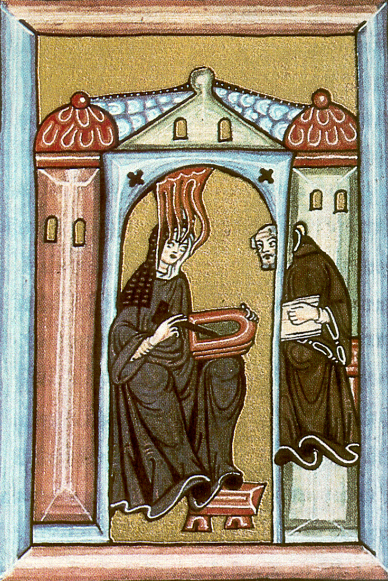
As a backdrop for a week of meditative reflection, I have chosen to kick it way back to the roots - to the early of the early birds. This includes gregorian & ambrosian chant, as well as the mystic Hildegard von Bingen.
Hildegard was a mystic from the 12th century - she claims to have received visions from God, as well as the command to "Write what you see." She wrote: three books of descriptions of her visions with interpretations, poetry, as well as musical compositions.
I was just listening to "Fire of Creation," from The Origin of Fire.
That's Hildegard in the blue doorway, with her scribe Volmar.
Um... I want a scribe named Volmar.
Sunday, November 19, 2006
I call and cry unto Thee
... is the name of the last song I am listening to by Thom Tallis. He and his licensed compatriot are being swept off the lens.
I don't know who I will choose next. I might break the bubble of the baroque tonight - step in from the strange & vast medieval landscape to the intricate interior of the Baroque.
Went on a walk tonight with Alan, my good fiction friend - he is not a fiction, I'm fairly certain, but he does write it. We walked through some of the wild Irvine brush just west of my apartment complex. There is a certain dip in the path where the air cools. Irvine, as she was meant to be, comes alive there. Sparrows dart from the bushes, white-tailed rabbits do the same, plunging back in moments later, and the wild scent of all the local herbs culminates into something like music.
I call and cry unto Thee, Being whose presence shines in this world you've made, whose voice mutters joyfully in the dry stick-bushes where the path dips.
I am a wild creature, tied to a lamp, tied to a bag of broken words. The sparrows don't accuse me - they don't notice. They assume I am an animal, like themselves, singing my song, walking along, eating seeds, maybe, they think, or meat - (all along the trail piles of coyote dung betray other wild eaters).
If we are full of the hot air of language disconnected from experience, then we must slowly exhale, paper bags puffed up and crushed, squeezed like bagpipes - to the point of being small and compact and ourselves. Wheeze with me awhile, and return to find that things have meaning. This is not existential moping - I pray it is not. This is not a task that many, most, have the pleasure of undertaking: To know oneself. To drag every last creature out of ones head & flesh and ask them "Who are you, little one, with a life inside of me?"
I am Animal. I am Lamp.
Unfortunately, this all has the flavor & tone of solipsism - to become wise, a man must walk through many doors, and the door of the self is one of them. At this point, he will not be sure if he is an egotistical ass or not - chances are, he is. We, most of us, are.
I draw my pictures. I write my words. I learn about music. I look for love. I strengthen my body. I whistle. Like a bird sometimes.
But after this, after a man walks through this door once - (I call and cry unto Thee with the hope of it God) - he can turn the lamp upon other things, other people. He can sweep the self from the center of his head's light, and fill it with other worthy creatures.
I don't know who I will choose next. I might break the bubble of the baroque tonight - step in from the strange & vast medieval landscape to the intricate interior of the Baroque.
Went on a walk tonight with Alan, my good fiction friend - he is not a fiction, I'm fairly certain, but he does write it. We walked through some of the wild Irvine brush just west of my apartment complex. There is a certain dip in the path where the air cools. Irvine, as she was meant to be, comes alive there. Sparrows dart from the bushes, white-tailed rabbits do the same, plunging back in moments later, and the wild scent of all the local herbs culminates into something like music.
I call and cry unto Thee, Being whose presence shines in this world you've made, whose voice mutters joyfully in the dry stick-bushes where the path dips.
I am a wild creature, tied to a lamp, tied to a bag of broken words. The sparrows don't accuse me - they don't notice. They assume I am an animal, like themselves, singing my song, walking along, eating seeds, maybe, they think, or meat - (all along the trail piles of coyote dung betray other wild eaters).
If we are full of the hot air of language disconnected from experience, then we must slowly exhale, paper bags puffed up and crushed, squeezed like bagpipes - to the point of being small and compact and ourselves. Wheeze with me awhile, and return to find that things have meaning. This is not existential moping - I pray it is not. This is not a task that many, most, have the pleasure of undertaking: To know oneself. To drag every last creature out of ones head & flesh and ask them "Who are you, little one, with a life inside of me?"
I am Animal. I am Lamp.
Unfortunately, this all has the flavor & tone of solipsism - to become wise, a man must walk through many doors, and the door of the self is one of them. At this point, he will not be sure if he is an egotistical ass or not - chances are, he is. We, most of us, are.
I draw my pictures. I write my words. I learn about music. I look for love. I strengthen my body. I whistle. Like a bird sometimes.
But after this, after a man walks through this door once - (I call and cry unto Thee with the hope of it God) - he can turn the lamp upon other things, other people. He can sweep the self from the center of his head's light, and fill it with other worthy creatures.
Thursday, November 16, 2006
To Be Perceived
...as such and such; To be regarded highly; To be known as someone who is different - as someone who has done something great; To do something great; To reach out to the world, great Philanthropist, and rescue many, heal wounds, lift the downtrodden of the world; To make sure that someone sees the thing you do for good in secret; To do a thing for good in secret and roll it under your tongue like a caramel; To distract yourself from the pain of not doing something great; To hide the fact that you have never acted because you have been afraid of the failure of not being perceived as having acted greatly; To know exactly what it means to do something great;
all these are chains that stop a man from doing - what? From living as himself. From doing the thing that is his thing to do. I am not entirely sure what this means.
But here is the world. Here I am, contraption of flesh & light. Here are others, near me. Push the whole damn dark world of fear aside - the fear of not being perceived by oneself or by the world as great - and suddenly you are very small, and very much yourself. Reach up and touch your nose. That is the sort of thing you can do.
And if there are things happening to you, things that you are choosing, that have the smell and texture of greatness, ingest them as the skin does oil - soak, and do not say a word, but keep doing things. Keep touching your nose. Keep combing the hair of the good thing. Listen to William Byrd's keyboard music. Smile and bend your knees and eat some food. It will break apart, back into the flesh & light it came from, and nourish you - a creature - an animal - a soul.
all these are chains that stop a man from doing - what? From living as himself. From doing the thing that is his thing to do. I am not entirely sure what this means.
But here is the world. Here I am, contraption of flesh & light. Here are others, near me. Push the whole damn dark world of fear aside - the fear of not being perceived by oneself or by the world as great - and suddenly you are very small, and very much yourself. Reach up and touch your nose. That is the sort of thing you can do.
And if there are things happening to you, things that you are choosing, that have the smell and texture of greatness, ingest them as the skin does oil - soak, and do not say a word, but keep doing things. Keep touching your nose. Keep combing the hair of the good thing. Listen to William Byrd's keyboard music. Smile and bend your knees and eat some food. It will break apart, back into the flesh & light it came from, and nourish you - a creature - an animal - a soul.
Tuesday, November 14, 2006
Spem in Alium
Not a beautiful phrase, (the first word being a near homonym to everyone's favorite meat-product), but, indeed, a beautiful song. Spem in Alium is a motet (a type of medieval musical composition) by Thomas Tallis, written for an 40-voice choir. The title translates as Hope in Another. I think.
Music is becoming the lense through which I see the world - or, to use a more apt metaphor, the ear, with curled and ornate lobe, through which I hear. If you say something to me, it's likely being filtered through the haunting sonic matrix of Spem in Alium, or Lamentations of Jeremiah - another piece by Tallis. Lamentations is a 2-set, nine part piece based on the Biblical book of Lamentations - it has also set camp in my cranium. Which is now covered in long hair. Which, as my sister tells me, looks like Mom's. I'd like to think I look like Dad back in his italian-soccer/beach-bum days (sorry Mom).
The lyrics (as you listen) (click the colored words above and wait - it's a big'n):
I have never put my hope in any other but in you
God of Israel
who will be angry
and yet become again gracious
and who forgives all the sins of suffering man
Lord God
Creator of Heaven and Earth
look upon our lowliness
Music is becoming the lense through which I see the world - or, to use a more apt metaphor, the ear, with curled and ornate lobe, through which I hear. If you say something to me, it's likely being filtered through the haunting sonic matrix of Spem in Alium, or Lamentations of Jeremiah - another piece by Tallis. Lamentations is a 2-set, nine part piece based on the Biblical book of Lamentations - it has also set camp in my cranium. Which is now covered in long hair. Which, as my sister tells me, looks like Mom's. I'd like to think I look like Dad back in his italian-soccer/beach-bum days (sorry Mom).
The lyrics (as you listen) (click the colored words above and wait - it's a big'n):
I have never put my hope in any other but in you
God of Israel
who will be angry
and yet become again gracious
and who forgives all the sins of suffering man
Lord God
Creator of Heaven and Earth
look upon our lowliness
Sunday, November 12, 2006
Byrd & Tallis
 William Byrd and Thomas Tallis were the first two composers in England with enough musical noteriety to earn themselves acknow- ledgement from the finicky hand of Music History. In fact, they were the only composers with a license to publish music in the 16th century in England. Yes, the whole century. They worked as a team at the Chapel Royal in London, and danced around waving their licenses when no one else was around. I would have. I bet the Chapel Royal has some big aisleways.
These two English blokes are the composers of the week, pushing the Franco-Flems out of the spotlight, though I have, as of yet, no idea what their music sounded like, nor how the mechanics of it worked. So here's hoping for the best [note: at this point, one would raise one's pint of Guinness awkwardly and nod]
Saturday, November 11, 2006
Drupelets and Splices
Today was an interesting day - mostly because I spent it with good people. First: eggnog pancakes & basic drum lessons with some old friends in Santa Ana, next: wild raspberry jam & lessons in comma splices with a friend here in Irvine, and last: Korean BBQ with my roommate Steve.
Theres a lot here, so I'll give you the basics. Keep the 8th note beats on the hi-hat, bass drum on 1, snare on 3; raspberries are not berries, but aggregate fruits, made of an aggregation of little fruit-droplets called drupelets; a comma splice is a common punctuation error made by 39B writing students wherein they use a comma to divide 2 independent clauses, which should only be divided by either a semi-colon or an em-dash; Korean BBQ involves a grill in the center of a table with various meats one applies to the grill, and then many little white dishes full of fermented cabbages and fish cakes and pickled onions.
My stomach is packed and my head is wriggling with new creatures.
Theres a lot here, so I'll give you the basics. Keep the 8th note beats on the hi-hat, bass drum on 1, snare on 3; raspberries are not berries, but aggregate fruits, made of an aggregation of little fruit-droplets called drupelets; a comma splice is a common punctuation error made by 39B writing students wherein they use a comma to divide 2 independent clauses, which should only be divided by either a semi-colon or an em-dash; Korean BBQ involves a grill in the center of a table with various meats one applies to the grill, and then many little white dishes full of fermented cabbages and fish cakes and pickled onions.
My stomach is packed and my head is wriggling with new creatures.
Friday, November 10, 2006
To a Little One
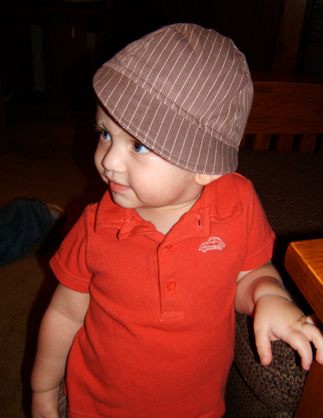
You are small right now. I have prayed
that you would grow. I have asked the Shepherd
to help you find your way into this field.
Your father is a tree, faithful,
firmly planted - your mother is a light;
full of bright laughter. Your brother
is a growing thing, green and more than a little
silly. I love him. Music never met us
except within a dream - but still it seems
not right to leave her out. Her?
I'm not sure why I call her her, since we never knew;
neither do we know who you, little one,
will be - will you join your brother in the underbrush,
or your mother in the spaces in between?
Well, either way you come is fine - but come,
little one, come now, let us see. If you please Dear
Shepherd, if you please.
that you would grow. I have asked the Shepherd
to help you find your way into this field.
Your father is a tree, faithful,
firmly planted - your mother is a light;
full of bright laughter. Your brother
is a growing thing, green and more than a little
silly. I love him. Music never met us
except within a dream - but still it seems
not right to leave her out. Her?
I'm not sure why I call her her, since we never knew;
neither do we know who you, little one,
will be - will you join your brother in the underbrush,
or your mother in the spaces in between?
Well, either way you come is fine - but come,
little one, come now, let us see. If you please Dear
Shepherd, if you please.
To Medieval Music
The old ones are mourning
for the new ones. Yes, long dead,
but they made their songs wise;
their music reaches forward into time
so that its beauty rings with sorrow
for us. This song, now wrapping
round my chest its arms
from somewhere miles and miles
ago, when men & women bent
their heads to older loves,
must feel the dark and growing
scar that’s hid beneath my shirt.
I hear, in the tremors of the wrists
pressed tight to me, a weeping.
for the new ones. Yes, long dead,
but they made their songs wise;
their music reaches forward into time
so that its beauty rings with sorrow
for us. This song, now wrapping
round my chest its arms
from somewhere miles and miles
ago, when men & women bent
their heads to older loves,
must feel the dark and growing
scar that’s hid beneath my shirt.
I hear, in the tremors of the wrists
pressed tight to me, a weeping.
Thursday, November 09, 2006
Figures of Speech
Yesterday in workshop words were getting thrown around that, yes, I have been acquainted to, but never really had any substantial relationship with. I know what they look and sound like, but don't know where they're from, how many brothers and sisters they have, if they're dating anyone.
IDIOM for instance. So... knowing it was a figure of speech, a figure within speech, i.e. not plain speech itself (when is speech ever plain?) - I looked it up on wiktionary.org.
An idiom is any group of words that can't be translated literally into another language and retain its meaning - E.g (the example they give) "kick the bucket". If I told my my italian cousin to "scosse la benna", even if I am saying it correctly, it won't mean "death" to her. It will mean "kick the bucket". Which is not the meaning of the phrase, though it is the literal meaning, that we think of when we say it. So, it is a group of words, usually an image, that is assigned an alterior meaning different than the literal meaning of the phrase.
The other major figures of speech they listed were SIMILE (My love, you are like a cananda goose, filling my heart with brillaint honking) and METAPHOR (My love, you are a canada goose, filling my heart with equally brilliant honking).
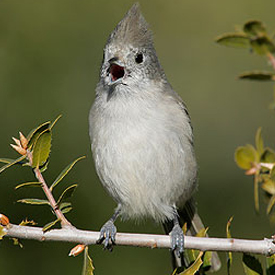
Oak Titmouse! click it
IDIOM for instance. So... knowing it was a figure of speech, a figure within speech, i.e. not plain speech itself (when is speech ever plain?) - I looked it up on wiktionary.org.
An idiom is any group of words that can't be translated literally into another language and retain its meaning - E.g (the example they give) "kick the bucket". If I told my my italian cousin to "scosse la benna", even if I am saying it correctly, it won't mean "death" to her. It will mean "kick the bucket". Which is not the meaning of the phrase, though it is the literal meaning, that we think of when we say it. So, it is a group of words, usually an image, that is assigned an alterior meaning different than the literal meaning of the phrase.
The other major figures of speech they listed were SIMILE (My love, you are like a cananda goose, filling my heart with brillaint honking) and METAPHOR (My love, you are a canada goose, filling my heart with equally brilliant honking).
Oak Titmouse! click it
Tuesday, November 07, 2006
Veni Redemptor
Here is a lovely old monophonic Ambrosian hymn, translated Come Redeemer.
click here to download and listen
click here to download and listen
Subscribe to:
Posts (Atom)