I saw this quote this morning, via Google quotes:
"We are here and it is now. Further than that all human knowledge is moonshine."
- H. L. Mencken
I want to ask myself honestly what is wrong with admitting this fact that so often now my heart wants to admit. Clearly, to admit it would be to downgrade our status in our own eyes, as we have largely absorbed the belief that Knowledge is Power. To say that most of our knowledge, and therefore most of our power, is moonshine, probably wouldn't come as a shock to any of us, but once it sunk in, we'd likely all be in a bit of an existential wonderfunk for a few days/weeks/years, who knows.
But my contention is that this small belief, that "we are here and it is now," is a seed from which all the knowledge we need can be grown. Beliefs such as, "There is a here," and, "There was a then." Certainly the ground of all scientific experimentation lies in these beliefs.
Funny the way that different sorts of people attract our admiration as we get older. Mencken, a journalist, essayist, and acerbic critic of American life, would not have impressed me years ago. Now his quotations make me feel a sort of tender respect for him.

Friday, January 30, 2009

Thursday, January 22, 2009
One Another
So we’ve come to this—
where you and I will meet
across time
and I'll agree to the idea
of your presence
and you'll agree to mine.
What can I offer you?,
except to say
I’m here,
and not for service—
I’m here in the other sense:
160 pounds,
relatively hot
inside
and pressing down
on a rotating chair.
If I kept only one belief
and I do
it's that you and I
could have held each other—
instead, in you
my written line
by your choice
comes, and leaves
what?
If there is a what,
I’d want it to be this:
that you and I agree
the world I’m in exists
in which we could hold,
or could have,
really!,
one another.
Tuesday, January 20, 2009
Reading Russell Again
As I claimed I would do this past summer, I'm attempting a reading (again) of Russell's "History of Western Philosophy," though approaching it this time without an agenda, or a plan.
The sort of philosophy he advocates is still the brand that I can't fully grasp, and not because it's various principles elude me -- I have difficulty conceptually approaching it. That's twice now I've used the figure of approach. Which is alright, as it underscores what makes me happy in all of this: regardless of whether I can conceive of his notions easily or not, I am willing to try without a predetermined animosity.
He's really quite funny. His occasional ironic lauding of the medieval Church is hilarious, even if it's unfair.
Liberated Objectivity
"After one has abandoned belief in god," says Wallace Stevens in his Opus Posthumous, "poetry is that essence which takes its place as life's redemption."
As I read through some old essays, I'm reminded that, yes, I've always been gnawing the same old bones. My drawn-out journey through Academia has so far proven to afford me with only one thing: the capacity to better state the same old questions, and then only slightly better. The difference lies now mostly in my consciousness of the particular words I'm choosing, and their meanings; important, yes, but as one of the great rhetoricians put it (I forget whether it was Cicero or Quintillian) great oratory strives for the persuasiveness and natural eloquence of the layman consumed by virtuous passion. Not to say I was particularly virtuous, but I certainly was passionate, and it allowed for a kind of confident lyricism.
And now that I have this (slightly) improved perspective on history, in that I've seen from many perspectives, having had my naivete made painfully obvious to me, and having asked for the bread of knowledge, and having received instead the burden of understanding the limits of language, I hardly want to speak at all. I want to be silent, and at the same time to have it spoken; to have all of it gathered up, this cloud of meaning risen around the academic parade that has passed by me in my few years of study, and have it condensed down to the smallness of the feeling inside my gut. Take away the parade, leave the smoke. Let me ramble on melodramatically. Let me not speak.
If there is redemption in poetry, then there is redemption, and it is not in poetry. If there is redemption in God, then there is redemption, and it is not in "God" -- the picture you might hold of "Him," whom you picture. And you who would like redemption to have no face, or to have god's face be the face of your feeling, whatever it will allow -- all of you who aren't nihilists, who feel the meaning of their life -- or if not their life, then of a particular moment -- who feel part of a world, who believe their senses -- you must know for yourself already that redemption is there, that meaning is there, and you can't undo it with your words, and you can't make it, either, however you might try -- because upon speaking, you locate yourself in a kosmos -- you show a perspective. That there is perspective. You make known your belief in objects, regardless of how or if you believe it is, any of it, out there.
There is an occurence in rhetoric, in creative speech of any kind, that unlocks this sense of ourselves in the world -- a sense of liberated objectivity. A moment of transcendence out of the lonely confines of the subject, and into epiphany -- a visceral realization of the world beyond our viscera. And it feels the way running for a glimpse of sunset feels: jogging up the hill, through shady residential streets but seeing on the tips of the tallest trees that last golden light, and knowing what will be there when you reach the crest. And you do, and all the climbing, all the foreshadowing, every glimpse of light and wash of shade, is fulfilled, and summed-up in the sunset vista.
It's philosophy happening to us, this epiphany. It's a religious reaffirmation of our primary beliefs, which seem to me to be enough. All else is humble experimentation, and never more.
Sunday, January 18, 2009
Lyric Epiphany
Ever since hearing and agreeing with Dickinson's description of what the experience of poetry feels like, I've often wondered what it is about poetry, good poetry, that produces that feeling in the reader. I've wondered how best to talk about it. The feeling isn't merely that of being moved, though it's very similar. And it isn't just the feeling of assent, of judging a poem well-crafted, or of being impressed by it.
She says:
"If I read a book [and] it makes my whole body so cold no fire ever can warm me, I know that is poetry. If I feel physically as if the top of my head were taken off, I know that is poetry. These are the only way I know it. Is there any other way?"
It's a compelling description -- particularly, to me, the second half, the lifting off of the top of her head. I can feel it, a faint coolness on the brain, and immediately recall the feeling I've had in my own experience with "poetry" -- though mine is located more in the back of my head and shoulders. I put "poetry" in quotes because I experience the feeling, the opening and cooling, when reading stories (as she apparently did as well), and occasionally when hearing a good speech. Poetry in this sense then isn't restricted to verse, or to the lyric poem; it's a quality of composition in general.
So, my question is this: what do we call this head-lifting, and what causes it? (And I mean to ask the question on a primarily literary level, though I'm sure approaching it as a psychological phenomenon would be interesting.) Paul Friedrich, professor of anthropology and linguistics at the University of Chicago, calls this response to poetry, what I take to be the same as Dickinson's, lyric epiphany.
In his paper by the same name ("Lyric Epiphany", Language in Society 30, 2001) Friedrich outlines a loose definition of lyric, and lyric epiphany, while conducting what he calls "intense analyses of four cases of linguistic epiphany in The Odyssey." That intensity most often manifests as a lack of control in his diction, and tone. Still, these sometimes hyperactive analyses of the different cases and kinds of epiphanic literature interest me, because of the fact that throughout all of them, he keeps coming back to the poetic turn, the moment of unification and compression, in the poetic text.
"Lyric epiphany," he states in the abstract, "is a subtype of generic epiphany: an intuition or revelation of truth values beyond language and empirical experience." Fortunately, I accept without too many reservations this rather loaded definition of epiphany, as he leaves his discussion of generic epiphany at that, and doesn't pause to define what "truth values" might mean. "...[T]he experience of epiphany," he says, "is terribly important." He seems naturally interested in the importance of lyric epiphany for the anthropologist and sociolinguist, but as a writer and reader, I feel justified in taking stealing what I can.
As I said, it's his concentration on the "turn" that interests me, for two reasons. 1.) I've been interested in the enthymeme, as a turn or cap or summing-up after a web of charged, value-laden oppositions, (as Jeffrey Walker puts it), and 2.) I’ve recently (in the last few years) come to see that it is usually at these junctures, these turns that I have my “poetry” experience, my lyric epiphany. I believe it was a book of loose ghazals by Robert Bly, wherein each poem takes an emotional turn in the last couplet, as the speaker shifts from a general address to a self address (at least in Bly’s case), and it feels as though the emotion of the poem is suddenly realized, brought into focus. I knew they weren’t particularly well-written, in that he allowed himself too many moments of lazy writing, of slipping into cliché, but even so, the turn managed to hook me nearly every time, and elevate me into “revelation of truth values beyond language.”
“From the formal linguistic angle,” Friedrich offers, “the shift into epiphany is like a shift from a durative, progressive, or habitual and customary sequence into a more momentary or instantaneous one.” In the opening pages, he refers to lyric epiphanies as “instants of … absolute aesthetic truth” and “ontologically profound breakout[s]” allowed by certain linguistic/literary techniques, and coming through “a heightening of emotion in the reader or hearer, be it empathy, sympathy, compassion or other kinds of involvement; vague features, in other words, of intensity and density that may resonate at any linguistic, emotional, or cultural level.”
A "heightening of emotion"; an "ontologically profound breakout" -- it sounds to me like Dickinson. I'm interested in what causes this, and specifically how and when the enthymeme causes it, as well as how this might intersect with ontology, the study of being, as Friedrich suggests. As I said, Friedrich doesn't directly address what absolute truth values are -- but the change in perspective that lyrical epiphany provides does seem to give one the feeling of momentary insight into some kind of universality. A unadulterated vision, perhaps, of the cosmos -- a moment of liberated objectivity, as I'll call it in my next post.
Thursday, January 15, 2009
Enthymeme pt.2
So, I haven't actually made much progress toward an explanation of what an enthymeme is, and since that's my goal in all of this, I'll get to it.
I was mislead by my reading of Aristotle last spring. I took a course on rhetoric, and the prof made passing reference to what Aristotle calls "the body of persuasion," the enthymeme. It intrigued me, as it reminded me of some part of the process a poet goes through in constructing a poem's speech act, so I wrote a paper on it, trying to flesh it out. My assessment was that it's a truncated syllogism, the syllogism of the rhetorician, which he uses to give the sense of logical demonstration to his speech. As Aristotle says, we are most convinced when we feel like something has been demonstrated. When we've seen it with our own eyes. But the Rhetorician can't bother with the exact science of logicians and philosophers -- he's talking to common folk, and even if they could follow him, it'd be boring from the pulpit, and the incandescence of his speech would dim. Therefore, he makes these quasi-syllogisms, that rely on a knowledge of what the audience already knows: I give you a premise, perhaps, knowing you will supply the other, so that when I add the conclusion, you feel like you're in the know, and I've saved time. I don't have to chase down proofs for what you already accept as true.
And that to me sounded like poetry: the way a poet heaps up tropes together, each associated with a set of cultural values, into a syllogistic sort of form, so that by the time the poems ends, a conclusion has been reached - an ideological conclusion. The reader has been lead to find convincing a certain emotional/intellectual stance - to find themselves standing the way the poet wants them to stand, within the field of possible ideological positions on any given subject. (Most often, I think, the ideology presented to us is an earnest agnosticism, sometimes kind & wonderstruck, and sometimes cynical and biting, leaning towards nihilism.) Each cultural trope used has some approximately known meaning, so that we can weave them together like a math problem, with prosody lending the rhetoric a helping hand, so that the sum of it resonates between emotion and idea.
Then I found Jeffrey Walker's book on ancient rhetoric; he argues that most contemporaries Rhetoric-scholars have it all wrong, because of a historical misreading of Aristotle. This misreading is really at the heart of his whole treatise. It's apparently the misreading that I had.
But I think that my way of taking the enthymeme into poetry actually produced an enthymeme closer to what Walker says the Greek's version of it was. By accident. I spend a lot of time thinking about how the lack of rigor in my studies will be the death of my scholarship, and then I remember that all I've ever made well has had, in some part of its development, an accident; has been somewhere founded on an unjustified, intuitive leap. And when I'm done thinking about that, I zone out and stare at the ceiling for an hour. Or read headlines. Headlines will be the death of my scholarship, if anything.
I love the way my painted Swainson's thrush sits in the window, with a perfect arc of California sun crowning his chesnut head. He looks eager to fly. (I'm still not a good rhetorician when I'm trying to be -- I was hoping to use that little interlude there with the reference to flying in much the same way a preacher uses humor -- to release, to cleanse, to regather the troops.)
Walker argues for a different, broader understanding of the enthymeme, and argues that originally, the enthymeme, though not yet refered to as such, was the heart of Greek poetry. But this is part of his larger argument, in the second half of the book: that lyric poetry is the most basic form of poetry, "synecdoche for 'poetic' discourse in general," and that "in archaic lyric we find embodied a poetic practice that predates the conceptualization of "poetry" and "rhetoric"" and is similar to what the sophists would call "epideictic" rhetoric; in other words, "as a fundamentally rhetorical practice, archaic lyric embodies a paradigm in which "poetry" may function (and did function) as culturally and politically significant civic discourse, that is, as an epideictic argumentation that can effectively shape communal judgements about dike, or what is "right" in various circumstances, and so can effectively intervene in, intensify, or modify prevailing ideological commitments or value-heirarchies."
I'm interested in this because of what I feel is a general squeemishness in American poetry toward admitting that poems do in fact embody specific ideologies.
And, with that, some left-over vegan pizza beckons. (Walker says that our misreading of Aristotle has lead to a grammaticalized poetics, so that a decorative representation of a subjective consciousness has become the norm -- its complicated -- but I'm thinking of what he might say about blogs.)
Wednesday, January 14, 2009
The Enthymeme, and Everything Else
We do weave figures toward satisfying our intuition's ache. Like music, a figure-weave will make amends with silences in ways no reason can explain. Understanding is a process of throwing out a trope into the dark, and then occupying the room by the trope's dim light until the mind's sun, convention, rises, and makes us feel at home. Makes it feel like real.
Enthymeming (I'm sorry for getting ahead of myself, for keeping the private as private still awhile longer) is not just the rhetorician's syllogism, it is the philosopher's journey into knowing. How can we progress except by this process of throwing our tropes ahead of our conventions, and following out the line they're tied to us by, into a dark world, then waiting for the sun to rise. It rises with us. The presence of the Da-sein makes the sun of being rise -- for us, that is, and who can say otherwise. I think the world remains though I am gone -- rather, I believe it -- and therefore I'm a member of the Human kind.
It is pretentious to say that last bit, and I feel sorry. There are indeed so many who've articulated the opposite. Still, I don't believe it, and I rest for now, for always?, on this fallacy of incredulity.
Follow the animal out of the grave and into the light. How many things can an image come to mean, and still be meaningful, rather than confused? I've known that when an image works, it works on all levels. It's different than a metaphor -- it's not a figure of speech, needing context within a certain speech act -- instead, it's a figure upon knowing. Even if it's not entirely public yet, if somehow one could dig into the mind of the figurerer, he'd find the ways, at least sometimes, that the figure kept on working. Rather than representing something, it's fastened to it -- rather than an image of it, a cloth thrown over the form itself.
Ghost Gathering
That is, there comes a time to let them be, and a time to gather. A time for sewing, and a time for reaping. A man must go away while the garden grows, and what is out of sight, it seems, is often out of mind. He forgets, and call his favorite angel, Anamnesis, whom the Greeks called Mnemosyne, and asks, what was I about again? And she inspires in him the voices of her daughters, certain daughters paired with certain men, until they revive him to the story of his garden growing. To which he hastily returns, ashamed of his forgetting.
And there the ghosts have sprawled up from the soil, new again, ready to be gathered to the man. Each time he plants the same, a word in planting spoken over them, and forgets; and each time they come anew as something more fully realized toward the language he's constructing. Each time the plant's names become more sophisticated, by becoming less private. So that when the day comes that the man no longer undergoes the calling on of Mnemosyne, a stranger may upon his garden stumble, and find himself in the midst of nameable, assignable ghosts, each one bearing something very much like, if not identical to, fruit.
And there the ghosts have sprawled up from the soil, new again, ready to be gathered to the man. Each time he plants the same, a word in planting spoken over them, and forgets; and each time they come anew as something more fully realized toward the language he's constructing. Each time the plant's names become more sophisticated, by becoming less private. So that when the day comes that the man no longer undergoes the calling on of Mnemosyne, a stranger may upon his garden stumble, and find himself in the midst of nameable, assignable ghosts, each one bearing something very much like, if not identical to, fruit.
Monday, January 12, 2009

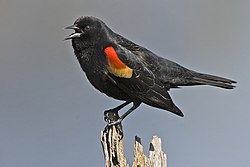
Red-Winged Blackbird
Enthymeme, part 1
January 12th, and 85 degrees. How can I not take a nap? And then if I nap, and don't sleep, how can I stop from staring at the ceiling, thinking how strange it is that 10 years have passed since I started this collegiate process? Trying to imagine the rule we measure ourselves by. Trying to argue with myself, alternately, one way or the other.
No, the "argument with myself" is a dying metaphor. Argument is finished, and now is the finding of the wherewithall to open my eyes in the land I've gotten myself to.
Does that way of saying satisfy? I'm in the business of finding satisfying ways of saying. Existential rhetoric to a small audience -- myself -- trying to persuade me toward a course of action: recognizing that the first stage is over, and the second needs a pair of legs and time.
Life as journey is an old trope, and one that usually revives me from any mild stupor.
And what would one call this weaving of a web of value-laden oppositions, temporal and figurative, some sincere, some slightly ironic, all leaning towards a final memorable climax, a turn, a last jab of the rhetorician to seal in the mind and heart of his hearer the position, emotional and rational, he wants him to have on the whole situation?
One would call it -- at least according to Jeffrey Walker, professor of Rhetoric & Writing at the University of Texas at Austin -- the enthymeme.
As I mentioned before, Walker had his reasons for defining thumos the way he did: it allows him to make his argument about the nature of the enthymeme. The second half of his treatise on classical rhetoric, Rhetoric & Poetics In Antiquity, tries to agree with and expand on what Aristotle meant when he said that the enthymeme is "the body of persuasion."
And I'll continue on that, but the Yellow Warbler in my Audubon clock has just announced that it's time for my meeting. Click the one below, and find yourself a little happier.
Sunday, January 11, 2009
Heraclitus & Logos
Before I delve further into the enthymeme, I thought it wise to tackle the driver of the chariot: Logistikon, figure of Logos, the reasoning portion of the human psyche. I assume he looks something like stoney Heraclitus below, marble-bearded, eyes void of any passion.
And it was Heraclitus, considered today the most important pre-Socratic philosopher, who first expounded on the subject of the Logos. No one is quite sure what exactly Heraclitus meant when he used the word -- we only have fragments of Heraclitus' work left, and the "definitions" he gives for logos aren't exactly conversation ending. Since his day, logos has been used to refer to a whole slew of related powers or principles: words, anything written or spoken; reason (either the faculty or the action); measure, proportion, ratio...
But Heraclitus seems to have thought about it in a much more fundamental way -- and not necessarily as a technical term. He is famous for believing that the "everything is in a state of flux." His most famous aphorism is an image of this flux: "On those stepping into rivers the same, other and other waters flow." The world figured as a flowing river -- though you might stand in one place in the river, it moves, and therefore, in some sense, the place changes, is always changing.
And yet, he says, somehow there seems to be a world that is common to us all. A "kosmos" he called it -- a somehow unified oneness we all exist within. How does this world-of-flux appear to become a kosmos? Well, as far as I can tell, for Heraclitus, that's where logos comes in. Logos is the principle, or the name he gave, to the commonness, the stability or orderedness, the able-to-be-described-ness, of the world. One Greek summed up Heraclitus' view this way: "Logos always exists, inasmuch as it constitutes the cosmos, and as it pervades all things"
For a believer in a world of flux, a believer in a world of motion, the ability to share a world in common is no small feat. Who or what performs this trick? We don't know, but what we do know is the rule of it -- we know the law it lays down, makes seen for us: the world around us. "Therefore," Heraclitus continues, "it is necessary to follow the common; but although the Logos is common the many live as though they had a private understanding."
What could it possibly mean for someone to have a private understanding of the shared surface on a world of flux? You get what you get -- I mean, different perspectives yes, but the common is the common. That's what we have, I imagine someone saying.
Potentially, he might have been attempting to describe the error of having any private belief at all. That is, of believing you have a private understanding, an understanding that is more or other than the understanding emanated to us by the logos, the kosmos.
Last night, and I'll end on this, I went to hear Arvo Part's 4th symphony, "Los Angeles." It was meditative, minimalistic, and, in certain moments, sublime. Part, like Heraclitus, is a mystical figure; one concerned with the most basic, the most elemental. In the notes handed to us at the door, there is a quote of his wherein he is attempting to describe the style of composition he pioneered in the late '70s, which he called Tintinnabulation. The word tintinnabulation comes from the latin world for bell, and is used in English to refer to the ringing of bells. Part's style has a simple bell-like quality to it, and is largely based on chordal triads, and a reduction of the music to these simple bell-like, resonating triads. As I read his reflections, it quickly became clear that tintinnabulation is more than a style for him -- it's a philosophy. It's a way of seeing the world. He speaks about it as though it were an abstract place of reflection. "Tintinnabulation," he says, "is an area I sometimes wander into when I am searching for answers -- in my life, my music, my work. In my dark hours, I have the certain feeling that everything outside this one thing has no meaning. The complex and many-faceted only confuses me, and I must search for unity. What is it, this one thing, and how do I find my way to it? Traces of this perfect thing appear in many guises -- and everything that is unimportant falls away. Tintinnabulation is like this."
I guess it reminds me of Heraclitus, and of the shame of saying I know anything more, or other, than the common. Human Dogma -- the world is there, and I'm stepping through it's movement, like an animal crossing a stream. The seed of all knowledge, and the extent of it.
Click on Heraclitus' stoney gape below to hear Arvo Part's "Spiegel im Spiegel," as heard in a Van Sant movie from 2002.
Friday, January 09, 2009
Thumos
I mentioned Fukuyama's coinage last post: isothymia, which is a joining of iso (equal) and thumos.
What does thumos mean?
In his Phaedrus, Plato figures the human psyche in three parts: a charioteer, and his two winged horses. The Driver is logistikon, derived from logos, the Reason -- and the two horses, one black and one white, are epithumetikon, representing bodily desire, and thumos, or "spiritedness." Reason keeps the two in check, and steers them through the sky toward "divine sights." While the black horse -- desire, concupiscence -- is unruly, and needs the Driver's whip, the white horse, beautiful and long-necked, will heed the driver's word. Both horses represent passionate parts of the psyche, but Thumos -- the location of pride, shame, indignation, and social recognition -- is the brighter side of passion, the more agreeable, manly, not quite as difficult to control part.
Jeffrey Walker, in his treatise on classical rhetoric called Rhetoric and Poetics in Antiquity, decides that thumos, or thymos, for the pre-aristotelian Greeks meant: "'heart' or 'mind' or 'spirit' as the seat of emotion, thought, wish, desire, intentionality, or will. In one's thymos," says Walker, "one considers things, draws inferences, becomes impassioned, forms desires, has intentions, and makes plans." He refers to uses of the word in both a Homeric hymn, and a poem of Pindar's, and says in these instances and others, "thymos as 'heart' is understood as both a principle or place of interpretation and a source of emotional response, urge, and intentionality."
Of Aristotle's conception of the thymos, Walker asserts:
"Aristotle typically associates both thymos and epithymia, "desire," with the "nonrational" (alogon), emotive part of the psyche, which he nevertheless considers to "partake of logos" in the sense that it has a "hearkening and obeying" capacity for interpretive understanding and response. [...] That is, depending on what perceptions are present to the psyche, and depending on the predominant cognitive frames within which those perceptions are interpreted, the "nonrational" part of the pschye, or the thymos, recognizes the significance or salience of those interpreted precepts and mobilizes emotions, desires, intentionalities, and behavioral scenarios (as well as bodily arousal for physical action) in response."
"Moreover, the specific emotions, desires, intentionalities, and bodily states mobilized by the thymos largely determine the predominant cognitive frames and behavioral scenarios within which the psyche's subsequent perceptions will be interpreted and responded to."
If Walker is interpreting these ancient sources correctly, the thumos begins to sound like a pretty darn important part of the psyche. If your body is a chariot, and Reason is the driver, then you've got two winged horses buried in your gut, one black, one white. The black one is pulling you earthward, and needs a good whipping -- but the white one? Well, the white one waits for you to say when.
Walker has a particular reason for talking about thymos -- a word he is very much concerned with, and a word that I have become very much concerned with, is derived from it. The word? Enthymeme. I'll talk more about that later -- for now I'm off to the premier of Arvo Part's 4th Symphony, titled "Los Angeles."
Thursday, January 08, 2009
Panera
In line, I am witness to life, a bit of life
negotiated: this post-adolescent boy
awkwardly conscious of his boss's looming
platinum hair. Boy-man tries to concentrate,
but boss-man speaks, asks him to work overtime,
asks him to do this favor, just once. Our hero
fumbles over my bagel, hesitates until
the promise comes: you can take a loaf of bread home.
Who am I to say what is or isn't worthy?
There is no rule, but look, in certain moments
my own heart rises from it's mortal bed,
and feels the brief delight of someone else
smiling like a goddamn goof, because tonight
in spite of death, he'll have a loaf of bread.
Noise Reduction
Snug against a olive-green column, I'm at Panera testing the new noise-reduction ear-buds I just purchased. Cheapest brand (Philips) and yet with the music playing -- I really can't hear anything around me. This public space is transformed into a sanctuary ... well, almost -- between songs, I can hear a muffled chatter. Muffled just enough I think, to be able to ignore it. The "noise reduction" technology seems to consist of the "ear-plug" style ear-buds, coupled with a little bit of gentle white-noise. Mr.Philips recorded himself blowing into microphone, and called it worth another 15 bucks. I wonder how much better the Bose ear-buds are?
Moby, The Rain Falls And The Sky Shudders.
Works well enough. Anyway, the sanctuary starts within, right?
Right. Mulling over so many dark, little thoughts. Can't figure how to act in a world that, if I'm honest, leaves me in a state of constant bafflement. And if I ride waves of convention, I feel listless, I feel disingenuous --
I've been reading over, thinking over, a theory of the steps toward a religious life: first, the aesthetic life, then the ethical, and finally, and for only a select few, the religious life. It's a progression of the self, from being ruled by passion, to rule by ethics and social agreements, and finally by faith in God --
I think one thing we can agree on is the absurdity of the word "God." The closest I can come to saying what I mean is: "That which transcends that which we exist within," and then it becomes a problem of inadequate pronouns.
**Product Update: there is a slight electronic flicker-click in my right ear-bud. Is it picking up a cell-phone? Annoying.**
I feel voices in me disagreeing with the word "transcends." Why must their be something that transcends the world we exist within? I'm not saying there must be -- you can trust me to never say (at least when I'm in a sober mood) what must be -- but I am saying that we believe it to be so. Think past the language we use to describe our thoughts about the world (something, I know, not everyone is convinced we can do). We learn early to look at the world outside of us as a mostly predictable environment that we exist in, are a part of. We believe in this unification that upon reflection seems possibly to be a trick of the trick of consciousness. Of language. But we believe in it. We believe that as we move across space, the predictions we made a moments ago will hold here as well, as long as the conditions are similar. A continuity of space & time. No, not on a micro or macro level -- only on the level I'm currently knowing, the one in which we live and move and have our being.
This unity of the world, this continuity, this world-ness, "transcends" the particulars that compose it.
I've long held that living "ethically" means two things: first, living with the ability to sympathize, living "isothymically" (living with a desire to be equal to everyone else)(a term coined by Fukuyama in The End of History and The Last Man); and, second, acting with the future in mind. Both require a good imagination. I guess that's a way of saying a proud person, or an evil person, is suffering from a deficient imagination.
We believe, whether because of conditioning, or because of observation, that when we die, the world continues -- not in the way we imagined it, the way our minds represented it to us, but in the way that it "is"...
Unity, though, is also an act of the imagination? The ability to see something as a distinct, unified object. (A little Sigur Ros coming on now, layered over a cottony blanket of white noise, layered over muffled chatter and some distant saxophoning.) So, if all imagining humans died right now, would all the world dissolve into nothingness? We don't buy it. There'd be the world, though oddly devoid of all connotation. And, yes, we believe the earth would still be a ball, upon which an animal could act by an instinct that would cause it to function correctly, oh, imagination, oh say, unification. Who's doing it? Something still transcends. I can keep taking out potential characters, and the oneness will still be there -- even if I reduce the universe to a slovenly spin of rocks in the void, they still collide, still operate according to some system -- and that, my friends, is unification. Is an act of the imagination. We believe it. And so we can't escape belief in this thing we often call "God."
Or a sense of the meaning of the world. Or a sense of the heartbreaking loveliness of sympathizing.
Our own impending deaths. What dream, or lack of dream, may come.
Tuesday, January 06, 2009
Wonderstruck
Wanting to name my post "Existential Wonder" I typed it into google to see what sort of hits I'd come up with. The second link, which I clicked after dismissing the first, was the title of a blog post. My heart sank a little, as it always does when I realize I'm just one of the millions of bloggers out there prattling on about anything that would make me sound the way I feel -- like a philosopher! Then I realized that the post was about a reincarnated dog. It had nothing to do with existential wonder, except for serving as a heart-warming example of it. Think "Marley & Me" for vaguely eastern folks.
So, I retreated, and clicked the third link. Boon!
From Mark Kingwell's Practical Judgements:
"In losing our ability to be amazed in a strange environment, or indeed to see a familiar environment as sometimes very strange, we may have obscured the origin of philosophizing. But an obscuration of origin does not mean we have lost philosophy. Modern philosophy – now made traditional, ruled by convention, canonical – continues without full regard for the experience that gave it rise. Wonder, even if in reality the origin of philosophy, may not be considered an experience deserving philosophical attention. On the other hand, simple wonder cannot be viewed as sufficient of itself to be the philosophizing it sets in motion. The tradition, with its conventions and rules, must be evaluated alongside the experience of wonder. Such a tradition may be rejected as ossified, conservative, or misleading, as Husserl attempts to do, but it cannot simply be ignored."
...then a few lines later, concerning analytic philosopher Ronald Hepburn...
"True wonderment in its philosophical connotation, says Hepburn, must be distinguished from astonishment at ‘mere novelty’ – a distinction to be found not only in Kant but also in Heidegger (curiousity vs. marvel). The thrust of Hepburn’s distinction is thus that ‘legitimate’ wonder must always be wedded to a concern for truth, ultimate causes, reasons; the wonderer wonders only to the extent that he gets his ‘real’ inquiry going. ‘Existential wonder’ at the sheer facticity of the world may not be of legitimate interest, Hepburn suggests, since it opens up no set of reasons to be investigated. It is a kind of wonder, but not one that leads to anything further. […]"
...and a quote from Hepburn...
"We can give no reason for the world's being rather than not being. We can meaningfully ask why it exists, but we have no resource for answering the question. Wonder is generated from this sense of absolute contingency; its object the sheer existence of the world. I shall call it "existential wonder." All reasons fall away: wondering is not prelude to fuller knowledge, though the general interrogative attitude may persist."
Kingwell goes on to point out that many philosophers disagree; in fact, most call this existential wonder the very source of philosophy. Take Plato for instance, who puts into the mouth of Socrates these words:
"[The] sense of wonder is the mark of the philosopher. Philosophy indeed has no other origin, and he was the good genealogist who made Iris the daughter of Thaumas."
Thaumas was a sea god of Greek mythology, whose name meant wonder. Iris was the goddess of rainbows, and a messenger of the gods.
Anyway, to get to my point -- although I think rambling may have been my point -- I recently decided that I've moved out of a state of religious wonder, into a state of existential wonder. Or, that my wonder has lost some of its epic ghosts, and has been whittled down to a dumb amazement that the world is here, around me.
And, conveniently, I think I may agree with Hepburn. Being wonderstruck, in the existential sense, kind of leaves one with a zen-like feeling -- no desires. A vague "interrogative attitude" persists, but with "no resource for answering the question" other than reference to existence itself, all we can do is sense its meaning, and keep quiet.
Wittgenstein said: "It is not how things are in the world that is mystical, but that it exists." (TLP, 6.44)
He also said, "What we cannot speak about, we must pass over in silence." Which makes me think of rainbows, conveniently -- the feeling of being left speechless.
Monday, December 29, 2008
Last Few Days of 2008
Usually you have your youth to reach over and touch in times of existential worry -- well, (you might say to yourself), at least I'm still young. And then suddenly, it's four days after your 29th birthday -- still young, granted, from many perspectives, but I guess what matters is your own sense of when your free-pass license of youth is all used up. And, for me, it suddenly feels like it is; at least, I'm reaching for that familiar box of inexhaustible do-overs, and not finding it.
And so I'm trying to get a taste for these last few days of 2008. Though I've forgotten nearly everything of consequence I ever learned, some residue has remained, and this strange post-Christmas space between two years is slick with the wetness of knowledge lost. Also, the wetness of the downpour of rain that fell earlier today, while I sat in Portland, sipping coffee and feeling romantic. Feeling a heck of a lot.
And I like feeling. My body seems made for it more than it's made for retaining verbal information. What exactly "verbal information" means, I couldn't quite tell you, and though I'm interested in trying to figure out how, right now I'm riding the feeling-wave of the song that's echoing from my ear-buds; and I'd rather feel it, than figure it out. Than make a system of figures for it. Organize that system -- literalize it. Whatever that means.
My stomach is full, and I'm 29, and 2008 is about to sputter out, a candle flame, wet with waxy residue, flapping like a tattered flag. I salute you, banner of those who keep their minds mostly free of entangling alliances. Who like to feel, instead, the free association of a world of moments, disconnected but by a certain simple animal-faith. Let's shake hands and admit that as far as we know, we're alive, and we're dying, and we have a little time together. And that no one has ever figured out more than that, and that it's enough. That all of the faith one needs in life is packed into that little seed.
And there are a hundred men and women like me tonight, earbuds sunk in waxy-wet time-canals between two years, typing out their heart's expression. Thumos, as the Greeks said -- logic of the gut-heart.
And we're all original, those of us typing, those of us sleeping, eating, urinating, making love, watching television, looking at cats, rubbing our feet across lineolium, laughing, reading magazines; we're all located somewhere in this world, doing something that's never been done before, in exactly the way we are, by someone exactly like us. Performing it for the first time, in time. Theme and variation.
Everything is new under the sun, Solomon. Everything, that is, except for the age-old whining about not being able to know anything. But no one has ever whined quite like me, so fine, so free.
Monday, December 22, 2008
Winter Sonnet?
Working on these is a mostly meditative practice, and as that is true, I feel for them as one feels for ones neighbor's pets: very little indeed. And yet I post them -- which is an interesting psychological event, is it not? No, no it's not.
Stuck in snowy ruts, then at intersections
fish-tailing, as they say, between the icy banks
in an unhorsed black sedan, we spent the day
wasting it. Christmas shopping, we called it,
and why you went, you couldn’t quite say.
A backseat hotshot, pouting in your borrowed coat
while nit-pickers picked on pointlessly
about which way to turn, which time to take.
A theoretical believer in free-will, now losing faith,
you inwardly recounted the ways you were
coerced to act against your nature – today,
and since the womb. Which was a thought, of course,
and buzzed cathartic. Determine this,
you said aloud, gesturing, and no one cared.
Sunday, December 21, 2008
Winter Sonnets, V
Suppose the sleet keeps falling all afternoon,
and suppose I continue having nothing to do,
until I picture Dante mounting the stairway's
ivory steps -- the steps he climbs to see you,
Beatrice, standing at the high end of the embattlement
all dressed in white, and snow-white all around you
falls gently, and still through the near blank slate
where light makes any black seem brilliant blue
your green eyes gleam. Oh, any mundane room
and cold-footed waiting through a dreary day
will suddenly take flight. Oh, I’ll speak in couplets,
oh I’ll get up from my chair, and walk down past
the kitchen lights, and stare awhile at Dad,
at Mom knitting by the tree, and think of you.
Winter Sonnets, IV
After a morning of sorting through some music,
of waiting for some feeling to accrue,
white maybe, on the sill, the snow has pushed against
the house in drifts, and sleet has fallen, and I
haven’t made much progress. Mom and dad
are clanging pots in the kitchen, making lunch,
and my brother, the youngest, is killing electronic
warlords. I’d help, but I’m bent on finding songs
to make the melancholy lift, like my dad said
the weather won’t, at least today; he presses
his face against the back window to see
the spears of ice. He smiles. And now, my mom
tries to come in, but the door’s stuck – she taps:
“Justin,” she says, “It’s ready.” And maybe it is.
Winter Sonnets, III
A guest in my parents house at twenty-eight,
and still no mortgage or child of my own,
I’m up at two and picturing the tree
still bright at the house’s other, warmer end,
still gently raining red from it’s star-crown down,
making the heap beneath the bottom branches
look huge. It always did. These gifts, this year,
aren’t for the pink-cheeked hopeful version
of myself—no, he’s gone, and in his stead
two little Christmas angels, my brother’s,
asleep in bed, will be at the downward end
of the yuletide avalanche. I’ll say it’s clear
up here, Children— it’s fine. But I won’t say climb.
Winter Sonnets, II
The winter’s slick white hand rains down the glass
and slithers five blurred streaks, that bend in five
the lawn’s gray face. Half-white, half-snow, the grass
looks limp, looks up at least, and will survive
the winter. I’ve seen it do just that most years,
though none as hard as this— and none so cold:
my bedtime water froze stiff on the sill.
That was days ago, and now the melt spears
the pane into murky limbs, one lit dull gold
as something like the sun begins to spill
into the corner. The lawn looks happier.
Once, it was, I had to march out, mud-gilled
and dig a grave beneath a too-dead yard;
I’ve done it for myself. It isn’t hard.
Winter Sonnets, I
There’s no reason to believe that after this
there will be something; except that always before
it’s come: something else. I’ve woken to it daily:
a new set of conditions, a new pattern
of clouds stretched across the sky. I’ve never
been surprised by it – by my father coming in
and saying the silly phrase he just concocted
coming down the hall; new, for the fact
that never before has anyone who looks
like he does, right now, hair speckled silver
just so, glasses askew at 5 degrees, with that
body, that sweater, leaned in this guestroom door
and said those words, just the way he did.
And who says death won’t bring its one word more?
Thursday, July 31, 2008
Que sais-je?
In the end, isn't all of this working to establish systems of language that we feel most accurately account for the state of things ethical.
That is, we want to know how to live. So we do live, some of us, ironically enough, lives of leisure concentrated on finding out how best to live. And to be honest, most minutes of the day I wouldn't want it otherwise. Occasionally, dailily, a panic will descend on me, saying, Justin! Why aren't you working your fingers to the bone!
I answer him with silence. I have no reason, except for a soft conviction concerning the value of work: quality and not quantity. Working to the bone and working well are not mutually exclusive, but it's easy enough to let them be.
Science! Funny when you think of it. I suppose it's contribution to the control we humans have over nature has provided me with my leisure, and yet... Mightn't I be just as happy in a medieval world, and act just as ethically? I might, yes, as self-righteous and naive as the question sounds. Montaigne, in his aristocratic leisure, sitting at home, translating, with more than a twinge of Irony, the work of Raymond Sebold...
Ethics: acting in a way that elicits confidence in and love for your person from the most people.
Knowledge (n.): The relationship between yourself and the world. Some call this our mental and physical impressions of the world's information. Also, the mental and physical categories we make for this information -- distinctions and organizations that continue to produce the capacity for more knowing.
To Know (v.): to develop a relationship between yourself and the world. (Also, the categorizing of impressions gathered during this relationship)
Belief: To be convinced of the relative accuracy or usefulness of some part of your worldly impressions.
Certainty: To be overly convinced of such.
It's all in Montaigne. Who got it all from Plutarch. Who got it all from ... Heraclitus? We've harped on this same chord for more than 2,000 years and yet...
Someone might say that without curiosity, we would wither away. But curiosity implies a light-hearted pursuit of knowledge. One that opens the eyes softly, rather than one that eats at the gut. An enlightenment, rather than an emburdenment, an embitterment, which always follows a perceived empowerment.
Adam and Eve ate from the fruit rather than naming the animals, both of which were kinds of knowing.
Which brings me to Human Dogma. The wonderful thing about complete skepticism and nihilism is that none of us are convinced by them. There are a few impressions, which we believe we've managed to communicate to each other, that we are all completely convinced of the accuracy of. I've named them before in this blog, but again: 1. That we have a self. 2. That it exists in a world (implying a web of things, given boundaries by and categorized according to their meaning in our lives). 3. That there are other selves.
And if its true that we share some basic beliefs, and that all other beliefs are made of impressions whose accurate naming we merely make ourselves feel convinced of -- well, before I finish that sentence, I suppose I should stop and consider that this idea would be impressed upon others and elicit conviction its accuracy only with great difficulty -- i.e. by being very convincing. I.e. rhetoric.
The role rhetoric plays in a world of seeming is indivisible from the role knowing plays -- what we know, we know by conviction. What has convinced us of what we know? Do you know you are sitting at your computer? How? Because you believe your senses, which are a power you believe in due to your capacity to categorize impressions, which is a power you believe in. Which isn't to say anything about belief in the statement "You are sitting at your computer." But we believe in our power of making useful phonemes and morphemes the same way -- we are convinced by certain impressions.
Try to convince me that Abraham Lincoln lived. You can't do it completely. If someone brought to me what I considered overwhelming evidence that Lincoln was a hoax perpetrated by the Illuminati, I would likely believe him. Especially if others started to hold that idea as accurate.
But try to convince me I don't exist, and gol-dernit, I won't quit.
Perhaps after some pretty extensive brainwashing, but I'm fairly certain it wouldn't stick. I'd stop eating and talking, to adhere to my new conviction, and then... I'd get hungry... and I'd ask for food...
Try to convince me you don't exist, and I'll only believe in your existence more.
So, what do we call it when people act on kill each other over impressions/idea/conceptions that neither party are fully convinced of (relative to the Human Dogma)? What else, but foolishness?
Sitting pretty in my ivory tower. Come down, come down, little fool.
An excerpt
Throughout this long development, from 600 B.C. to the present day, philosophers have been divided into those who wished to tighten social bonds and those who wished to relax them. With this difference others have been associated. The disciplinarians have advocated some system of dogma, either old or new, and have therefore been compelled to be in a greater or less degree, hostile to science, since their dogmas could not be proved empirically. They have almost invariably taught that happiness is not the good, but that "nobility" or "heroism" is to be preferred. They have had a sympathy with the irrational parts of human nature, since they have felt reason to be inimical to social cohesion. The libertarians, on the other hand, with the exception of the extreme anarchists [Robespierre!], have tended to be scientific, utilitarian, rationalistic, hostile to violent passion, and enemies of all the more profound forms of religion. This conflict existed in Greece before the rise of what we recognize as philosophy, and is already quite explicit in the earliest Greek thought. In changing forms, it has persisted down to the present day, and no doubt will persist for many ages to come.
[Well, at least we've established a bias, Mr. Russell]
[Well, at least we've established a bias, Mr. Russell]
The Rise of Greek Civilization
So, Russell left us last week with an oscillation -- the pitch between social-cohesion/tradition/authority/dogma and individualism/empiricism/science.
Which makes me think of Galileo, sitting before the Catholic tribunal, feeling convinced of what he had observed and reasoned, and yet perhaps also feeling sympathy for the concepts that the Catholic Church had draped her authority, and therefore her empire, over.
Perhaps the best image of this oscillation is the French Revolution. France swung, in a matter of ten years, from a Monarchical society, where Aristocracy and Clergy held places of power, to "forms based on the Enlightenment" -- individualism, science, democracy. Many hold that the conflict came because of the clash between the capitalistic bourgeoisie and the aristocracy -- which sounds again like this oscillation.
Russell chooses, I think, a middle way. He is all for science and subjectivity, but he also knows that Storming the Bastille might mean you get, along with a Republic, The Reign of Terror. You might get blood-thirsty mobs running through the streets.
Which makes me respect the original United States Government all the more -- for striking a delicate balance, or seeming to at least, between centralized power and individual freedom. But then, I have libertarian leanings.
Money -- so much has been said about it -- symbol of individualism, issued by a centralized power.
Which has nothing yet to do with the Rise of Greek Civilization.
Wednesday, July 30, 2008
Blue Angel
written at Squaw...
My brother chose Bubba Shot the Jukebox
For God knows why. He bought some snakeskin boots.
This was our brief Summer of Country, and
I did it my way: more secretive, no
Tight jeans, no cowboy hat – I hadn’t yet rung
Puberty’s bell. I still crept through starless vaults
Rat-like, even as we learned to line-dance,
Both hands hooked on bighorn buckles – Angel
It was then I chose you. That night
The newly buxom white-fringed girls
bootscooted the hardwood, invisible to me.
A lonely tune began to conjure you
from another, darker, world. Blue Angel, he crooned,
And my rat-eyes gleamed, and my brother, dimly, knew.
One more post from Richardson
This collection also has aphorisms! I love this guy. Here are some that caught my eye as I flipped through them:
219. It takes more than one life to be sure what's killing you.
221. More than you remember stays green all winter.
222. Worry wishes life were over.
224. Water deepens where it has to wait.
227. I am saving good deeds to buy a great sin.
234. Why should the whole lake have the same name?
242. If I can keep giving you want you want, I may not have to love you.
395. Disillusionment is also an illusion.
475. We have secrets from others. But our secrets have secrets from us.
32. If you're Larkin or Bishop, one book a decade is enough. If you're not? More than enough.
39. The will is weak. Good thing, or we'd succeed in governing our lives with our stupid ideas!
128. Intimates: the ones it's hardest to tell everything you're thinking.
212. Happiness is not the only happiness.
276. No gardens without weeds? No weeds without gardens.
Encyclopedia of Stones
(These are entries from James Richardson's Encyclopedia of the Stones - a Pastoral.)
1.
They do not believe in the transmigration of souls.
They say their bodies will move
as leaves through light.
Everything would be perfect if the atoms
were the right shape and did not fall down.
2.
They resent being inscribed
as if they could not remember,
but they congratulate us on the wisdom
of using them to mark graves.
3.
Sand makes them nervous.
4.
They perceive the cosmos as the interior
of a mighty stone.
At night this is perfectly clear.
5.
Long ago
they began to give of their light
to build what we now call the moon.
It was almost finished.
6.
Tradition says they were the paperweights of a lord
whose messages rotted beneath them.
So they think hard.
The old remember being flowers,
but the young ridicule them and remember fire.
8.
This is their heroic myth:
"One afternoon the great stone set out."
It is not over.
9.
They are unable to perceive moths.
10.
They have a dream, but it is taking
all of them all time
to imagine it.
13.
Knowing them to be fond of games, I asked
why they did not arrange themselves
according to the constellations, but they said
Look.
22.
Here is another one of their stories:
"One Stone."
Like the others it is characterized
by control of plot and fidelity to the real.
24.
They are experimenting with sex
but are still waiting for the first ones to finish.
28.
When it is unbearably clear,
the stones have taken a deep breath.
35.
When I describe to them how we see a shooting star,
they say "That is how you look to us."
When I tell them how they look to me,
they are elated and describe in turn
something I have never seen and do not understand.
37.
Some of their favorites: October,
salt, flowers, 10 P.M., starfish,
Paul Klee, stories, waiting, the moon.
38.
You know the sky is blue
from the accumulated breath of stones,
or will, next time you are asked.
48.
I told them my favorite story:
"One day."
They liked it except for
the surprise ending.
49.
They know the infinitesimal ways
to the center of peach and oyster,
cherry, brain and heart.
63.
I say "How do you get to the river?"
They say "It will come."
Tuesday, July 29, 2008
Squaw Valley, James Richardson, and Russell
I've been a week away, and so Russell has had to wait by the wayside. Whatever that might mean. I've been in Squaw Valley, which is a lovely dip in the rock, a meadow lined with Aspens, twenty minutes away from Tahoe. I was there for a writing conference, and did write, some of which I will shortly post.
Today I've been catching up on the centuries -- that is, regaining the speed necessary to not be flung far off when I lay a hand back to Russell. Charting the 15th. If the 16th century was the beginning of the modern era, then the 15th was the ending of the middle era, the middle ages -- Constantinople fell, Brunelleschi painted perspective, Gutenberg invented the Press, and Columbus sailed the Ocean Blue.
And I've also been reading James Richardson's poetry -- suggested to me by Jim McMichael, who is my professor here at UCI, and was a nominee for 2006's National Book Award.
It's a collection called Interglacial. The first three poems -- one which serves as an epigraph, and two from his first collection called Reservations -- are fantastic. They don't give me the feeling of beings rhetorical tricks, which of course merely means they are better at being rhetorical, at convincing me -- more convincingly speaking of some True.
Here is one of his published in the New Yorker (I like it):
End of Summer
Just an uncommon lull in the traffic
so you hear some guy in an apron, sleeves rolled up,
with his brusque sweep brusque sweep of the sidewalk,
and the slap shut of a too thin rental van,
and I told him no a gust has snatched from a conversation
and brought to you, loud.
It would be so different
if any of these were missing is the feeling
you always have on the first day of autumn,
no, the first day you think of autumn, when somehow
the sun singling out high windows,
a waiter settling a billow of white cloth
with glasses and silver, and the sparrows
shattering to nowhere are the Summer
waving that here is where it turns
and will no longer be walking with you,
traveller, who now leave all of this behind,
carrying only what it has made of you.
Already the crowds seem darker and more hurried
and the slang grows stranger and stranger,
and you do not understand what you love,
yet here, rounding a corner in mild sunset,
is the world again, wide-eyed as a child
holding up a toy even you can fix.
How light your step
down the narrowing avenue to the cross streets,
October, small November, barely legible December.
Wednesday, July 16, 2008
Introduction to Russell's "History"
I was taught to consider "evil" all those who spoke out against the tradition in which I was raised. To look on them with a mixture of pity and hate.
I found Russell's "Why I am not a Christian" when I was in high-school, and promptly assigned him to my growing blacklist. I found his arguments to be outrageous. I decided, almost immediately, that they were juvenile, inflammatory, and empty.
Of course, they aren't. They are, for the most part, compelling. They do still prickle my skin, simply by being polemics aimed at the heart of my mind -- however, he himself has since been granted (by whom?) a pardon. His horns have fallen off. I've read a bit of a biography of his childhood as well as bits of other works, and they've convinced me of his sincere desire to believe what he feels are honest and justifiable things to believe.
"Why I'm not a Christian" ends by advocating the leaving-off of dogmas -- "A good world needs knowledge, kindliness, and courage; it does not need a regretful hankering after the past or a fettering of the free intelligence by the words uttered long ago by ignorant men," Russell says.
20 years later, in the middle of the second world war, Russell finished writing his History of Western Philosophy, with the help of his wife Patricia (who did most of the research for him). The issue of dogma factors heavily in this work as well. Dogma is on one end of the pendulum swing that Western Philosophy has been beating out since the beginning -- the other is Science. The No Man's Land between the two is Philosophy -- "something intermediate between Theology and Science."
All definite knowledge ... belongs to Science; all dogma as to what surpasses definite knowledge belongs to Theology. ... Almost all the questions of most interest to speculative minds are sych as science cannot answer, and the confident answers of theologians no longer seem so convincing as they did in former centuries.
He lists a series of unanswerable questions, questions that require dogmatic belief, or ... philosophy. He asserts that this book will be the answer to the question of why, historically, philosophy has bothered to ponder these unanswerable questions. Action depends on belief, and to understand why people acted the way they did, is to understand, in part, what they believed.
Science tells us what we can know -- not much -- and Theology purports to fill in the rest. Russell clearly doesn't appreciate this gesture. He would rather live bravely through the uncertainty he believes himself to be in, but "it is not good either to forget the questions that philosophy asks..."
To teach how to live without certainty, and yet without being paralyzed by hesitation, is perhaps the chief thing that philosophy, in our age, can still do for those who study it.
Russell then proceeds to give us the brief outline of history, through this oscillation-lens. He links to dogma any sort of cultural tradition that unites a people in a unified belief -- thus creating civilization of some sort -- and to science he ties any individualism or free-minded exploration of the world that tends to dissolve societal bonds. The cycle of history, according to Russell, follows this track, back and forth, rigid tradition to a relaxation to the beginnings of free-minded genius, to dissolution, to tyranny, whereby a new tradition is instituted ...
Russell ends his introduction with a rally-cry quite similar to that of "Why I am not..." His vision of a brighter future, in this instance, comes under the title of "Liberalism":
The doctrine of liberalism is the attempt to escape this endless oscillation [the one I've illustrated for you above.] The essence of liberalism is an attempt to secure a social order not based on irrational dogma, and insuring stability without innvolving more restraints than are necessary for the preservation of the community. Whether this attempt can succeed...
...only the future can determine.
Tuesday, July 15, 2008
One of a Kinds
The ones
who each think
that they are the one
not of, but distinct
from the kind.
They are right --
for the kind know
it's wrong to seem
to themselves as anything
but the one who is
very much like
every other.
To say "I like you"
is to make this claim.
who each think
that they are the one
not of, but distinct
from the kind.
They are right --
for the kind know
it's wrong to seem
to themselves as anything
but the one who is
very much like
every other.
To say "I like you"
is to make this claim.
Friday, July 11, 2008
"Thoughts that are at peace"
When you find yourself awake at 1 am charting the events of the 16th century, you should ask yourself: Am I insane? Am I doing this out of anxiety, or pride, or because of strange love?
I'll agree with Wittgenstein, who was in turn agreeing with a great many philosophers before him, starting with Socrates, who first said: The goal of philosophy is thoughts that are at peace.
That is, the product of loving wisdom is thoughts that are at peace. Wisdom is -- so the cliche goes -- knowing that you don't know much. Loving wisdom -- that is: humbly observing and meditating on the world and its ways because you just want to, that is: philosophy -- is the process of untangling what you think you know and why you think you know it. It is therapeutic. It is freeing oneself, and humbling oneself, at the same time.
Knowledge is what we call our belief concerning the experiential relationship between ourselves and the world. It is a relationship. Certainty is the name of a feeling we have about that relationship. It is not the result of mathematical deduction. One becomes more or less convinced that what one says about the relationship between oneself and the world is an accurate way of saying it.
I for one am glad for the few simple human dogmas we all, or nearly all, share: 1. That we are existing in a world (I've never met or heard of someone not considered crazy who did not act on this belief) (if you say "Buddhism" I say read the story of Siddhartha's enlightenment, and think on the significance of the way he comes to it) (If you say George Berkeley, I say that saying that the world is actually there or saying that it is just perceived aren't really different, practically speaking) 2. That the world, existing outside of us, is governed by laws that we perceive, not that we create. 3. That reflecting on and talking about our relationship to the world, revering the existence of and power of objective reality, is a good thing: Sursum Corda -- lift up your heart.
To that end, some stay up late charting the centuries, mulling over the course of human thought and action. We are strange creatures -- strange that it fills me with feelings of wonder and of its strangeness -- strange compared to what?
I think it is strange compared to what I once thought of being human. Which wasn't much -- not much thinking, that is. Or, thinking that happened behind many veils.
So, to get to my purpose: I am reading Betrand Russell's "History of Western Philosophy" and will be doing little summaries of the chapters here, for my own benefit. I have an awful memory. Fixing this online, forever!, will be helpful for me, and maybe also for anyone else who happens to stumble upon it, and doesn't have the time to read the actual 800 page text.
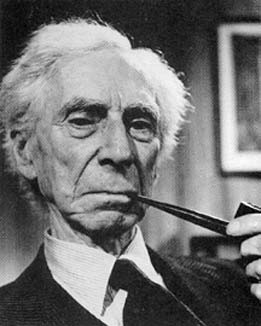
I'll agree with Wittgenstein, who was in turn agreeing with a great many philosophers before him, starting with Socrates, who first said: The goal of philosophy is thoughts that are at peace.
That is, the product of loving wisdom is thoughts that are at peace. Wisdom is -- so the cliche goes -- knowing that you don't know much. Loving wisdom -- that is: humbly observing and meditating on the world and its ways because you just want to, that is: philosophy -- is the process of untangling what you think you know and why you think you know it. It is therapeutic. It is freeing oneself, and humbling oneself, at the same time.
Knowledge is what we call our belief concerning the experiential relationship between ourselves and the world. It is a relationship. Certainty is the name of a feeling we have about that relationship. It is not the result of mathematical deduction. One becomes more or less convinced that what one says about the relationship between oneself and the world is an accurate way of saying it.
I for one am glad for the few simple human dogmas we all, or nearly all, share: 1. That we are existing in a world (I've never met or heard of someone not considered crazy who did not act on this belief) (if you say "Buddhism" I say read the story of Siddhartha's enlightenment, and think on the significance of the way he comes to it) (If you say George Berkeley, I say that saying that the world is actually there or saying that it is just perceived aren't really different, practically speaking) 2. That the world, existing outside of us, is governed by laws that we perceive, not that we create. 3. That reflecting on and talking about our relationship to the world, revering the existence of and power of objective reality, is a good thing: Sursum Corda -- lift up your heart.
To that end, some stay up late charting the centuries, mulling over the course of human thought and action. We are strange creatures -- strange that it fills me with feelings of wonder and of its strangeness -- strange compared to what?
I think it is strange compared to what I once thought of being human. Which wasn't much -- not much thinking, that is. Or, thinking that happened behind many veils.
So, to get to my purpose: I am reading Betrand Russell's "History of Western Philosophy" and will be doing little summaries of the chapters here, for my own benefit. I have an awful memory. Fixing this online, forever!, will be helpful for me, and maybe also for anyone else who happens to stumble upon it, and doesn't have the time to read the actual 800 page text.
Thursday, August 30, 2007
A Difficult Grace
I've been reading the essays of Michael Ryan, one of the professors of poetry here at UCI. Which is an interesting title, I've always thought - professor of anything. A public declaration of your expertise in a field, apparently, from the Latin verb "profitieri".
Anyway, his essays, as Pinsky tells us on the front cover blurb, are "crisp, passionate, and learned." I like "learned", thanks Bob.
Crisp, though, yes, they are crisp. They slice well. Many of them are short, and full of clear expressions of a simple philosophy of poetry, form and purpose.
Anyway, his essays, as Pinsky tells us on the front cover blurb, are "crisp, passionate, and learned." I like "learned", thanks Bob.
Crisp, though, yes, they are crisp. They slice well. Many of them are short, and full of clear expressions of a simple philosophy of poetry, form and purpose.
Tuesday, May 29, 2007
This Mortal Coil
This blog has been on hiatus again. It seems to happen for a few months, every few months. It usually corresponds to some new swing of thought and action -- in this case, a series of actions, that led to a series of thoughts, that led to the neglecting of this blog.
I've been reading Shakespeare, and Hass, and Heidegger -- that is The Poet, a poet, and a poet-philosopher. I am thinking about Hamlet, and that too much introspection becomes inaction. As Coleridge says, "I have a smack of Hamlet myself, if I may say so."
You may.
I've been reading Shakespeare, and Hass, and Heidegger -- that is The Poet, a poet, and a poet-philosopher. I am thinking about Hamlet, and that too much introspection becomes inaction. As Coleridge says, "I have a smack of Hamlet myself, if I may say so."
You may.
Wednesday, March 21, 2007
Anamnesis
I found some previously unpublished blogs, sitting in draft-form in the "Edit posts" section -- this one from early 2007 (about Anamnesis -- the process (to state it simply) of remembering what you have forgotten) (So strange to think about the history of your own psyche) :
"It's that time again - cycle, cycle, cycle - wheel of time churns its melancholy way, me hog-tied to a cross beam, coming up for air.
Asleep in the water, bewildered in the light.
Shall I make written language the memory I don't have? Shall I correspond with the visible - make symbols for the abstract concepts in my head?
The answer to that question is yes. Yes I will do this, having found it the best way to maintain the livelihood of the eternalhoodness of my head. That is, keep the body in step with the "me" that has been a-ponderin for some years now, gnawing at its favorite bone, but forgetful. Forgetting everything it loves, always - its okay. We start again.
Principal #1: Express the yet-unexpressed intuitions of the world and its loveliness.
Principal #2: Wholeness and soundness of being.
Principal #3: Be still and know the voice, the hand, the shepherd. Know the worlds Maker as best as you can, and let the goodness of that knowing change the way you talk and step.
Principal #4: Don't ever hesitate to say what you mean, regardless of what nonsense it seems to be.
Principal #5: Don't try to sound cool. Don't try to be sexy. Don't believe the sugar-lie.
The Sugar-lie? Thus: the lie my body believes, told to it by sweet sweet voices, that hunger must be filled immediately. It must not necessarily. Maybe not evil to fill it -- what is the definition of evil? Who defines evil? Say God, yes, but how do you know what God says? Who made you Lord over the world's knowledge?
All of the symbols of my life stand before me mute, waiting for the signal. I have none. I am listening to Gorecki's 3rd symphony, and I have none. I am holding up a finger.
Monday, March 12, 2007
Objectivism
Ayn Rand, your spirit hovers over these american waters. Since Atlas shrugged, many of us have been following suit. I'm not sure what it was that makes me hate you so much. I think that it's because, like everyone, you failed to say the truth, the whole truth, and nothing but. And you wouldn't admit having failed.
Of course, I have figured it all out. All of the unfitting pieces of your systematic assembly of the puzzle of existence I have removed and filled the gaps with light. You left me your mantle like Elijah, and I've cut it to pieces, patched it into sails, tried to catch the wind.
The world exists. In this we agree, apparently. Knowledge is a relationship to this actual existent and orderly world. Yes, this order that we perceive hovers between two layers of flux - our minds and mystic fields of energy - yet it exists.
Certainty is a feeling about the relationship of our minds to this world. Concepts, we agree I think, are abstractions of perceived objects and their relationships - or that language, the ability to perceive ourselves lucidly and conceptualize and step back and speak, is grounded in things. So if there was a chain, our minds perceive things and relations between things, and this is grounds for language, symbol for thing, which causes communication, which causes the ability to abstract, which causes language about abstractions, which causes self-awareness, which I have right now. I am aware of my flesh in a tilting chair in Irvine, CA (we give names to geographical locations!) (language is beautiful) and I am aware that I am aware, and it allows me to circle around myself as I speak, to check myself, to say to self:
"Self, as ye listen to Thomas Tallis' lovely ancient music through two ear buds sucking electronic juice through long black root to release wave-sound-scent into your head's chambers remember that ye are capable of commiting the sins of your foremother, our dearly beloved Aynnie Randoferous. You are capable of speaking too soon and saying a dishonest word. You are capable of flinging words unwinged out of the nest, and they will fall hard to the real ground. Self, come to me, let me hold you, let me kiss you, yes, we are crazy, but it is the kind of craziness I desire, the kind that does not hide from itself, that kind that stands willingly in the hard light of the world, not even turning from the hope that is here, not even turning from the happiness of it. "
Monday, January 29, 2007
Thread of the Amnesiac
The thread often slips. I try
to keep it clasped tight between my pincers
through the long-winded goose
chasing. I fail.
Even in this moment as I clatter backwards
on all fours recounting
all of the ways I have fallen short – all of the music
I began, with what heat!, and promptly cut off cold
turkey. Oh, I’m sorry, yes,
an accident of course, just
slipped my mind. Socrates
stood motionless for days on end
to keep a palsied grip on the kite’s
elusive tail that whips up sometimes, pulls taut, 80 degrees
skyward, significant
I’m telling you, easy to follow.
We get this hallowed sense of self, religious
inflation, which, in the course of things, is lost
when the kite dips and the rope
goes limp,
and I’m left alone
in one place, trying to re-collect the story,
trying to patch together clues
to my amnesiac life, amidst a rabble
of circumstantial evidence, and this ridiculous
rope strung backwards through time,
tied always - strange now that I think of it -
to the successive images of me.
Sunday, January 21, 2007
Vivaldi
all of the ways
that eagerness fails –
in the end. But do we ever have the end?
We have only now, this: mop of hair
on the Red Priest’s pate jouncing back and forth
to the cheerful cadence, raised arm
announcing each arriving beat.
We wait expectant for the bright descent –
for the opening of the next gate, ajar,
daylight betraying the world behind.
We follow the hand that runs from room to room
throwing wide the doors of the house.
Don’t try and explain away
the smile on Vivaldi’s face,
or mine. Let tomorrow worry
about itself.
Won’t eagerness wend its way off some distant cliff
of meaninglessness? Yes, and how the hell should I know.
Too many monolithic syllables in between.
And such delight in the next.
Such vivid delight in the next.
Monday, January 08, 2007
Arcangelo Corelli
Jumping back to one of Vivaldi's influences, Corelli's music sounds more like Scarlatti than the later more complex Baroque sound. Listening to his violin sonata opus 5.
He was born in Ravenna, which was one of my favorite stops in Italy when I went a couple years back. Lovely old Byzantine city, cobblestoned and courtyarded - home to San Vitale, an exceptionally beautiful Byzantine Basilica of the 6th century.
His melodies are clear and fluid. They are refreshing.
Click on Corelli's flowing mane to hear Concerti Grossi, Opus 6, no 8, allegro.
Saturday, January 06, 2007
Mortaldi
Get it? "Viva" means "live" and "morte" means "die" so "mortaldi" would be... nevermind. This is the last day of Vivaldi's ornate moment in the spotlight. Listening to a random concerto for violin, strings, and the harpsichord right now. I read somewhere that the historical category of "baroque" as its own era is questionable because of the vast differences between early baroque, and late. I can hear them. Vivaldi was a bit of a jump into the mid to late baroque for me, and his music is quite different than Scarlatti's. Much more... classical - you know, complex and varied. Lots of tempo changes. Violins dancing around like fruit flies - the strings in the back like an industrious cityscape. Bom, bom, bom! (puffs of smoke) Scarlatti still had that careful, reserved simplicity of ye olden days.
As I listen, I'm prepping to jump back into the waters of Rhetoric and Critical Reading. Met my new class. They seem swell. Not so much in the swollen sense, as in the neat-o, allright.
As I listen, I'm prepping to jump back into the waters of Rhetoric and Critical Reading. Met my new class. They seem swell. Not so much in the swollen sense, as in the neat-o, allright.
Thursday, January 04, 2007
The Man and His Soul
The man sat next to his soul on the sofa touching it occasionally to see if its feeling would change from moment to moment. It did not. He only asked it questions when he became lonely. I would encourage those inclined to object to the ambiguity of the pronoun usage in this scene to remember that when I say "he" in any moment, it does not matter to whom I am referring - either way it is one and the same. The soul abstracts the man, as does the man, away from himself. They are, however, and ever will be, the same creature.
So, as I said, the soul asked questions to the man who touched, and he replied in kind with light and encouraging puffs of language. His sentences, it became clear, his words to himself, were wrapped about something.
This made the soul touch faster - the man began to ask his questions in rapid succession - poppop pop -like a derrick pumping oil, bad and noxious, from the world's snake bite wound. They watched his words unravel. Something was appearing. Loneliness evaporated into mystic glee. Harder and harder they went, language greased and gunning, and then
the thing itself revealed.
Was laid bare.
I saw it.
I was watching.
The man and the soul, however, had fallen asleep. Three times this happened. Before the fourth could find its culmination, the ground had taken back its own.
The Consolation of the Soul
After all the doors have had their handles
twisted off. After all the roads out to the lake
have been erased. (Leaving me stranded)
After we have stood and faced
what it is
that we aren't capable of calling you,
Soul, come, and sit with me.
I need an arm,
a bit of flesh,
to lean my weight upon.
You dont refuse an old man
it? A moment ago I was young
and building -
Then the raucous vacuum
came and orchestrated the renewal
of the dark. It meant to.
Oh, it feels that it meant to
do that to you.
Come, then, let me touch your face
so you can know
you are.
And we shall lean again into the wind -
Soul, do you hear me
calling down the funnel?-
the dark and ravishing wind.
Wednesday, January 03, 2007
Viva Vivaldi
Buona vita nel'anno nouvo. Is that the way its said? I guess that would be saying that the good life, buona vita, is in, "inside of", nel, the new year. Which isn't what I meant, but sort of nice. Poetical. And thats my question. Does the poetical blurring of reality by language create some of the meta-substances we base so much of our lives on? I don't think so, but its a question anyway.
Vivaldi! He, formidable master of the Baroquean pitch, is the composer of the week. I've been listening to the Four Seasons, which you've heard nearly in entirety even if you think you haven't. La Stravaganza is next in the queue. His music feels like the Californian New Year: bright, busy, wealthy.
Vivaldi! He, formidable master of the Baroquean pitch, is the composer of the week. I've been listening to the Four Seasons, which you've heard nearly in entirety even if you think you haven't. La Stravaganza is next in the queue. His music feels like the Californian New Year: bright, busy, wealthy.
Come now, let us reason it together Soul
We must be frank,
for the days are short -
It being winter.
It being the climate.
It being the mustard sandwich
we wave when bereft at lunch
of the thing itself -
whatever we happen to be speaking of.
Soul? Are you my gesture's pith or sandwich?
That's not the question I brought you here to ask,
but it seems pertinent.
It seems like it will fit.
It always fits.
It was made to.
I'm asking: there's you, and there's your flesh -
in English, two extremities, and two hearts, composite
acting as the thing we wave
when we speak of you.
My lips, bread.
My tongue, processing meat -
I am waving myself out over the dark lake.
I am conversing of you.
With whom?
With whom?
------
dedicated to the Hofer
What the Soul is making
In the mornings, over the stovetop.
With an arched neck,
lays an ear to the fleshy divet
between his chests pectoral lumps
and listens to the metronomic
drumbeat of blood.
Oh Soul, can't you see I'm dying
to know where it is you're making
your habitation?
(This is not about the beauty of the language!
Come out, my hands are clean!)
The soul remains quiet,
flexing in the dark
to whom I addressed my next question:
And what are you the lack of?
And why do I hate you so much?
The blood pumps.
A waft of pancake batter cooking lifts,
pungence of a morphic creature.
Monday, January 01, 2007
Vegas
It means the meadows! I was thinking of warrior Amazon goddesses, not grasslands. Apparently it was named thus because the Spaniards who christened it found natural artesian springs as they passed through.
It was a clean place, and gracious.
It was a clean place, and gracious.
Ulysses and the New Year
I have just finished reading, here on this lovely and bright January the first of 2007, the opening chapter of James Joyce's Ulysses. It is, to be blunt, amazing. The last time that I can remember enjoying a bit of prose so much was my brief liaison with the journal entries of Gerard Manley Hopkins.
The syntax is a veritable freak show of perfection, the slipping between thought and dialogue smooth and sweet, and the characters livid with animation. Buck Mulligan is doing wonders for my heart.
This may be presumptuous, but if the first chapter is a clue, this book will be one of my favorites long before I reach its faraway final word. It is, after all, not in the least a short novel.
And the new year is here. As you might have induced from my last two poems, I spent some of it in the desert. Mojave National Preserve, 100 miles southwest of Satan's National Preserve. No, I'm not talking about Death Valley - that's 100 miles due north. I'm speaking of Vegas. Las Vegas. The Vegas. And what are the Vegas? No one really knows, but shoot, can they put on a show.
Sorry, my verbosity has been aroused.
Back to Stephen Dedalus.
on the graciousness of light to the desert
the sun and moon are both good to the desert.
they do no harm to it.
it is so simple. it is not listening
to the babble of the way things
should be. it is even, steady,
and rises quickly in both lights
when it wants to.
these rises, these white peaks, granite
and dry scrub,
are silent in that hour
when the sun and moon meet -
they want to be silent -
they have nothing more to say than being there.
they let the sky speak its smallest most
neglected songs: the low swish of cirrus clouds
unraveling, the faint clap
of stars appearing. these love the desert for its humility,
and fear it.
who is this, so wise, so simple
as to let things be how they are?
the sun reveals it.
the moon makes it bright with joy.
What the Soul is doing in the Desert
Oh Soul,
I am thinking of a new kind of year.
As the late year folded down
old behind the last range,
red and thin, flapping in the hard winter wind,
I clapped my hands -
a new idea.
I waited, not speaking a word to any soul,
not even you,
until the sun blushed its sphere
and sank. Until the last spot of light winked.
Until the dimming sky screamed,
ripped the last pink
gauze off the dying thing and slapped it
back into the universe, I waited,
every inch of my skin bristling -
and when the old man howled and collapsed back,
I clapped
and the sky said "Ma cosa fai?"
I replied "I am inventing again."
Saturday, December 30, 2006
The Soul
I am asking myself a question
when I write those two words.
It has been said that God will not be mocked,
so I am not afraid to ask.
I am in a small room
typing on a black plastic keyboard
having just read the words of a friend about
the desert he is in;
Iraq, war, separation,
the soul.
Some of us are forced to stand still in the dark and face ourselves.
I lift my trembling hand out over the dark lake.
What do I hope for, oh Soul, in all of this reaching,
say it back to me:
joy.
Sunday, December 17, 2006
Hanukkah
It’s such a small miracle –
1 days oil stretching to 8.
No one come death-ragged from
the gaping tomb,
no one taken up
in a whirl of fire.
I almost believe it
like I would believe you if you told me
that you made a cake yesterday
and it came out
with the shape of a feather on it.
Feathers mean something to you and I,
vaguely. Just enough. But if none had come
no one would be weeping.
No souls would plummet to the earth.
We’d wait awhile
till we got the oil
and come up with a reason
why it was all perfect timing –
light the candles,
call it “When the Oil
Finally Showed Up Day.”
But it stretched.
You pulled the cake
from the hot tomb
and across its yellow face
a feather had been mysteriously swirled.
You called me.
I remember.
Sunday, December 10, 2006
A Native Hill
I am heading back toward home soon for Christmas - early this week.
For awhile, I thought that it was good to call whatever place I was in, I was living, my home, in order to fully define myself as a man - a rock - carrying his home on his back like a manly snail. Snails are manly in this sense.
Irvine is lovely, and I can feel myself acclimating to its oceanview desert scrubbrush wilderness. But it is not home. It is not in my blood. And the ridiculous suit of armor, concrete and plastic, that has been pulled over top of its rooty desert beauty, makes it nearly impossible for me to love it fully.
Can a man love a city? Yes. A city, glass and chrome, does not seem quite as much of an insult to land as this sprawling suburbia that Irvine is made of - that shrieks when it sees an open spot, diving to clap a strip mall over it.
The Lord is making me sane in an insane world. I am afraid it is going to be painful. I am afraid of the pain of sanity in America.
Wendell Berry, author of the essay A Native Hill, has his land in Kentucky - he can stand back and say "Well at least I settled in a place, and raised a family, and did not destroy, but shepherded, made good." Wendell, I am a wanderer - I am a shepherd only to a flock of wild visions.
Can a man find a home in an idea? Can he find home in a Spirit? Can he find home in a woman?
This below is one the last poems from Shepherd, which I've been working on over the course of the last year.
______
If in the wild places of the world
you come across the cloaked figure
of a man clenching a black bag
pacing or perched in a squat
on the high point of a desert rock,
violently sweating,
leave him be. He
is looking for his home
and he does not have a home.
Friday, December 08, 2006


Scarlatti!
First, a shout out to Google for revamping Blogger.com - it's much more excellenter now.
Second, a shout out to Allesandro Scarlatti. A prominent figure in the landscape of Baroque composers, Scarlatti's pieces have levity, energy and clarity even through their relative complexity. Music beyond the Baroque era is often full of a complexity that can become a sort of heaviness - like hearing Joyce read aloud. Its beautiful, but too much. Scarlatti's music seems to be a perfect balance, for my ear, between simplicity and complexity, joy and sorrow. I am listening to Sinfonia in C Major, and I don't have any idea what this means (specifically the Sinfonia part), but I am enjoying immensely even in my ignorance.
Third, a shout out to the students in 39B Rhetoric & Critical Reading, section whatever-the-stink-it-was, who learned a thing or two I think, and enjoyed themselves in the process - this is all a way of saying that I liked my students, and am sad to part with them. They will always hold a place in my heart until they don't anymore.
Christmas is coming. Listen world - the One you long for has come. Let's tell each other the story again.
Subscribe to:
Posts (Atom)